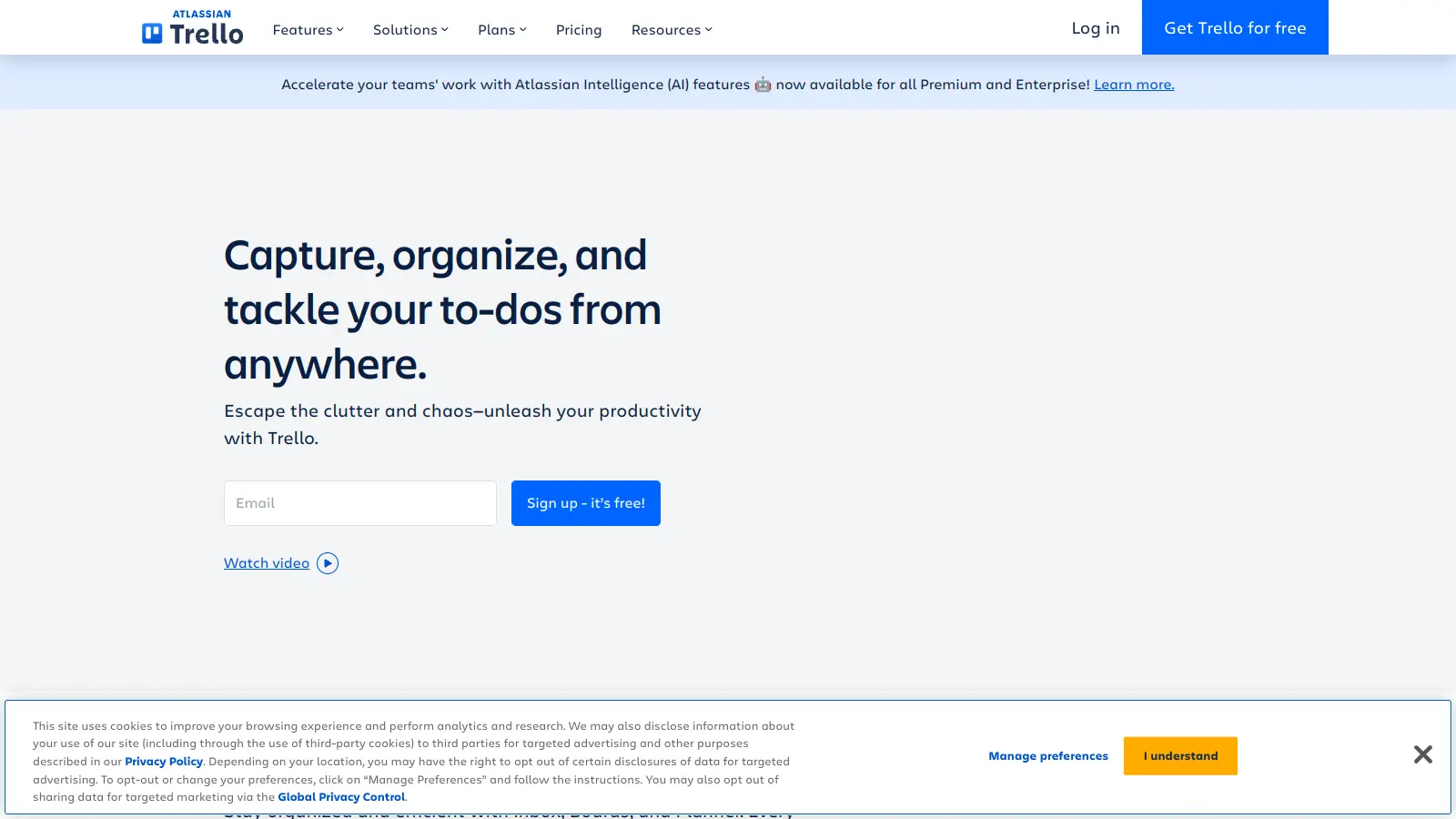
Trello is a project management tool that helps teams organize tasks and workflows through a visual board system. At its core, it uses a simple structure of boards, lists, and cards to help users track projects from start to finish. Think of it as a digital whiteboard where you can move sticky notes around to show progress.
The platform shines in its flexibility, working equally well for personal to-do lists or complex team projects. Teams can create boards for different projects, add members, set due dates, and attach files directly to tasks. What makes it useful is how it adapts to different work styles, whether you're planning an event, tracking sales leads, managing content calendars, or handling software development sprints.
Trello now includes AI capabilities that can summarize meeting notes, generate cards from emails and Slack messages, and extract action items automatically. You'll find automation tools through Butler to handle repetitive tasks, multiple view options to visualize work, and integrations with popular apps like Slack, Google Drive, and Microsoft Teams. The free version includes essential features for small teams, while paid plans unlock capabilities like timeline views and unlimited boards.
Security hasn't been overlooked either. The platform maintains industry-standard certifications and offers permission settings to keep sensitive project data safe. Whether you're a freelancer or part of a large organization, Trello scales to match your needs while keeping things straightforward and accessible.
Trello works for visual thinkers and collaborative teams who want to organize workflows and track progress without learning complex software.
Creative agencies, software development firms, educational institutions, and nonprofit organizations all use Trello when they value simplicity and adaptability over feature bloat.
Trello gets praise for its simple interface that makes it easy for beginners to jump in quickly. Users love how the free plan is generous enough for personal task management and small teams, and the Kanban boards provide a clear way to track work. The mobile app works well for on-the-go access, and integrations with tools like Slack, Google Drive, and Jira make it fit smoothly into existing workflows.
On the downside, users complain that Trello lacks advanced features like Gantt charts or built-in time tracking without paying for Power-Ups. Performance can slow down with large boards or many cards, and the search functionality struggles on bigger projects. Some find the customization and reporting limited compared to Asana or Monday.com, and the fact that Power-Ups eat into limited free slots quickly can be frustrating. The automation is basic without Butler upgrades, which pushes users toward paid plans faster than expected.
Trello stands out with its simple, visual card-based system that's easier to learn than complex alternatives. Unlike tools with steep learning curves, Trello lets you start organizing tasks in minutes. It's good for teams that need flexibility and visual organization, but won't cut it for complex projects that need detailed reporting, Gantt charts, or built-in time tracking. While Asana and Monday.com provide more customization and reporting, Trello wins for teams wanting a straightforward, visual way to track progress without overwhelming options.
Can I use Trello effectively with the free plan?Yes! The free plan works great for individuals and small teams with basic needs. You'll get unlimited cards, lists, and members, up to 10 boards per workspace, 1 Power-Up per board, 10MB file attachments, and 250 automation runs per month. The main limits you'll hit are the 10-board maximum and single Power-Up per board. Many users stick with the free plan for personal projects and small team coordination. If you need more boards, multiple Power-Ups per board, or larger file attachments, you'll want to look at the paid plans.
How secure is my data on Trello?Trello takes security seriously with 99.99% uptime and industry-standard certifications. Your data is encrypted both in transit and at rest, and the platform offers two-factor authentication even on free plans. Trello follows SOC2, SOC3, ISO/IEC 27001, and other compliance standards to protect your information. For Enterprise users, there are additional security controls like attachment permissions and organization-wide settings. While no online system is 100% foolproof, Trello maintains strong security practices that most businesses can trust.
What's the learning curve like for new Trello users?Most people pick up Trello basics in under an hour. The drag-and-drop interface is intuitive - you create cards, move them between lists, and open them to add details. New users can start with simple board organization and gradually discover features like checklists, due dates, and card assignments. The visual nature helps teams adapt quickly without extensive training. The harder part isn't learning the tool itself but developing consistent workflows that your team will follow. Trello also offers templates that new users can copy to get started faster.
What AI features does Trello offer?Trello includes Atlassian Intelligence, which can automatically generate cards from emails and Slack messages, summarize meeting notes, and extract action items from text. The AI helps with writing assistance, grammar improvement, and brainstorming directly in your boards. You can turn form submissions into cards automatically, and the AI will summarize lengthy content to save you time. There's also predictive analytics for project forecasting on higher-tier plans. While these features add convenience, the basic board functionality works fine without touching the AI tools if you prefer manual control.


Our newsletter comes with exclusive discounts, trials and practical insights from within the industry