Editorial note:this was originally published in september of 2024
Sales performance management software handles the mechanics that sit between your CRM and your payroll: commission calculations, quota setting, territory planning, and incentive plan design. Without dedicated tooling, these tasks fall to spreadsheets, which break under complexity and create payout disputes that damage rep trust.
This list covers 8 tools suited to different team sizes and use cases, from scrappy mid-market teams running straightforward commission plans to enterprise revenue orgs with multi-overlay structures, global payouts, and ASC 606 compliance requirements.
Tools were selected based on compensation flexibility, integration depth with common CRM and ERP systems, transparency of pricing, and how well each handles common edge cases like mid-year plan changes, clawbacks, and split credit scenarios.
We collect first-hand reviews from people who use these tools every day — what works, what doesn't, whether it's worth paying for. We research pricing, features, and comparisons so that feedback has real context behind it. For this guide, tools were selected based on real-time performance tracking, pipeline visibility, and forecasting accuracy for sales teams. Read our full research methodology.
help us improve this guide
tell us what you're looking for, what you're using now, and what caught your eye — takes 30 seconds.
What is sales performance management software?
Sales performance management (SPM) software is a category of applications that help revenue organizations design, automate, and administer incentive compensation plans. The core function is calculating variable pay accurately and on time, but mature platforms also cover quota management, territory design, capacity planning, and performance analytics.
SPM tools are used primarily by sales operations leaders, finance teams, and revenue leadership. They typically connect to CRM systems like Salesforce or HubSpot to pull deal data, and to payroll or ERP systems to push approved payout figures.
The main problem SPM software solves is the compounding error rate of spreadsheet-based compensation management. As plans grow more complex with accelerators, draws, multi-product splits, and overlay credits, manual processes produce payout errors that erode rep confidence and consume admin time in disputes.
Incentive compensation management with a focus on mid-market usability.
Mid-market teams with varied incentive plan types
CustomPricing on request
our top pick
1
Xactly Incent
Enterprise incentive compensation with deep analytics and benchmarking data.
Custom
Best for · Enterprise sales orgs with complex comp plansPricing · Pricing on request
Xactly Incent is built for complex incentive compensation management at scale. It handles multi-tier accelerators, draws, clawbacks, and global multi-currency plans, and connects to Salesforce, SAP, Workday, and other enterprise systems. Its standout differentiator is access to Xactly's anonymised compensation benchmark dataset, drawn from years of customer data, which helps plan designers set competitive quota and rate structures.
Pros
✓Compensation benchmark data built into the platform
✓Handles complex multi-overlay and split-credit plans
✓Strong audit trail for ASC 606 compliance
Cons
✗Implementation typically takes 3 to 6 months minimum
✗Pricing and contract terms are opaque without a sales call
Flexible SPM platform covering commissions, quotas, territories, and forecasting.
Custom
Best for · Mid-market to enterprise teams wanting full SPM coveragePricing · Pricing on request
CaptivateIQ covers the full SPM scope: commission automation, quota management, territory planning, and attainment forecasting in one platform. Its spreadsheet-like formula interface makes plan configuration more accessible to ops teams without heavy technical support. The rep-facing portal gives sellers real-time visibility into earnings and pipeline impact, which reduces dispute volume.
Pros
✓Spreadsheet-style formula editor reduces reliance on vendor support
✓Rep portal shows real-time earnings and projected commissions
✓Covers commissions, quotas, and territory planning in one tool
Cons
✗Pricing requires a sales process, no self-serve trial
✗Reporting customisation can require additional configuration time
Commission automation with a rep experience that actually gets used.
Custom
Best for · Mid-market teams wanting fast implementationPricing · Pricing on request
Everstage focuses on making incentive compensation transparent for both admins and reps. The platform handles plan configuration, automated calculations, and quota tracking, and its rep-facing app lets sellers simulate earnings based on deals in their pipeline. It's positioned as a faster-to-implement alternative to legacy SPM platforms, with implementation timelines measured in weeks rather than months for most mid-market use cases.
Pros
✓Rep earnings simulator drives deal motivation
✓Faster implementation timeline than legacy enterprise tools
✓Integrates with Salesforce, HubSpot, and common payroll systems
Cons
✗Less suited to highly complex multi-overlay enterprise structures
✗Pricing not published, requires demo to get a quote
Commission management built natively into the Salesforce ecosystem.
Custom
Best for · Salesforce-native sales teamsPricing · Pricing on request
Salesforce acquired Spiff and integrated it into Sales Cloud as a native commission management tool. Because it runs inside Salesforce, deal data flows directly into commission calculations without an external integration layer, which reduces sync errors and admin overhead. It suits teams already standardised on Salesforce who want to avoid managing a separate vendor relationship for compensation.
End-to-end revenue performance management for large enterprise teams.
Custom
Best for · Large enterprise teams with thousands of payeesPricing · Pricing on request
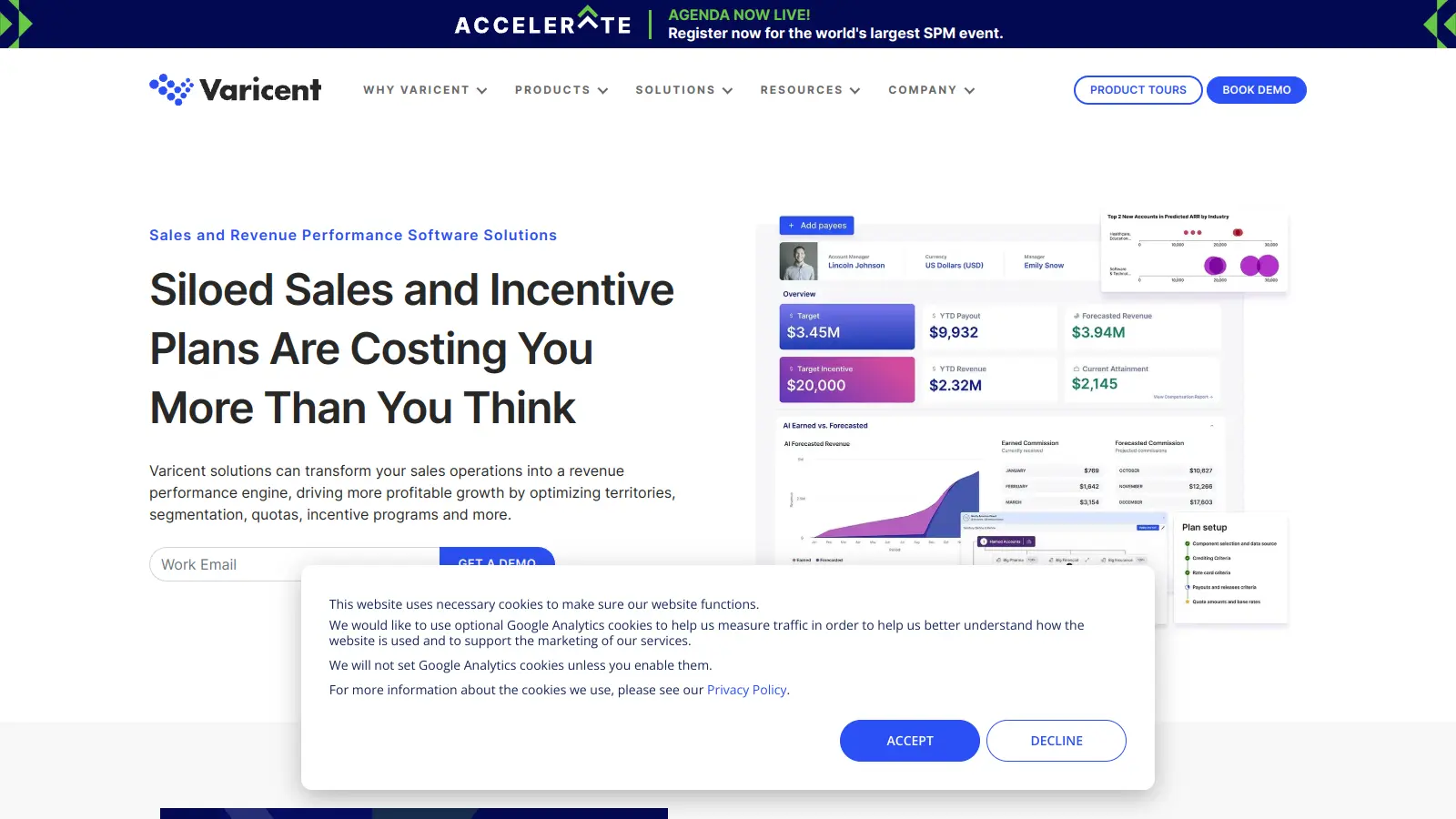
Varicent covers incentive compensation, territory and quota management, and revenue intelligence under one platform. Its calculation engine is designed to handle very large data volumes and highly complex plan logic, making it a common choice for financial services, insurance, and technology companies with thousands of payees. It also includes a predictive analytics layer for modelling plan changes before they go live.
Pros
✓Handles very large payee counts without performance issues
✓Predictive modelling for plan design scenario testing
✓Strong fit for regulated industries with complex compliance needs
Transparent commission tracking built for growing sales teams.
Paid
Best for · Growing teams with straightforward commission plansPricing · From $25/user/mo
QuotaPath is one of the few SPM tools with publicly listed pricing, starting at around $25 per user per month. It handles commission plan setup, attainment tracking, and rep-facing earnings dashboards with less configuration overhead than enterprise platforms. It's designed for teams that have outgrown spreadsheets but don't yet need the full complexity of Xactly or Varicent.
Pros
✓Transparent published pricing, no sales call required to get a number
✓Quick setup for standard quota and rate structures
✓Rep dashboard clearly shows attainment and projected earnings
Cons
✗Limited support for complex multi-tier overlay structures
✗Fewer native integrations than enterprise-tier competitors
Connected planning platform used for quota, territory, and capacity modelling.
Custom
Best for · Enterprise teams needing sales and finance planning alignmentPricing · Pricing on request
Anaplan is a connected planning platform, not a pure-play SPM tool. Sales teams use it for territory design, capacity planning, quota allocation, and top-down financial modelling that links sales plans to broader business forecasts. It's particularly strong when sales planning needs to connect tightly with finance and workforce planning. The trade-off is that incentive compensation is not a native strength, and most Anaplan customers pair it with a dedicated commission tool.
Pros
✓Connects sales quotas directly to financial and headcount planning
✓Powerful scenario modelling for territory and capacity decisions
✓Used by finance, HR, and sales ops on the same platform
Cons
✗Not a strong standalone commission automation tool
✗Significant model-build time required, typically needs an Anaplan specialist
Incentive compensation management with a focus on mid-market usability.
Custom
Best for · Mid-market teams with varied incentive plan typesPricing · Pricing on request
Performio handles incentive compensation plan configuration, automated calculations, and rep-facing statements with a focus on mid-market teams. It supports a wide range of plan types including MBOs, SPIFFs, and multi-product commissions, and has direct integrations with Salesforce and common payroll platforms. It sits in a practical middle ground: more capable than entry-level tools, faster to implement than Xactly or Varicent.
Pros
✓Handles MBOs, SPIFFs, and multi-product splits without custom dev
✓Native Salesforce and payroll integrations
✓Implementation typically faster than Tier 1 enterprise platforms
Cons
✗Less name recognition means fewer peer references to validate against
How to choose sales performance management software
Compensation plan complexity
Simple quota-and-rate plans can run on lighter tools like Everstage or QuotaPath. If your plans include multi-tier accelerators, team overrides, overlay reps, clawback rules, or multi-currency payouts, you need a platform built for that complexity, such as Xactly Incent or Varicent.
Team size and implementation capacity
Enterprise SPM platforms require significant implementation effort, often 3 to 6 months with a dedicated admin. Smaller teams without dedicated sales ops resources should prioritize tools with faster onboarding, clearer self-serve configuration, and responsive implementation support.
CRM and payroll integration depth
Check whether the tool has a native connector to your CRM or relies on CSV imports. Native Salesforce integrations, for example, allow real-time deal data to flow into commission calculations without manual intervention. Also confirm how payout data gets to payroll: API, flat file, or manual export.
Rep-facing visibility
Reps who can see their commission statements, pipeline impact, and projected earnings in real time close more deals and spend less time questioning their payouts. Evaluate the quality of the rep portal, not just the admin dashboard.
Audit trail and compliance support
Finance teams need documentation for ASC 606 and IFRS 15 compliance, plus a clear audit trail for every calculation. Confirm the platform logs plan changes, override approvals, and dispute resolutions in a way that satisfies your finance and legal teams before committing.
frequently asked questions
A CRM tracks customer interactions, deals, and pipeline. SPM software takes the output of those deals and uses it to calculate commissions, manage quotas, design territories, and produce incentive reports. Some CRMs like Salesforce have added SPM modules, but purpose-built SPM tools generally handle more complex compensation logic and provide better audit trails.
Pricing varies widely. Lighter tools like QuotaPath start around $25 to $30 per user per month. Mid-market platforms like Everstage and CaptivateIQ typically price by seat with custom quotes based on plan complexity. Enterprise platforms like Xactly Incent, Varicent, and Anaplan operate on annual contracts that commonly run into five or six figures. Most vendors require a demo before sharing pricing.
For teams with fewer than 20 reps running a single commission structure, yes. Once you introduce multiple plan types, accelerator tiers, overlay credits, or international payouts, lightweight tools hit configuration limits quickly. The cost of a platform upgrade is usually lower than the cost of a disputed payout or a compliance audit failure.
The most common mistake is underestimating implementation time. Teams often assume SPM software is plug-and-play, then spend months cleaning CRM data, mapping fields, and rebuilding legacy plan logic. The second mistake is not involving finance and legal early, which leads to compliance gaps discovered after go-live.
In most organizations, not immediately. SPM platforms centralize calculation logic and audit trails, but finance teams often maintain parallel spreadsheets during the first few commission cycles to verify accuracy. Most vendors expect this and provide comparison reports to support the transition.
tools for humans
toolsforhumans editorial team
Reader ratings and community feedback shape every score. Since 2022, ToolsForHumans has helped 600,000+ people find software that holds up after launch. The picks here come from that.