Best Property Management Accounting Software (2026)
8 tools reviewedlast reviewed 20 march 2026
Editorial note:this was originally published in august of 2024
Property management accounting has real quirks that generic bookkeeping software doesn't handle well: owner distributions, security deposit tracking, trust accounting compliance, per-property P&L, and CAM reconciliations. A general ledger built for a retail shop won't cut it.
This list covers eight tools built specifically for property managers and landlords, from solo investors with a handful of rentals to mid-sized portfolios with hundreds of units. Each pick was evaluated on accounting feature depth, pricing structure, ease of setup, and how well it fits the portfolio type it targets.
You'll find the obvious market leaders here, plus a couple of less-covered options worth considering depending on your situation.
We collect first-hand reviews from people who use these tools every day — what works, what doesn't, whether it's worth paying for. We research pricing, features, and comparisons so that feedback has real context behind it. For this guide, tools were selected based on tenant accounting accuracy, rent collection integration, and compliance with property tax regulations. Read our full research methodology.
help us improve this guide
tell us what you're looking for, what you're using now, and what caught your eye — takes 30 seconds.
What is property management accounting software?
Property management accounting software is a financial and operational platform built for landlords, property managers, and real estate investors. Unlike standard accounting tools, it organises income and expenses by property or unit, handles tenant ledgers, tracks security deposits in separate trust accounts, and generates owner statements and Schedule E reports automatically.
The core problem it solves is multi-entity bookkeeping: when you manage ten properties for five different owners, you need a system that keeps every owner's money cleanly separated, produces accurate monthly statements, and flags late rent without manual reconciliation. Standard tools like QuickBooks require significant workarounds to do this.
Users range from DIY landlords managing two or three units to professional property management companies overseeing thousands of doors across residential, commercial, and mixed-use portfolios.
General accounting software that many small landlords adapt for rentals.
Landlords who want unified business and property accounting
PaidFrom $35/mo (Simple Start); $65/mo (Plus, recommended for properties)
our top pick
1
AppFolio Property Manager
Full-stack property management with deep native accounting.
Paid
Best for · Mid-to-large residential and mixed-use portfolios (50+ units)Pricing · From $1.40/unit/mo (Core plan, 50-unit minimum)
AppFolio is a cloud-based platform covering accounting, leasing, maintenance, and owner reporting in one system. Its accounting suite handles trust accounting, automated owner disbursements, bank reconciliation, and per-property financials without requiring third-party integrations. The Realm-X AI layer can pull reports and execute bulk actions on request, which cuts down on manual reporting work for larger teams.
Pros
✓Native trust accounting built into core product
✓Owner statements and disbursements fully automated
✓AI assistant handles bulk reporting and inbox actions
Cons
✗50-unit minimum excludes small landlords entirely
✗Full pricing requires a sales call; costs climb fast at scale
Free rental property accounting built for DIY landlords.
Freemium
Best for · Individual landlords with 1 to 20 unitsPricing · Free plan available; Pro from $20/mo
Stessa connects directly to bank accounts and automatically categorises rental transactions, producing a proper Income Statement, Net Cash Flow report, and Schedule of Real Estate Owned without manual data entry. It's designed for individual investors, not professional property managers, so there's no owner accounting or trust ledger. The free plan is genuinely functional; the Pro plan adds automated rent collection and tax package exports.
Pros
✓Free plan covers core accounting for small portfolios
✓Automatic bank transaction sync and categorisation
✓Schedule E and tax package reports built in
Cons
✗No trust accounting or owner disbursement tools
✗Tenant portal and rent collection require paid plan
All-in-one property management with solid owner accounting.
Paid
Best for · Small to mid-size property management companies (20-300 units)Pricing · From $58/mo (Essential, up to 150 units)
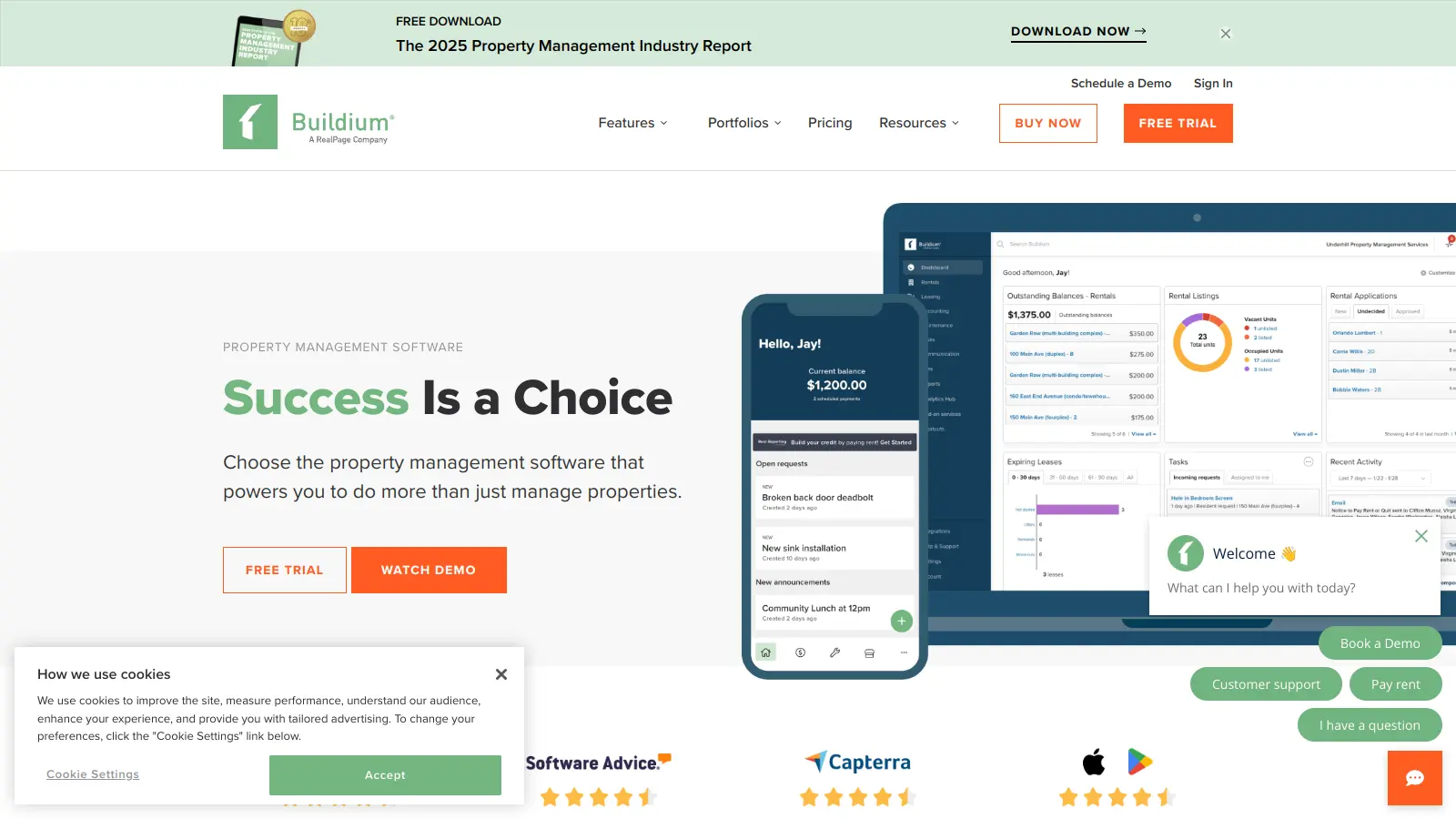
Buildium handles residential and association management with a full accounting suite including trust accounts, owner and tenant ledgers, 1099 e-filing, and bank reconciliation. It sits in the mid-market, with plans starting at $58 per month for up to 150 units. The interface is more accessible than AppFolio for smaller teams, and the Essential plan includes accounting, online payments, and basic reporting without needing to upgrade.
Pros
✓1099 e-filing included in all plans
✓Trust accounting and owner ledgers on base plan
✓Per-property P&L without manual setup
Cons
✗Per-unit fees stack up quickly beyond 150 units
✗Commercial lease accounting is limited compared to Yardi
Yardi's accessible platform for residential and commercial landlords.
Paid
Best for · Mixed-use and commercial landlords (10-250 units)Pricing · From $1/unit/mo residential ($100/mo minimum); commercial from $2/unit/mo
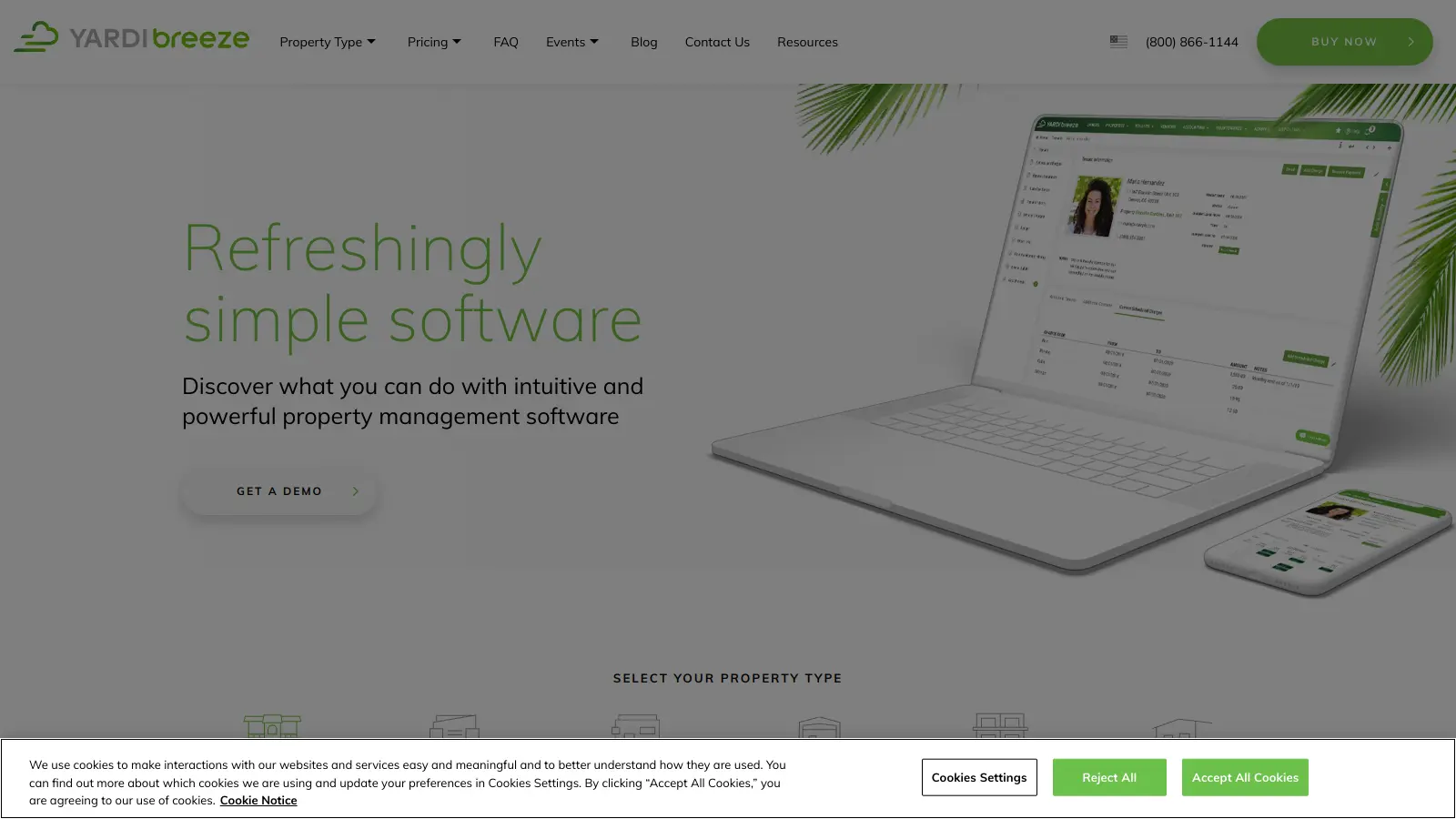
Yardi Breeze is the lighter, cloud-first product from Yardi Systems, aimed at smaller portfolios that want Yardi's accounting depth without the full enterprise deployment. It covers residential and commercial leases, CAM reconciliations, online payments, and owner reporting. Pricing is per unit per month with a monthly minimum, and the commercial version costs more than residential. It's a strong pick for landlords who mix residential and commercial assets.
Pros
✓CAM reconciliation built in for commercial leases
✓Handles residential and commercial in one account
✓Strong audit trail and bank reconciliation tools
Cons
✗UI feels dated compared to AppFolio and Buildium
✗Monthly minimums make it pricey for very small portfolios
Highly configurable accounting for complex property portfolios.
Custom
Best for · Experienced property managers with complex or commercial portfoliosPricing · Pricing on request
Rent Manager is an on-premises and cloud-based platform with one of the most configurable accounting engines in the category. It supports custom chart of accounts, advanced general ledger functions, multiple bank accounts per property, and detailed CAM tracking. It's not the fastest to set up, but property managers with unusual lease structures or complex multi-entity portfolios often prefer it over more rigid platforms.
Pros
✓Highly configurable chart of accounts and GL structure
✓Handles multiple entities and bank accounts per property
✓Strong CAM tracking for commercial leases
Cons
✗Steeper learning curve than most competitors
✗Pricing requires a sales conversation; no public tiers
Enterprise property management accounting for multifamily operators.
Custom
Best for · Large multifamily property management companies (500+ units)Pricing · Pricing on request
Entrata is built for multifamily operators at scale, with accounting, leasing, resident management, and reporting on a single platform. Its accounting layer handles trust accounting, owner distributions, bank reconciliation, and real-time financial reporting across large portfolios. It competes directly with AppFolio at the enterprise end and is particularly common among companies managing 500 or more units.
Pros
✓Accounting, leasing, and operations in one platform
✓Real-time portfolio-wide financial dashboards
✓Built for high-unit-count multifamily from the ground up
Cons
✗No transparent pricing; implementation costs are significant
✗Too complex and expensive for portfolios under 200 units
Simple rental accounting with a mobile-first design.
Freemium
Best for · Independent landlords managing up to 20 unitsPricing · Free plan available (up to 3 units); Pro from $12/mo
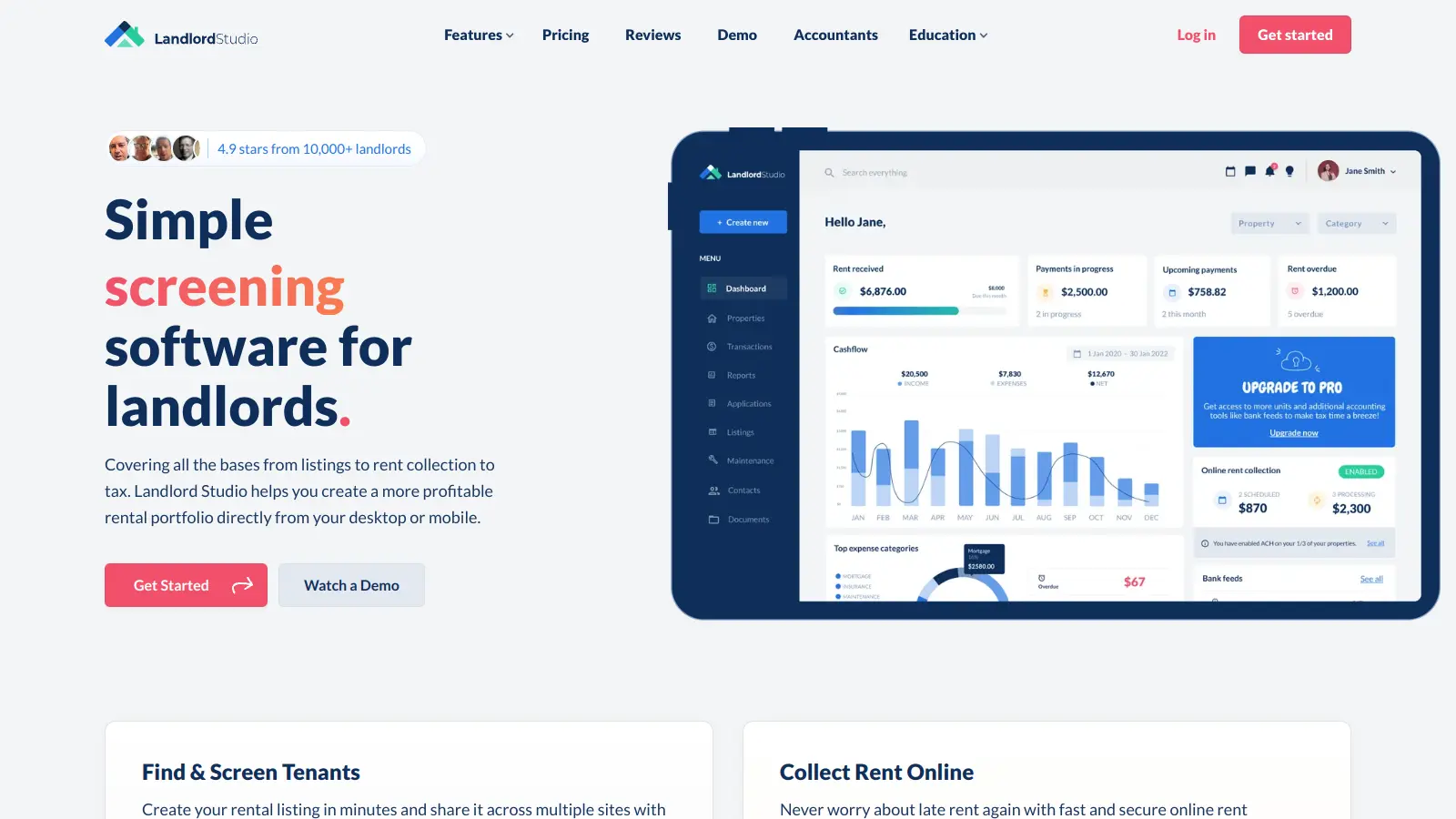
Landlord Studio is a rental accounting and management tool aimed at independent landlords who want clean financial records without learning a full property management platform. It tracks income and expenses by property, generates Schedule E-ready reports, and connects to bank accounts for transaction import. The mobile app is one of the better-designed in the category, making it practical for landlords who manage properties without office support.
Pros
✓Mobile app genuinely usable for on-the-go expense logging
✓Schedule E and tax reports generated automatically
✓Clean interface with low setup time
Cons
✗No trust accounting or owner statement generation
✗Not designed for professional property management companies
General accounting software that many small landlords adapt for rentals.
Paid
Best for · Landlords who want unified business and property accountingPricing · From $35/mo (Simple Start); $65/mo (Plus, recommended for properties)
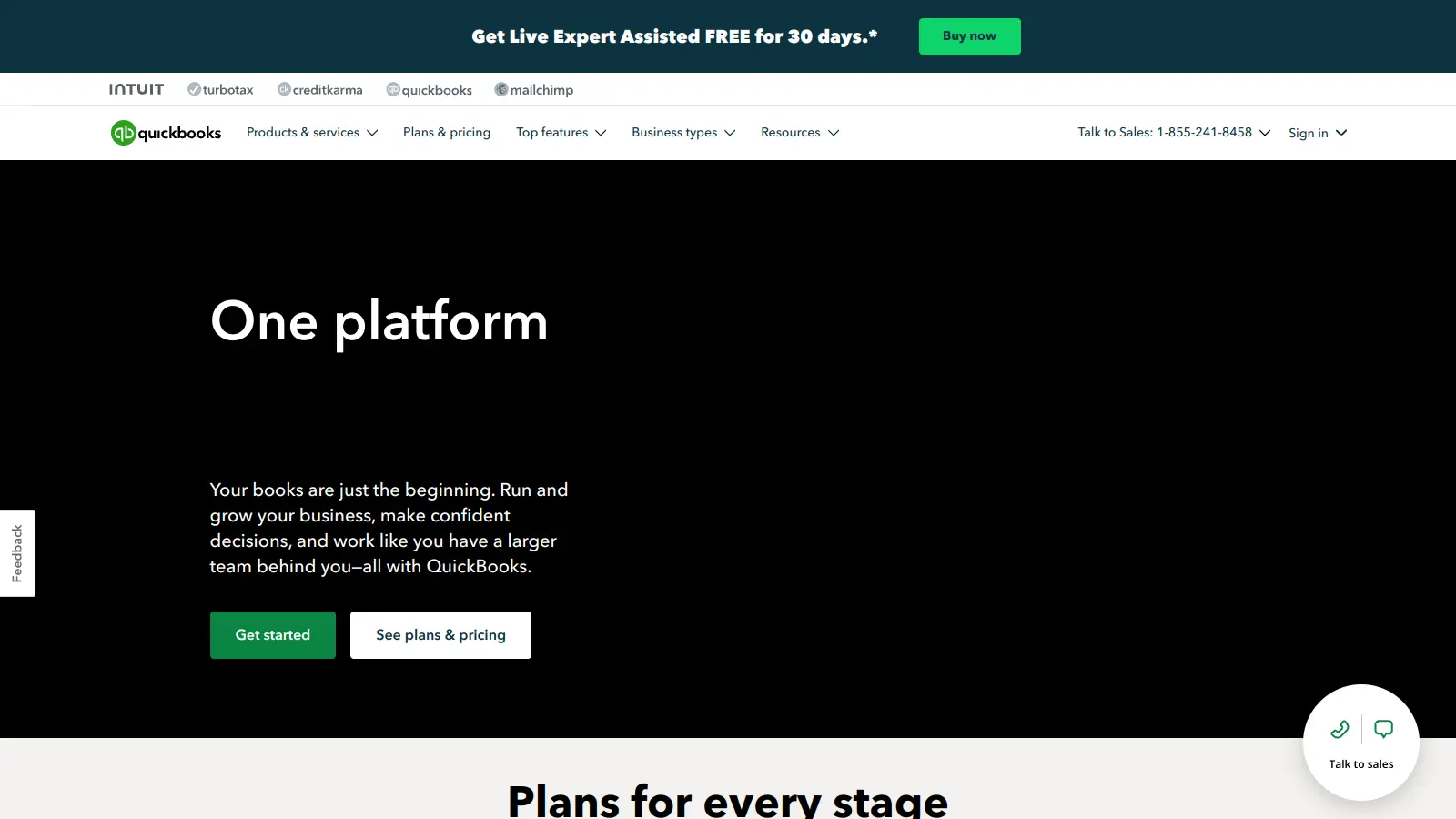
QuickBooks Online isn't purpose-built for property management, but many small landlords and property managers use it with a structured chart of accounts organised by property. It integrates with tools like Propertyware and some rent collection platforms. It works for landlords who want their property finances inside the same system as their other business accounts, and CPAs are universally familiar with it. The tradeoffs are real: no tenant ledger, no security deposit escrow tracking, and no owner statement generation without manual work.
Pros
✓CPAs and bookkeepers know it without any onboarding
✓Integrates with payroll, invoicing, and other business tools
✓Class tracking can separate income by property
Cons
✗No native trust accounting or owner disbursement tools
✗Requires significant manual setup to work for property management
How to choose property management accounting software
Match the tool to your portfolio size
Most tools are priced per unit, and the pricing tiers are designed for specific scale ranges. Stessa is built for small landlords; AppFolio requires a minimum of 50 units. Choosing a tool designed for a different scale than yours usually means either paying for features you don't need or hitting walls when you need to grow.
Check whether trust accounting is genuinely built in
If you manage properties on behalf of owners, you need proper trust accounting: separate ledgers for each owner, automatic calculation of management fees, and compliant disbursement tracking. Some tools market themselves as property management software but rely on manual journal entries for owner accounting. Ask specifically how owner disbursements and security deposit escrow accounts are handled.
Assess the reporting depth
A basic profit and loss statement is table stakes. Look for per-property income statements, cash flow reports, rent roll exports, owner contribution tracking, and — if you manage commercial space — CAM reconciliation. If you file Schedule E taxes yourself, a tool that exports a ready-to-use report saves hours at tax time.
Understand what integrations you actually need
Some platforms are all-in-one: accounting, leasing, maintenance, tenant screening, and online payments in one product. Others are accounting-focused and expect you to connect separate tools for leasing or maintenance. The all-in-one approach means less data entry; the modular approach means more flexibility. Check which integrations are native and which require a third-party connector.
Calculate the real monthly cost
Per-unit pricing sounds simple but adds up quickly. A platform charging $1.50 per unit per month costs $1,500/month at 1,000 units. Factor in fees for online payment processing, ACH transfers, e-signatures, and tenant screening, as these are often charged separately and can double the effective cost.
frequently asked questions
QuickBooks can handle basic rental income and expenses, but it doesn't natively support per-property trust accounting, tenant ledgers, owner statements, or security deposit escrow tracking. Many property managers use property management software as their primary system and export reports to QuickBooks or their CPA rather than maintaining both actively.
Small landlord tools like Stessa have a free tier; premium plans run $20 to $60 per month regardless of unit count. Mid-market platforms like Buildium and Rent Manager are typically $50 to $300 per month depending on unit count and features. Enterprise platforms like AppFolio, Yardi, and Entrata start at several hundred dollars per month and scale with portfolio size. Online payment processing fees (usually 2.5% to 3% for credit cards, $1 to $2 for ACH) are almost always charged separately.
For landlords with fewer than 10 units, yes. Stessa's free plan handles transaction syncing, income and expense tracking, and basic reporting well enough for a small portfolio. The limitations show up when you need automated rent collection, tenant portals, or maintenance tracking, which require a paid plan. Free tools from larger platforms are usually stripped-down lead generators with limited accounting depth.
Migrating mid-year without reconciling historical data first. If you switch platforms in October, you need your year-to-date income and expense figures to match your previous system before you enter them into the new one. Most platforms don't offer migration assistance for accounting data, so plan for a manual entry period or hire a bookkeeper familiar with property management software to handle the transition.
Some can, some can't. AppFolio, Yardi Breeze, and Rent Manager support mixed-use and commercial portfolios including CAM reconciliations and triple-net lease structures. Stessa and Landlord Studio are primarily designed for residential rentals. Buildium supports residential and some commercial, but its commercial accounting features are less developed than Yardi's.
tools for humans
toolsforhumans editorial team
Reader ratings and community feedback shape every score. Since 2022, ToolsForHumans has helped 600,000+ people find software that holds up after launch. The picks here come from that.