Editorial note:this was originally published in august of 2024
Early-stage startups don't need a 200-feature HR suite. They need something that handles payroll, onboarding, and compliance without requiring a dedicated HR team to operate it. The tools on this list are picked specifically for companies hiring their first 5 to 150 people.
Each tool was evaluated on pricing transparency, how fast you can get up and running, and whether it scales as headcount grows. A few are full HR platforms; others do one thing well enough to anchor your stack.
If you're pre-Series A and still running HR out of spreadsheets, this list covers where to start and what to skip.
We collect first-hand reviews from people who use these tools every day — what works, what doesn't, whether it's worth paying for. We research pricing, features, and comparisons so that feedback has real context behind it. For this guide, tools were selected based on affordability, core HR functionality essentials, and ease of use for resource-constrained teams. Read our full research methodology.
help us improve this guide
tell us what you're looking for, what you're using now, and what caught your eye — takes 30 seconds.
What is HR software for startups?
HR software for startups is a category of tools that automate and centralise people operations: payroll, onboarding, benefits administration, time tracking, and compliance. The goal is to handle tasks that would otherwise fall to founders or office managers who have no HR background.
At the startup stage, the main problems are speed and risk. You need to pay people correctly, collect the right tax forms, and stay compliant with employment law, all without hiring a full HR team. Most startup-focused tools are designed to be self-serve, with guided setup and sensible defaults out of the box.
The category spans simple payroll tools like Gusto at the lightweight end, all the way to unified HR and IT platforms like Rippling that can manage devices, apps, and global entities as the company scales.
All-in-one HR platform priced for small and growing teams.
Startups in Europe or budget-conscious US teams wanting an all-in-one platform
PaidFrom $5/employee/mo
our top pick
1
Rippling
HR, payroll, and IT management in one platform for growing teams.
Paid
Best for · Startups scaling past 20 people with remote or hybrid teamsPricing · From $8/employee/mo
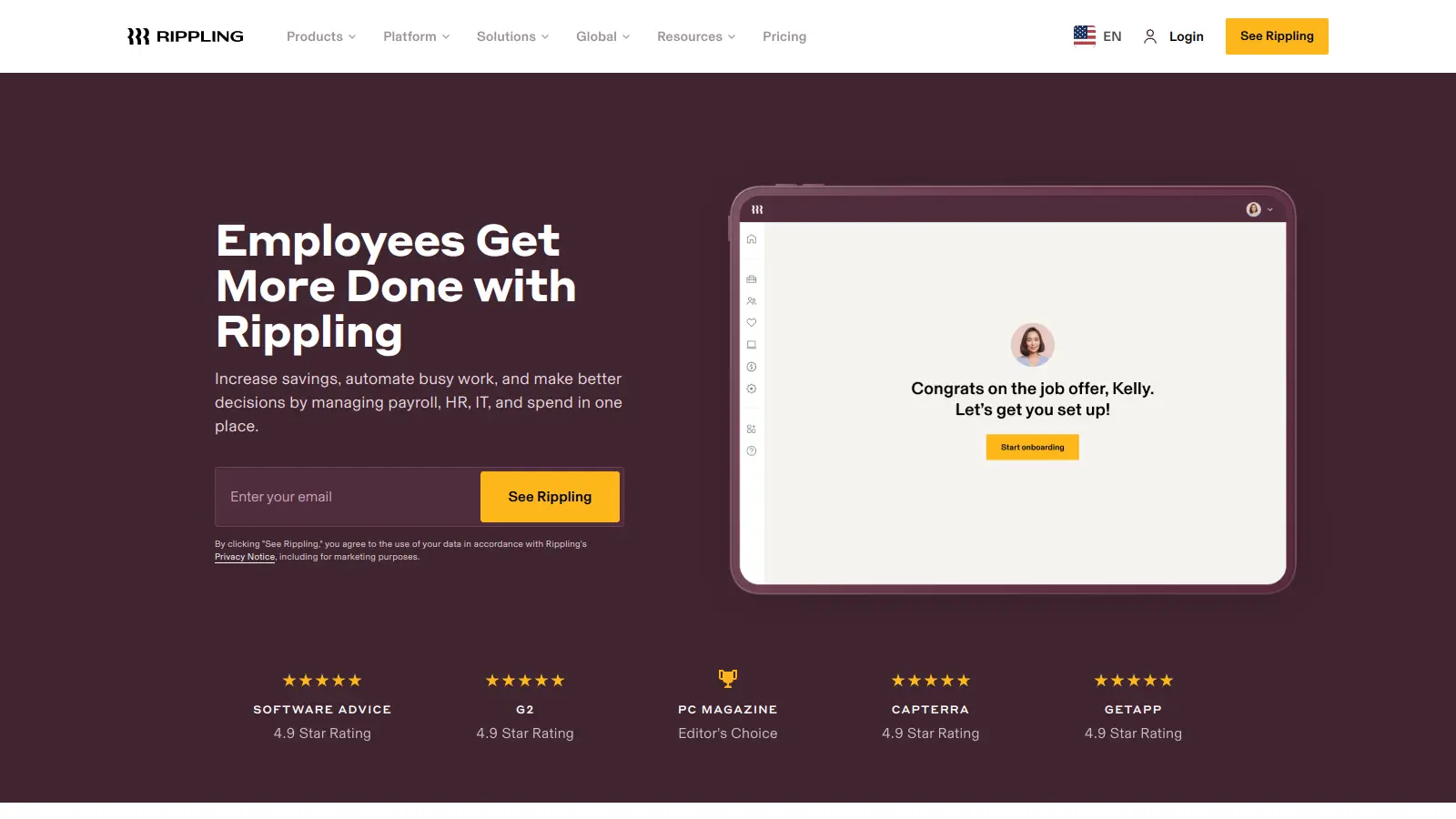
Rippling connects HR, payroll, benefits, and device management in a single system. When you onboard a new hire, Rippling can simultaneously add them to payroll, send equipment, and provision their SaaS apps. It supports US multi-state payroll, international contractors, and, through its PEO offering, employer-of-record services.
Pros
✓Combines HR and IT provisioning in one workflow
✓Strong automation for onboarding and offboarding
✓Wide integration library with 500+ apps
Cons
✗Modular pricing adds up quickly as you enable features
✗Setup can take several days for complex configurations
Payroll and HR basics designed for small US businesses and startups.
Paid
Best for · Pre-Series A startups hiring their first employees in the USPricing · From $46/mo + $6/employee/mo
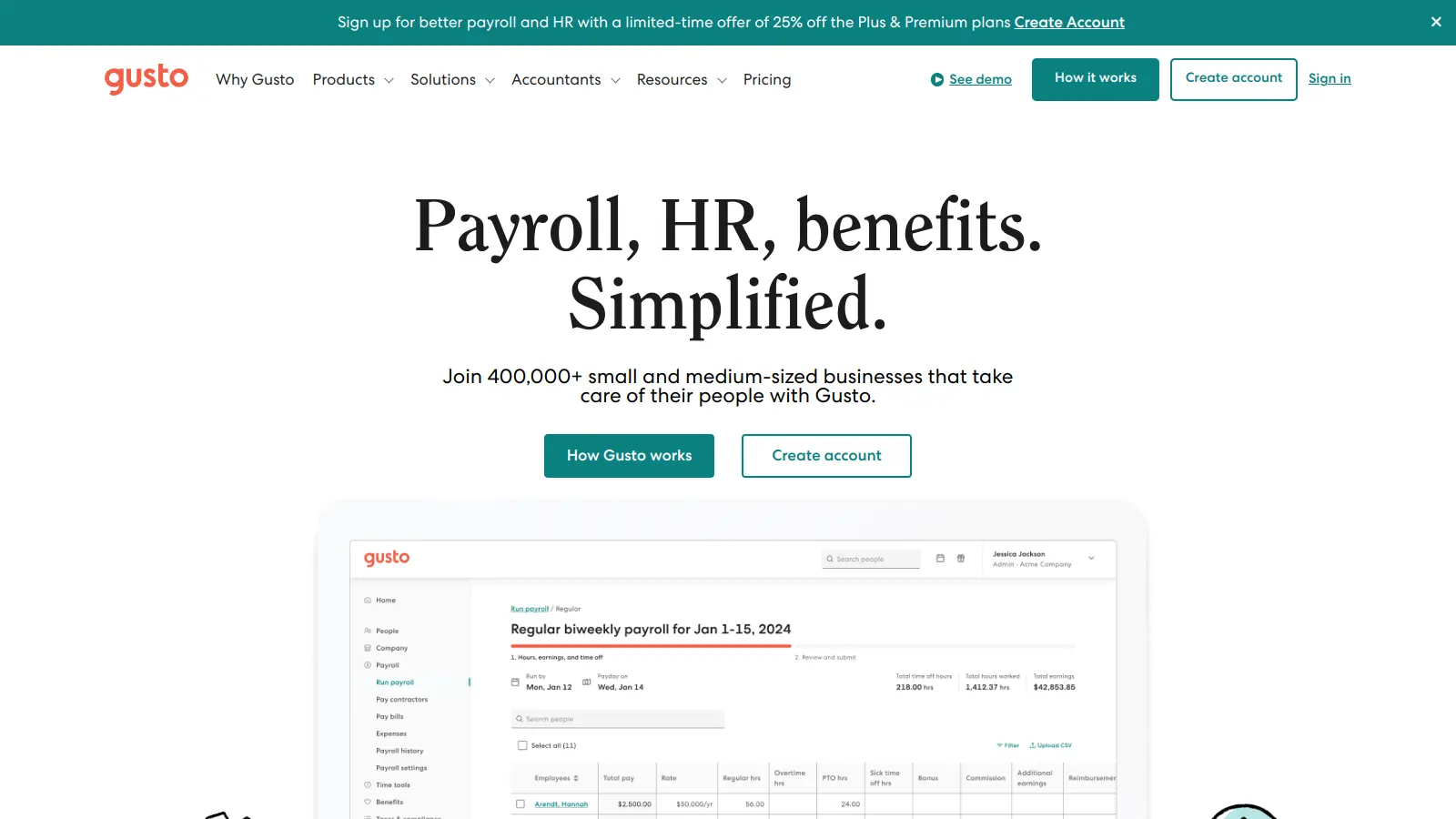
Gusto handles US payroll, tax filings, benefits administration, and new hire onboarding. The Simple plan covers payroll for one state; higher tiers add multi-state payroll, time tracking, and HR tools. It's one of the fastest tools to get up and running, with guided setup that takes a few hours.
Pros
✓Guided payroll setup takes under a day
✓Handles federal and state tax filings automatically
✓Transparent, predictable pricing at small headcounts
Cons
✗No employer-of-record for international full-time hires
✗Performance management features are basic compared to competitors
People-data platform built for small and mid-sized businesses.
Paid
Best for · Startups that need a clean HRIS before investing in a full platformPricing · Pricing on request
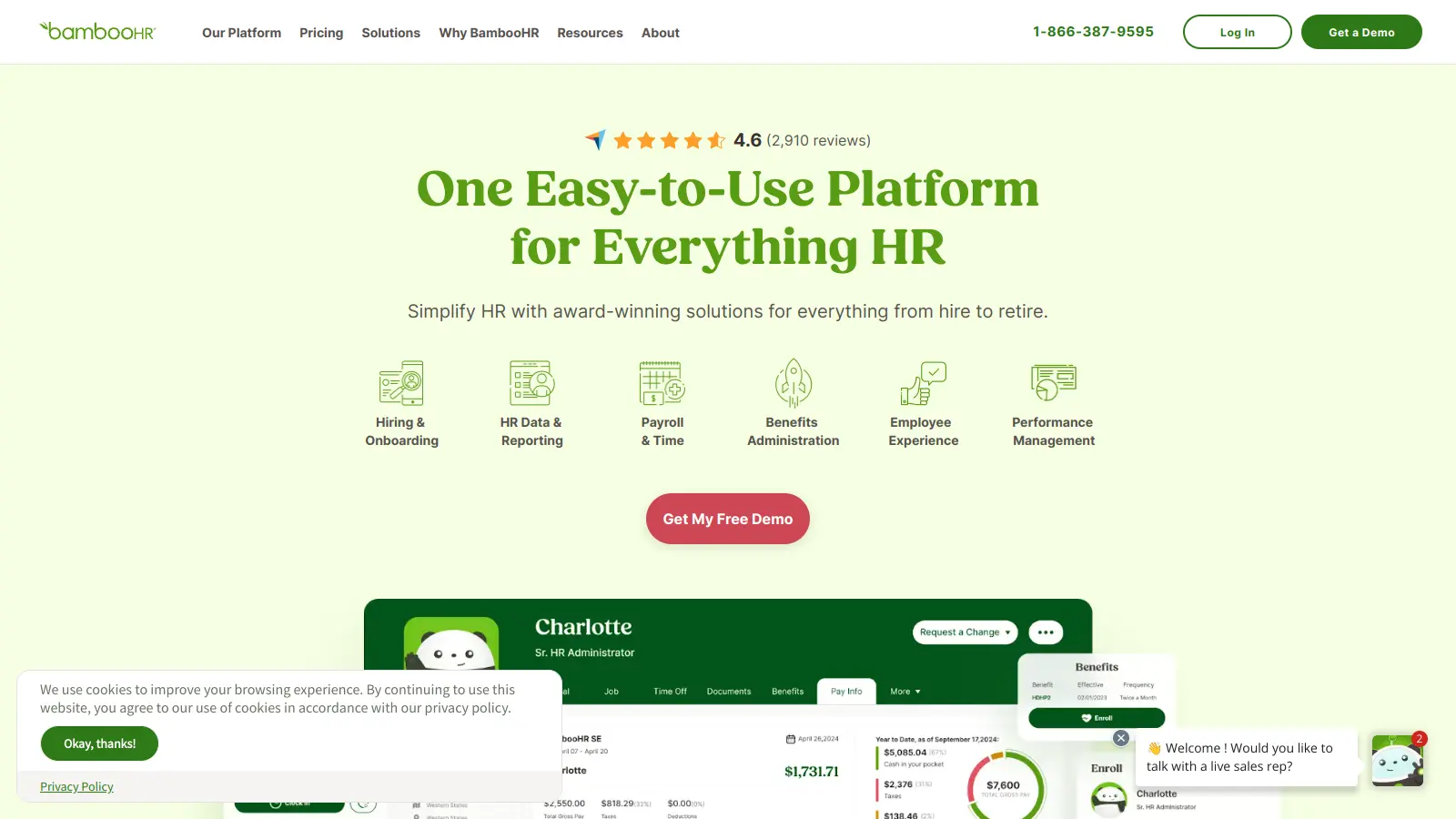
BambooHR centralises employee records, time-off tracking, onboarding workflows, and performance reviews. It has a clean interface that non-HR managers can use without training. Payroll is available as an add-on for US companies, but many startups use BambooHR as their HRIS and connect it to a separate payroll tool.
Pros
✓Intuitive interface requires minimal onboarding for managers
✓Strong employee self-service for time-off and document management
✓Good ATS and onboarding workflow integration
Cons
✗Pricing is not public, requires a sales call for a quote
✗Payroll is a paid add-on, not included in the core plan
Payroll and compliance for teams that hire across borders.
Freemium
Best for · Globally distributed startups paying contractors or full-time employees abroadPricing · Free HRIS; EOR from $599/employee/mo; Contractor from $49/contractor/mo
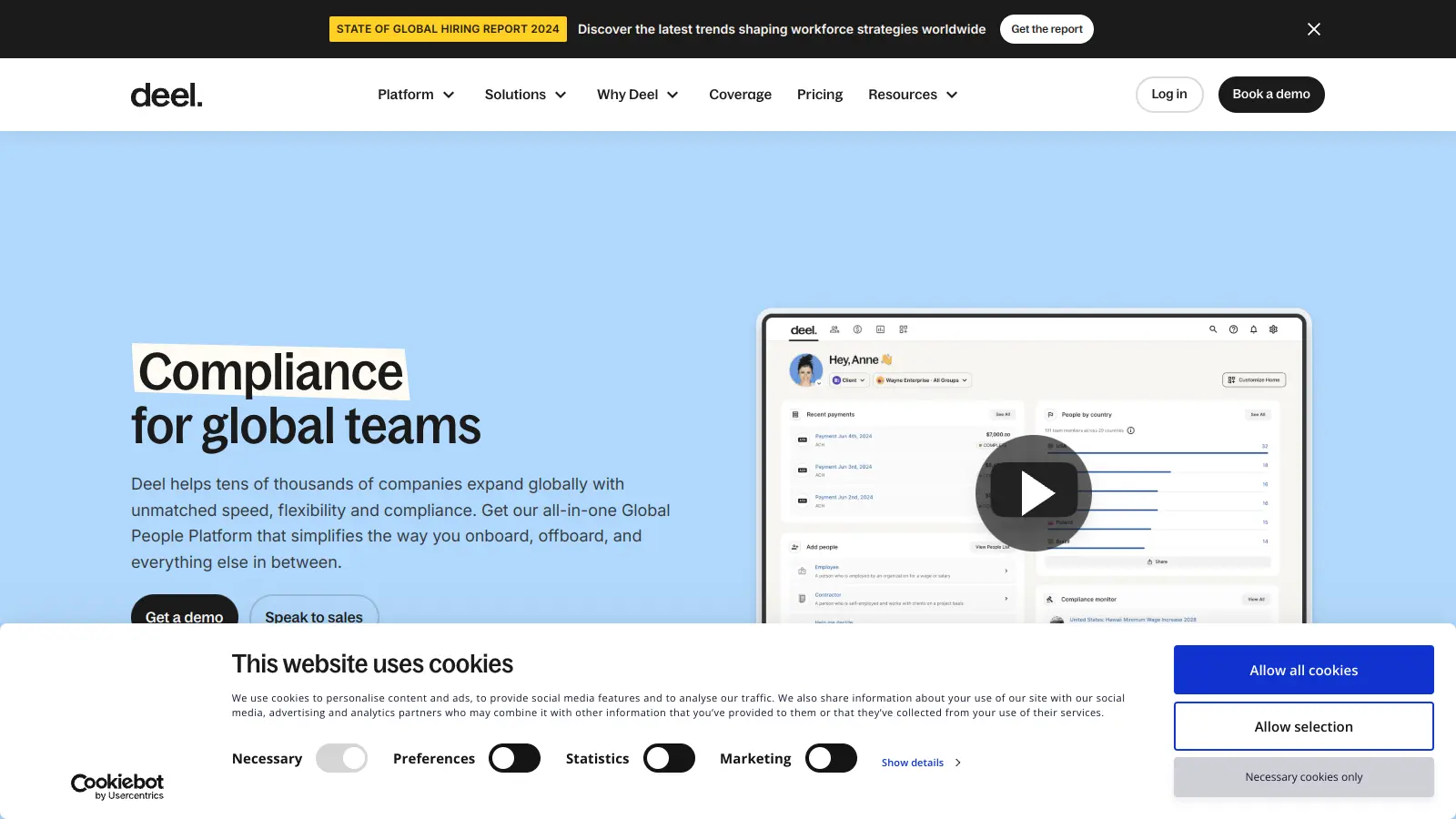
Deel specialises in international hiring: contractor payments in 150+ countries, employer-of-record services for full-time employees abroad, and US payroll. For startups hiring globally before they have legal entities in each country, Deel's EOR service removes the need to set up local subsidiaries. It also has an HRIS for free for teams under 200.
Pros
✓Free HRIS for teams up to 200 people
✓EOR coverage in 150+ countries without local entities
✓Contractor and full-time payroll in a single platform
Cons
✗EOR pricing at $599 per employee per month is expensive at scale
✗US domestic payroll features are less mature than Gusto or Rippling
HRIS built for mid-size teams that care about culture and engagement.
Custom
Best for · Startups at Series A or B building out a proper people functionPricing · Pricing on request
HiBob (branded as Bob) is an HRIS with strong people analytics, org charting, and engagement tools alongside the core HR record-keeping. It targets companies in the 50 to 500 employee range that want more visibility into retention and team health than tools like BambooHR provide. Payroll is handled via integrations rather than natively.
Pros
✓Strong workforce analytics and retention dashboards
✓Well-designed employee experience and self-service features
✓Good fit for multi-country teams in Europe and APAC
Cons
✗No native payroll, relies on third-party integrations
✗Pricing is not public and typically requires a demo call
Performance management and people analytics for growth-stage teams.
Paid
Best for · Post-seed startups building a performance review process for the first timePricing · From $11/person/mo
Lattice focuses on performance reviews, OKRs, 1:1s, and employee engagement surveys. It added HRIS and payroll capabilities in 2023 and 2024, making it a more complete platform. Startups use it primarily to build a structured performance culture early, before bad habits form at the management layer.
Pros
✓Best-in-class performance review and OKR tracking tools
✓Engagement surveys with actionable analytics built in
✓HRIS and payroll now available as add-ons in one platform
Cons
✗Modules are priced separately, so full platform cost adds up fast
✗Payroll and HRIS features are newer and less mature than core competitors
All-in-one HR platform priced for small and growing teams.
Paid
Best for · Startups in Europe or budget-conscious US teams wanting an all-in-one platformPricing · From $5/employee/mo
Factorial covers time tracking, leave management, payroll (in select countries), onboarding, and performance management in a single subscription. It has a strong foothold in Europe, with Spanish, French, and German payroll built in. For US-based startups, it competes on price against Gusto and BambooHR with a more unified feature set per dollar.
Pros
✓One of the lowest per-employee prices for a full HR suite
✓Native payroll available for Spain, France, Germany, and more
✓Time tracking and leave management included at base price
Cons
✗US payroll support is limited compared to Gusto or Rippling
✗Reporting and analytics are basic relative to HiBob or Lattice
Some tools are optimised for 1 to 50 employees and become expensive or clunky past that point. Before committing, check per-employee pricing at your expected headcount in 12 months, not just today.
Payroll geography
If you hire across multiple US states or internationally, confirm the tool handles multi-state payroll tax filings and, if relevant, international contractor or employer-of-record payments. Not every tool does this without an add-on.
Onboarding and compliance workflow
A good onboarding flow collects I-9s, W-4s, direct deposit details, and e-signatures automatically. If you're hiring frequently, this saves hours per new hire and reduces the risk of missing a required document.
Integration with your existing stack
Check whether the HR tool connects to your accounting software, ATS, and equity management platform. Rippling and Gusto both have wide integration libraries; smaller tools may require manual data entry or Zapier workarounds.
Pricing structure
Most HR tools charge a base fee plus a per-employee monthly rate. Calculate the all-in cost at your current and projected headcount. Some charge separately for payroll, benefits administration, and time tracking, so the sticker price can be misleading.
frequently asked questions
Gusto is the most common choice for US-based startups in the 1 to 50 employee range because it handles payroll, benefits, and onboarding at a reasonable price. Rippling is a close second for teams that also need IT provisioning or plan to scale quickly. Both have free trials and are designed for non-HR operators.
Most tools charge a base fee of $40 to $100 per month plus $6 to $15 per employee per month. A 20-person startup on Gusto's Simple plan would pay around $260 per month. Platforms with more features like Rippling or Lattice cost more, often $8 to $16 per employee depending on the modules selected.
Free tiers exist on tools like Factorial and HiBob but are typically limited to basic employee records and time tracking. Payroll is almost never included for free. If you have employees rather than just contractors, you'll need a paid payroll tool to stay compliant.
Picking a tool based on current headcount without checking what it costs at 50 or 100 employees. Several popular startup tools have pricing that scales steeply, so a cheap option at 10 people can become one of your larger SaaS expenses by Series B. Always model the cost at 2x your current headcount before committing.
Some can. Deel and Rippling both support international contractor payments and employer-of-record services for full-time hires abroad. Gusto handles international contractors with its Global Contractor Payments add-on but does not offer full EOR services. BambooHR and Lattice are primarily US-focused for payroll and compliance.
tools for humans
toolsforhumans editorial team
Reader ratings and community feedback shape every score. Since 2022, ToolsForHumans has helped 600,000+ people find software that holds up after launch. The picks here come from that.