No Code Development Platform+2 more

Replit
best deal
Teams users automatically upgraded to Pro at no additional cost for remainder of term; yearly Teams subscribers get $100 monthly credits free until term ends
redeem now
Replit
best deal
Teams users automatically upgraded to Pro at no additional cost for remainder of term; yearly Teams subscribers get $100 monthly credits free until term ends
redeem nowWe start with direct ratings from our readers, then look at what real users are saying in practitioner forums and community spaces. We pair that with search demand data and profession-level persona analysis.
Editorial note: this was originally published in february of 2023
quick take
based on real user feedback, community sentiment, pricing value, and fit for target audience. see our full methodology
used Replit? we'd love to know your thoughts
reader ratings shape our score
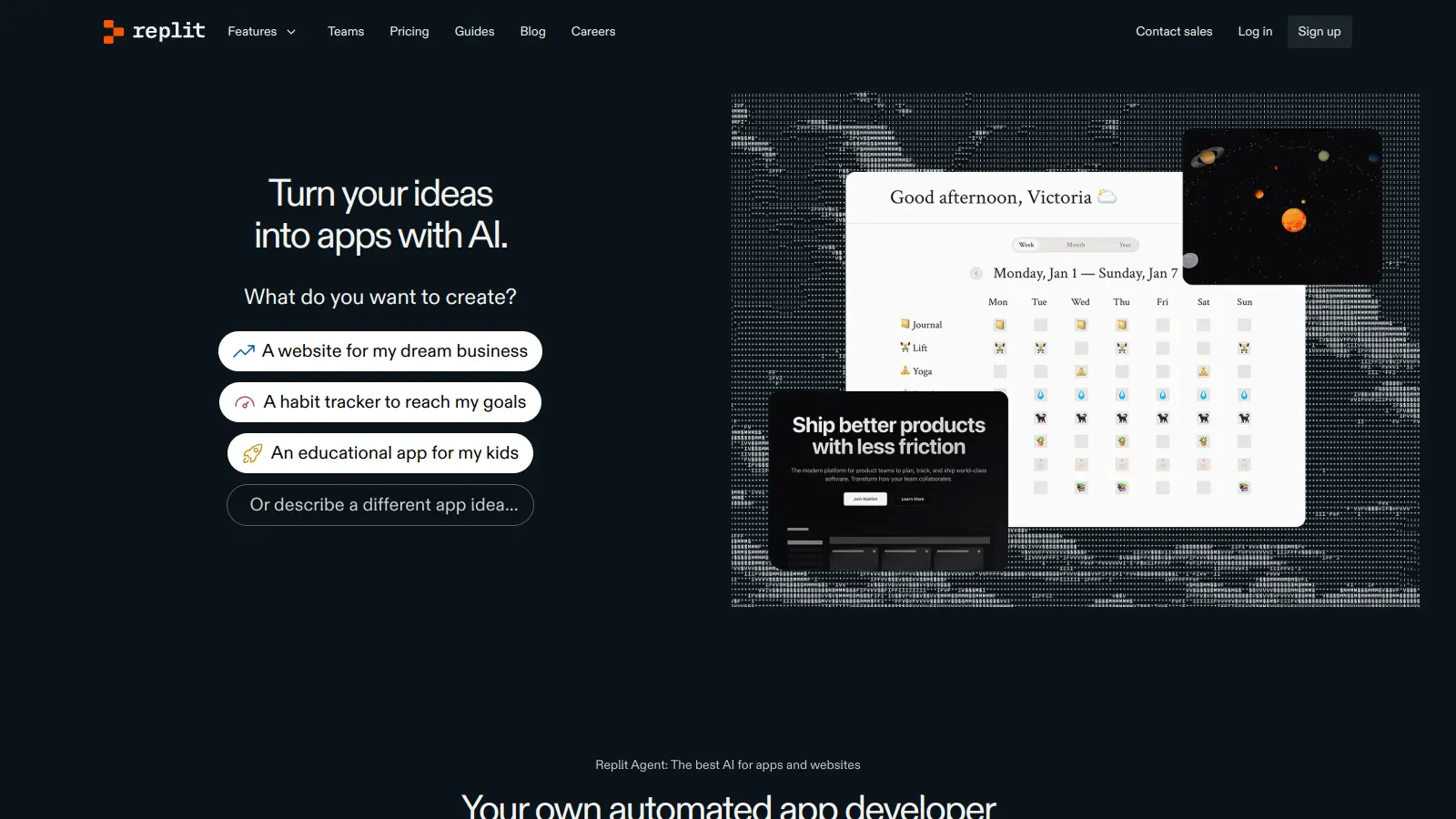
Replit is a cloud-based IDE that lets you write, run, and deploy code entirely in a browser, and its AI agent can turn a plain English description into a working full-stack app, complete with database and authentication, without touching a terminal. Computer Science Students and Product Managers get the most immediate value: students skip environment setup entirely and collaborate in real time, while non-technical prototypers can validate ideas in an afternoon instead of a sprint. The tradeoff is real: Replit is faster to start than anything else in its category, but it hits resource limits quickly, and those limits become obvious the moment you try to do anything production-grade.
The free Starter plan covers light use with daily AI credits and one hosted app. The Core plan is $20/month (billed annually) and unlocks private apps, unlimited workspaces, and more agent runtime. It runs on any device with a browser and needs no local installation. Before you commit to a paid plan, test a real project on the free tier first: the gap between free and paid is significant, but the gap between paid Replit and a self-hosted setup matters a lot once your project outgrows the platform's CPU limits.
monthly search interest
246k/mo now
Replit's search interest drifted sideways or downward through most of 2023 and 2024, then surged sharply in mid-2025, likely driven by broader interest in AI-powered coding tools rather than Replit-specific momentum. The peak appears to be behind it for now, but 200k-plus monthly searches is a healthy stable floor. The hype wave has passed, which means you're evaluating the real product, not a viral moment.
Whether Replit clicks for you depends almost entirely on what you're trying to build and how far you need to take it. Pick your role below to see the honest breakdown.
overall sentiment
select your role to see what people like you are saying
Computer Science Student
positiveIf you're starting out or working on coursework, Replit removes every setup barrier: open a browser, pick a template, and you're writing code in seconds. The free tier covers most class projects and the real-time collaboration is genuinely useful for pair programming. You'll hit the CPU limits if your assignments start involving large datasets or complex algorithms, so don't count on it for computationally heavy upper-level work.
strengths
concerns
Product Manager / Non-Technical Prototyper
mixedReplit's AI agent is the most direct path from a written feature idea to a working, deployed prototype if you have no coding background. You can test multiple concepts in a day, which is a real advantage for validation cycles. The risk is reliability: IDE bugs and occasional downtime make it a shaky foundation for high-stakes stakeholder demos, and performance drops fast if you try to stress-test anything with real traffic.
strengths
concerns
Professional Developer / Engineering Team Lead
mixedReplit's browser-based collaboration is genuinely useful for distributed teams doing quick prototypes or onboarding demos, and the AI agent speeds up boilerplate work. But the resource throttling, code privacy concerns, and IDE instability make it a non-starter for production workloads. At $95/month for the Pro plan, you're paying more than a self-hosted VPS that gives you full control. Use it for rapid MVPs; don't build anything mission-critical on it.
strengths
concerns
Hobbyist / Casual Coder
positiveFor side projects and weekend experiments, Replit is hard to beat: nothing to install, works on any machine, and the AI agent can get a working app running before you've finished your coffee. The free tier is tight but sufficient for most casual use. If a project starts getting serious, you'll outgrow the resource limits faster than you'd expect.
strengths
concerns
“Agent 3 is slow compared to other AI app builders, and costs can add up fast.”
Superblocks Blog
The available reviews on Replit in 2025 come mostly from independent bloggers and competitor-adjacent sources rather than a deep well of community forum discussion, so take the overall picture with that in mind. A hands-on test documented on Medium found Replit competitive when compared side-by-side with Bolt.new and AI Studio for building a mobile app, though the reviewer noted it as a first impression rather than a long-term verdict. A more detailed build test from Superblocks clocked 36 minutes to produce a working bill-splitting app and landed on a clear-eyed conclusion: Replit is genuinely good at quick prototypes across a wide range of project types including web apps, data tools, and 3D games, but Replit Agent is noticeably slower than rival AI app builders and costs stack up quickly once you move beyond the free credits. Across broader online commentary, the recurring complaints centre on CPU throttling during intensive tasks, IDE instability at inconvenient moments, and the jump from free tier to $20 or $100 per month feeling steep once you need anything resembling reliable uptime or production-grade performance.
The free Starter tier is worth using for exploration and small class projects, with genuine daily AI credits and one hosted app. The Core plan at $20/month makes sense if you're a solo developer or product manager who needs private apps and more agent runtime regularly. The Pro plan at $95/month (billed annually) is hard to recommend unless you're running a small team that lives entirely in the browser and doesn't need production-grade reliability. For most individual users, Core is the sensible ceiling.
Computer Science Students get disproportionate value here: zero setup, real-time collaboration for pair programming, and a free tier that actually covers small coursework projects. Product Managers and non-technical prototypers also get a lot out of it, since the AI agent genuinely converts a feature description into a working full-stack app without needing to write code. Professional developers get useful remote collaboration features but will likely hit the platform's ceiling faster than the other groups.
CPU throttling kicks in on anything computationally intensive, which is a real problem if you're running algorithms on larger datasets or simulating any real-world traffic. IDE instability and periodic downtime are consistently flagged by users, and both are genuinely risky if you're mid-demo or up against a submission deadline. Storing code on external servers is also a compliance non-starter for enterprises or any project with data sensitivity requirements.
Both are browser-based AI app builders aimed at people who want to skip local setup. Bolt.new tends to generate output faster, which matters if you're iterating quickly. Replit has a deeper feature set once you're past the initial build: databases, deployment, collaboration for up to five people, and broader language support. If you're a student or non-technical prototyper doing rapid iteration, Bolt.new's speed gives it an edge for first drafts. If you need to actually deploy and share what you've built, Replit's integrated hosting and collaboration workflow is more complete.
This is the central risk for product managers and non-technical prototypers relying on Replit for client or leadership demos. Replit's uptime is adequate for casual use but not guaranteed under pressure, and performance degrades with anything resembling real traffic or complex database queries. The honest answer: test the specific demo on the platform at least 24 hours before the presentation, keep a screen recording as backup, and don't demo anything that requires fast response times. If the stakes are high, a local fallback is worth building.
toolsforhumans editorial team
Reader ratings and community feedback shape every score. Since 2022, ToolsForHumans has helped 600,000+ people find software that holds up after launch. how we research →
is this your tool?
claim your listing to update details, respond to our review, or upgrade to a featured partnership.
claim this listing →
Shopify is an e-commerce platform that enables businesses of all sizes to create, manage, and grow online stores. It offers tools for store creation, product management, payment processing, and multichannel sales, supporting both online and in-person transactions. With customizable themes, extensive app integrations, and flexible pricing plans, Shopify caters to entrepreneurs, small businesses, and global brands.
best deal
Get Shopify Basic for $29/month when billed annually (regularly $39/month)

Wix is a website builder that lets individuals and businesses create professional websites without coding. It offers drag-and-drop editing, AI-powered design tools, templates, and features for e-commerce, SEO, and marketing. Pricing ranges from free to enterprise-level, covering everything from personal portfolios to online stores.
best deal
Get 50% off Wix annual plans, with Light Plan starting at $17/month

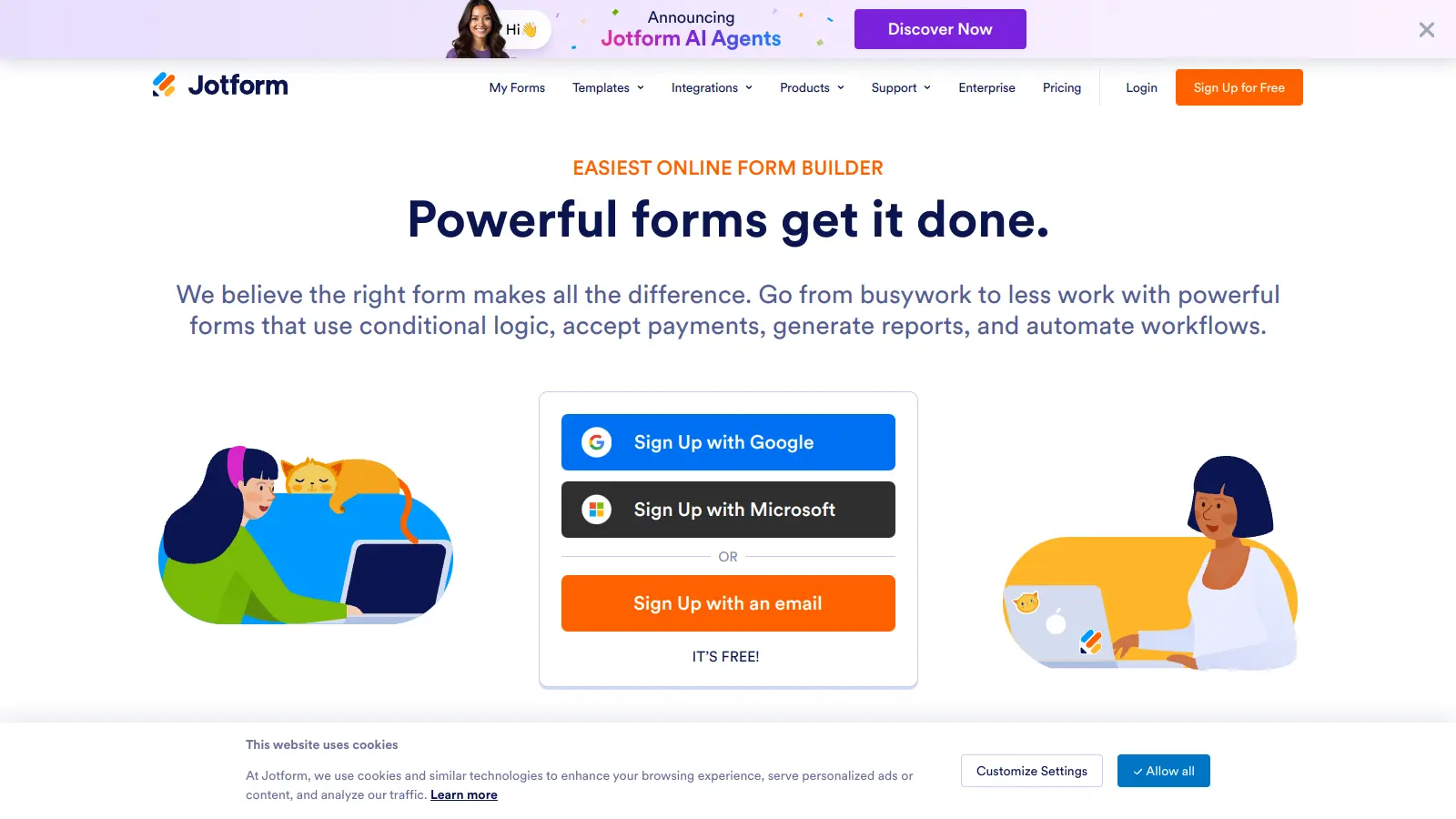
Jotform is an AI-powered form builder that enables individuals and businesses to create, customize, and manage digital forms, apps, and workflows without coding skills. It offers a drag-and-drop interface, 10,000+ templates, payment integrations, AI agents for customer support, and connects with over 1,000 apps. The platform provides conditional logic, form analytics, and robust security, making data collection and workflow automation simple across industries.
best deal
Try the Starter plan for free with 5 forms, 100 monthly submissions, and all standard features. Nonprofits and educational institutions get 50% off paid plans.

Dora is a no-code AI platform that enables users to create dynamic, 3D animated websites without coding knowledge. It offers AI-driven design assistance, seamless 3D integration, and a user-friendly interface similar to Figma. The tool allows for easy customization, responsive design, and incorporates advanced features like automated design tasks and 3D model incorporation, making web design more accessible to beginners and professionals alike.
best deal
Try Dora AI Free - Unlimited projects with AI website building, 3D animation, and responsive design.

Zapier is a no-code automation platform that connects over 8,000 apps, enabling users to create automated workflows called "Zaps" without coding. It integrates different services, automating repetitive tasks through customizable triggers, multi-step processes, and real-time data transfer. Pricing ranges from free to enterprise tiers.
best deal
Start automating with unlimited Zaps and 100 monthly tasks free – no credit card needed

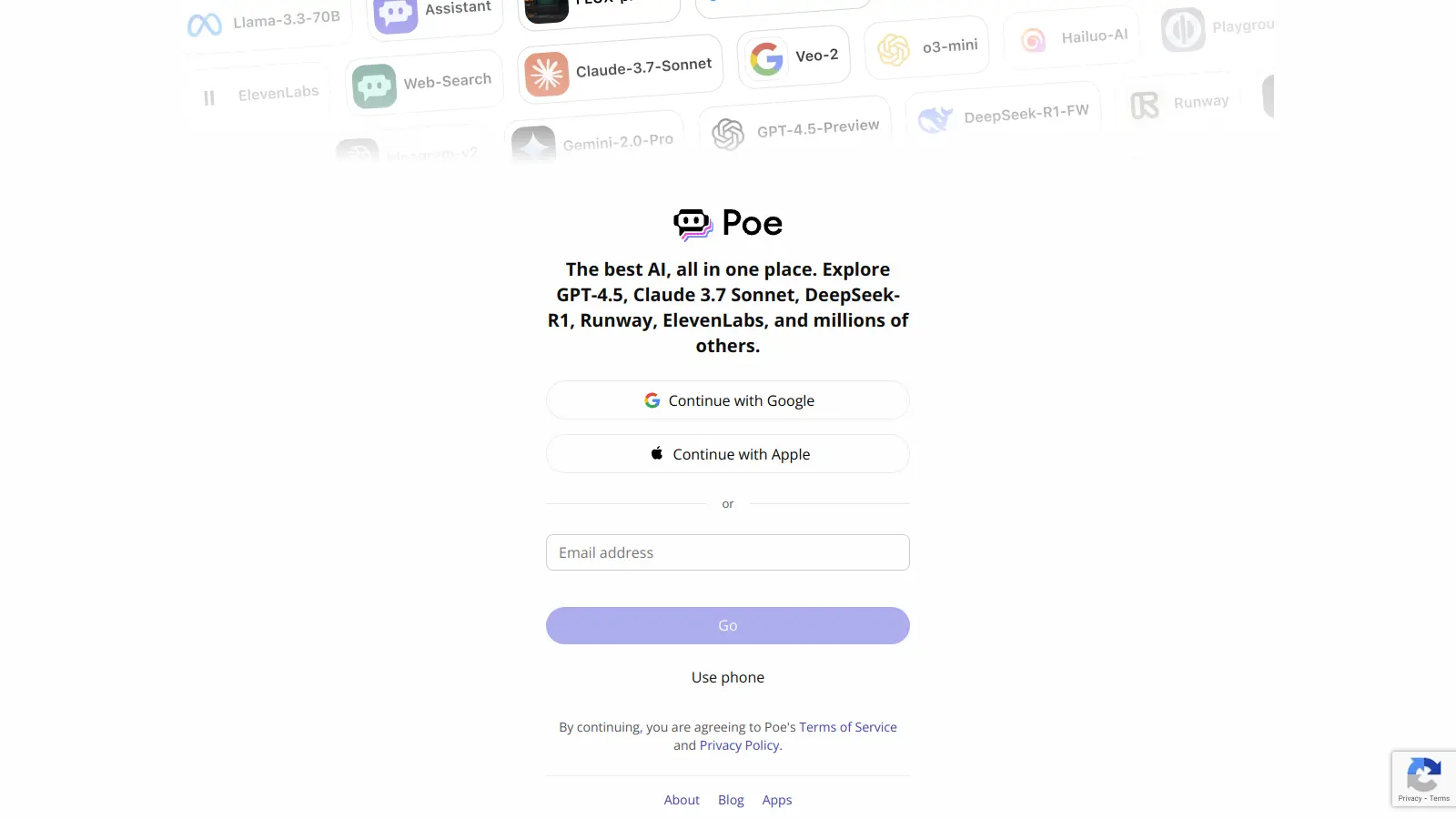
Poe is an AI chatbot aggregator platform developed by Quora that allows users to interact with AI models from companies like OpenAI and Anthropic. It enables users to access and switch between different chatbots, create custom AI assistants, and offers both free and paid subscription plans. The platform supports web and mobile interfaces, provides monetization options for bot creators, and serves as a centralized hub for AI interactions.
best deal
Try Poe Free: 100 daily messages with ChatGPT, Claude & more AI assistants in one place