Digital Risk Protection Platform+2 more

PimEyes
best deal
Get 25% off annual plans: PROtect for $26.24/month or Advanced for $224.99/month
redeem now
PimEyes
best deal
Get 25% off annual plans: PROtect for $26.24/month or Advanced for $224.99/month
redeem nowWe start with direct ratings from our readers, then look at what real users are saying in practitioner forums and community spaces. We pair that with search demand data and profession-level persona analysis.
Editorial note: this was originally published in may of 2023
quick take
based on real user feedback, community sentiment, pricing value, and fit for target audience. see our full methodology
used PimEyes? we'd love to know your thoughts
reader ratings shape our score
PimEyes is a facial recognition search engine that scans an index of 3.5 billion images to find where a specific face appears across the web. It's one of the few tools in this category that's genuinely accessible to individuals rather than just law enforcement or enterprise security teams. Journalists and investigators get the most straightforward value from it, as it compresses what would otherwise be hours of manual searching into seconds. The tradeoff is an ethical one that sits at the centre of every search: a tool capable of protecting your privacy can just as easily be used to invade someone else's.
Pricing starts with a limited free tier (up to 5 daily searches, thumbnails only), with the first genuinely useful tier at $29.99 a month for full source URLs. Takedown assistance starts at $79.99 a month. It's browser-based and works on any device. Before you subscribe, run the free searches first; if the thumbnails show nothing, you've saved yourself $30 a month and confirmed you're not being scraped.
monthly search interest
165k/mo now
PimEyes spiked hard in early 2023, likely driven by a wave of press coverage calling it a 'dangerous superpower', then settled into a plateau of around 200,000 to 300,000 monthly searches that has held fairly consistently since mid-2023. That stabilisation suggests a real core audience has formed around specific use cases, mostly privacy monitoring and investigations, rather than casual curiosity. The hype has passed, so you're getting the actual product now rather than a viral moment.
Whether PimEyes is worth it depends almost entirely on why you're searching and what you plan to do with the results. Pick your role below to see the honest breakdown.
overall sentiment
select your role to see what people like you are saying
Privacy-Conscious Individual
mixedPimEyes can show you where your face appears online, and that's genuinely useful if you've ever wondered whether someone is using your photos without permission. The free tier is enough to confirm whether a problem exists. The frustration is that acting on what you find requires a paid subscription, and knowing other people can run the same search on you is an uncomfortable trade-off that never quite goes away.
strengths
concerns
Journalist/Investigator
positiveFor investigative work, PimEyes is the most efficient face search tool available outside specialist law enforcement software. It surfaces matches across 3.5 billion indexed images in seconds and gives you enough to verify identities or track image provenance. The Open Plus plan at $29.99 a month is a reasonable professional expense if you're running regular searches. Be aware of legal uncertainty around facial recognition in some jurisdictions before you publish findings based on it.
strengths
concerns
Identity Theft Victim / Parent Monitoring
positiveIf you're worried your images, or your child's photos, are being misused, PimEyes gives you a concrete way to find out. The free search will tell you whether there's a problem. To see exactly where images appear and start filing takedown requests, you'll need at least the $29.99 Open Plus plan. Customer support is reported as poor, so don't expect much help navigating what you find. The tool finds the evidence; getting images removed is a separate battle.
strengths
concerns
Content Creator/Photographer
mixedIf someone is using your work with your face in it, PimEyes can surface it. For tracking image theft more broadly, it's less useful than dedicated reverse image tools like TinEye or Google's image search, which cover social media and shopping platforms that PimEyes deliberately excludes. At $29.99 a month, it's worth a short trial if you suspect specific misuse, but it's probably not a permanent fixture in a creator's toolkit.
strengths
concerns
“In the results, I could see thumbnails that I recognized, and my heart dropped. They were explicit photos taken when I was 15 and uploaded to the internet without my consent. Pimeyes does not show you the full link to the website that these results come from unless you p”
Reddit r/privacy
Coverage of PimEyes in the press has been striking enough that BBC, Vice, the Washington Post, and the New York Times have all written about it, with the NYT calling it 'a potentially dangerous superpower from the world of science fiction' at $29.99 a month. That framing captures the community tension around the tool accurately. On Reddit's r/privacy, discussion is dominated less by whether the search results work and more by the ethical weight of what happens when they do. One thread involves a user who uploaded their own photo and found thumbnails of non-consensual intimate images taken when they were 15. The tool found them. That's the double-edged reality: it works, and that's precisely the problem for many people. Commercial review platforms give PimEyes a middling score across over 100 reviews, with complaints centring on opaque billing, unhelpful customer support, and the frustration that the free tier shows you thumbnails but locks the full source URL behind a paid subscription, starting at $29.99 a month. Users who need to actually act on results, whether for takedown requests or legal action, have to pay before they can see where their images live.
For a one-off check, no. The free tier gives you up to 5 daily searches and shows you matching thumbnails, but it hides the full source URLs, which makes the results essentially useless for taking action. The Open Plus plan at $29.99 a month unlocks those URLs and adds 75 daily searches, which makes sense if you're actively monitoring your presence or running investigations regularly. If you need actual help getting images removed, that requires the PROtect plan at $79.99 a month. For most people, the free tier confirms whether a problem exists, and the paid plans are only worth it if you intend to do something about the results.
Journalists and investigators get the clearest value: it does in seconds what would take hours of manual searching, and the accuracy is good enough to support due diligence work. Identity theft victims and parents checking whether a child's photos have been misused also have a concrete reason to pay. Privacy-conscious individuals who want to monitor their digital footprint will find it useful but may struggle with the uncomfortable fact that other people can run the same searches on them.
The free tier is structured to show you enough to worry you but not enough to act. Full source URLs require a paid subscription, and actual takedown support starts at $79.99 a month. Customer support is widely reported as poor, which matters a lot when results reveal something distressing. The tool deliberately excludes social media and video content from its index, which means gaps in coverage for some of the most common places images are shared without consent. And there's no guarantee that even with evidence in hand, you can get images removed from the websites that host them.
Google Reverse Image Search and TinEye are free and cover social media, news, and shopping results. PimEyes is specifically built for faces, searches 3.5 billion indexed images, and returns matches across a much wider range of sites than Google's reverse search will surface. For finding whether a face appears somewhere on the internet, PimEyes is more thorough. For checking whether a specific image has been copied or repurposed, Google or TinEye is usually sufficient and costs nothing. Start with the free tools; move to PimEyes if they don't find what you're looking for.
Yes, and this is exactly the use case it handles best. Upload your own photo, run a search, and you'll see thumbnails of matching images across the web. The catch is that you'll need the Open Plus plan at $29.99 a month to see the full URLs, and if you want help filing takedown requests, that's the PROtect plan at $79.99. If you find something serious, like non-consensual intimate imagery, the results give you enough to escalate to a platform or legal contact, but PimEyes itself can't force any site to take content down.
toolsforhumans editorial team
Reader ratings and community feedback shape every score. Since 2022, ToolsForHumans has helped 600,000+ people find software that holds up after launch. how we research →

Barracuda Networks is a cybersecurity company founded in 2003, offering AI-powered solutions for email, network, and data protection through its BarracudaONE platform. The product suite includes email gateway defense, web security, firewalls, cloud backup services, and managed XDR with multimodal AI threat detection.
best deal
Free trials available for email protection and other products

FaceCheck.ID is an AI-powered facial recognition search engine that allows users to upload a photo to find matching faces across social media, news sites, blogs, mugshot databases, sex offender registries, and criminal news for identity verification and safety checks. The platform scans over 763 million public images and returns results in seconds with confidence scores and source links.
best deal
Try FaceCheck.ID free with basic search, or start with 36 credits for just $6

Mimecast is a cloud-based cybersecurity platform that provides email security, archiving, and continuity solutions. It protects against phishing, malware, ransomware, and business email compromise using AI-powered detection engines, URL scanning, attachment sandboxing, and user awareness training.
best deal
Explore Mimecast's Protect Plan with AI-powered email security starting today.

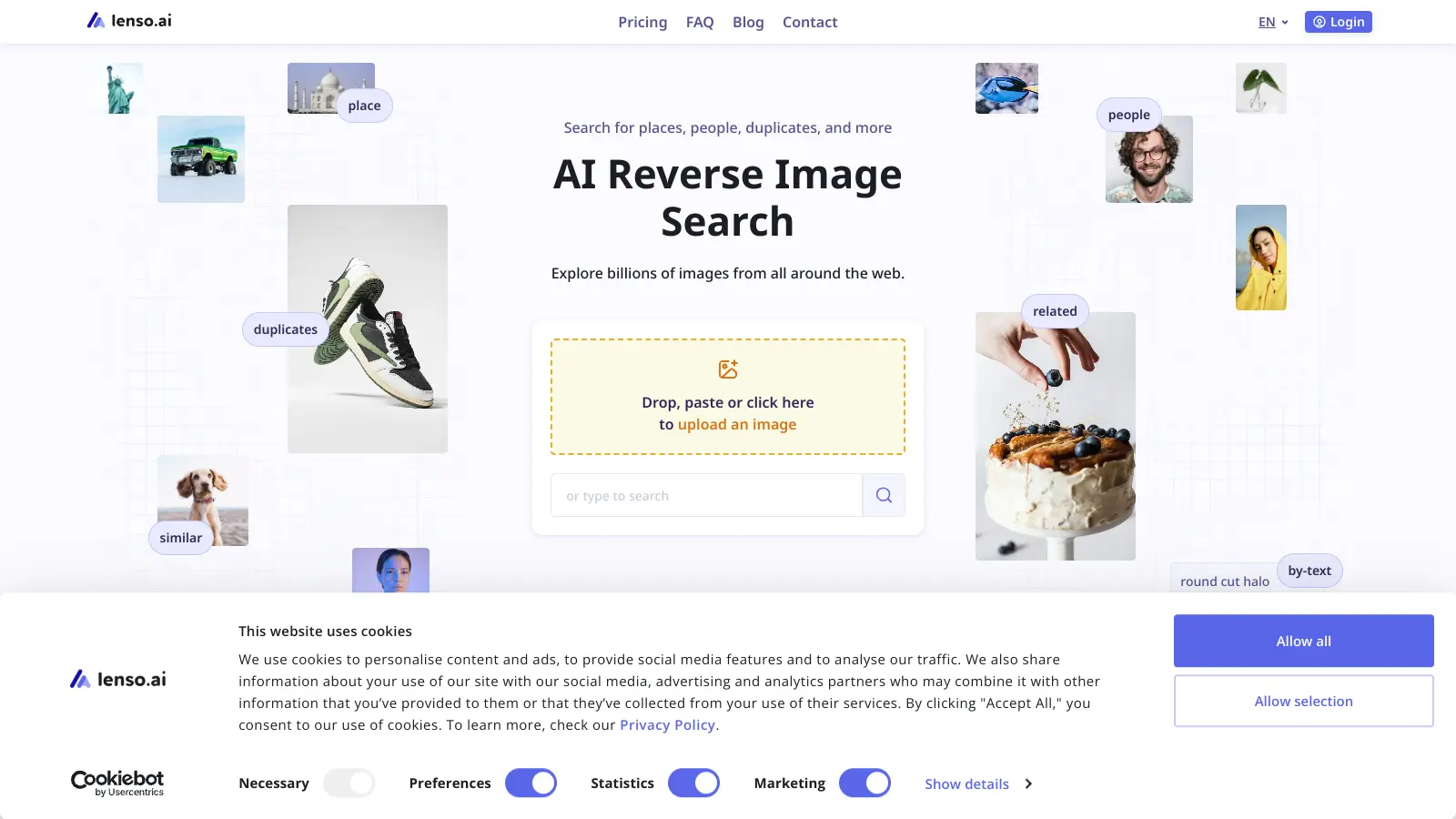
Lenso.ai is an AI-powered reverse image search tool that helps users find and analyze images through features like face search, location identification, and duplicate detection. It serves photographers, researchers, and brand managers who need to protect digital rights, locate visual matches, and track how their images appear online.
best deal
Try the free version with unlimited searches and result previews, or save 20% with a yearly subscription on any paid plan.

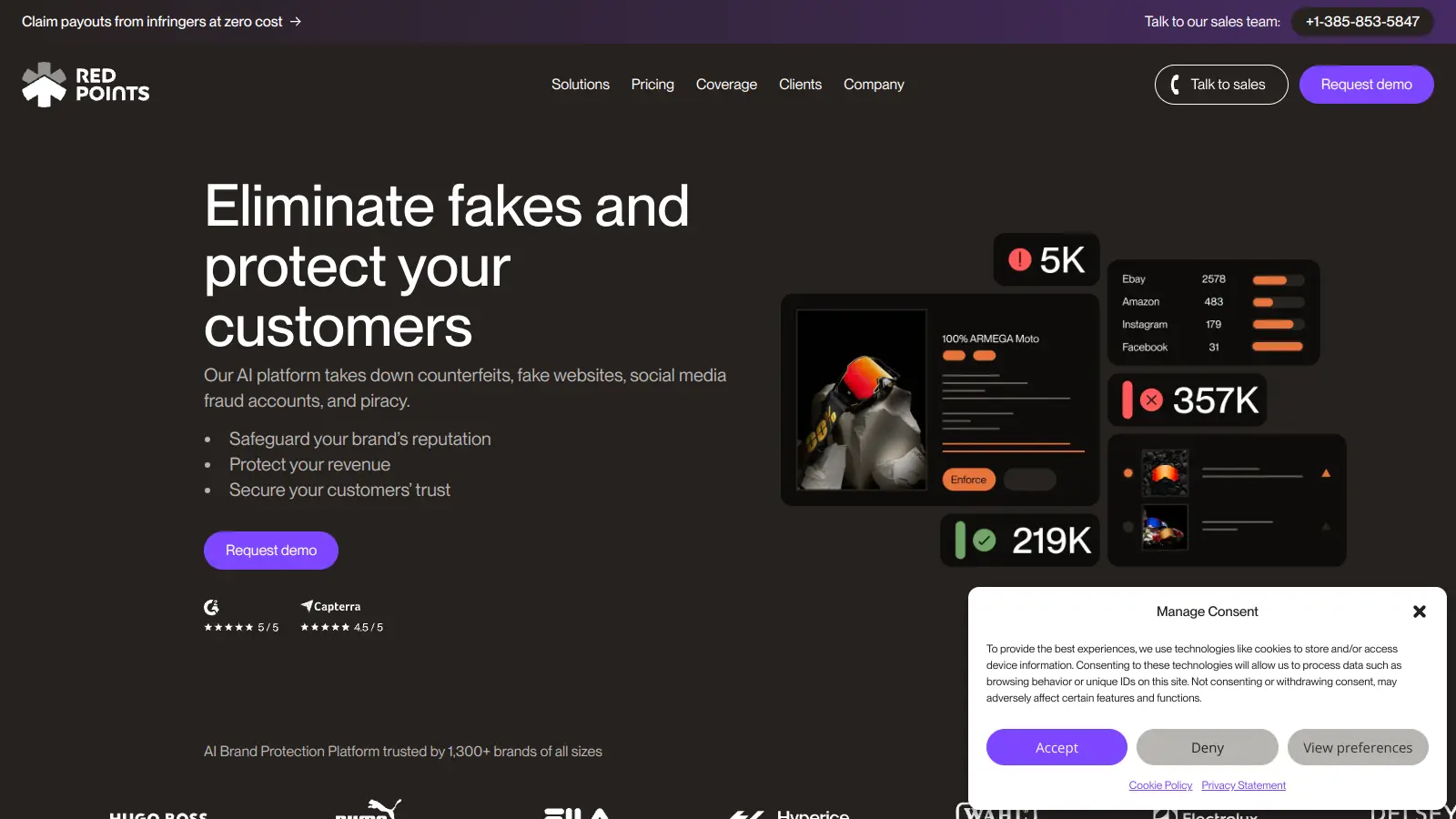
Red Points is a brand protection company that uses AI technology to find and remove counterfeits, impersonation, and digital threats. Founded in 2014 and headquartered in Barcelona, the platform uses image recognition, machine learning validation, and automated takedowns to protect over 1,300 organizations worldwide.
best deal
Get a Custom Quote - Starter or Professional Plans Available

Snyk is an AI-driven developer security platform that scans code for vulnerabilities, license compliance issues, and provides AI-powered fixes using static and dynamic analysis. It integrates with IDEs, Git workflows, and CI/CD pipelines for real-time scanning across open-source dependencies, container images, infrastructure as code, and proprietary code.
best deal
Try Snyk Free: Unlimited tests on open-source projects, 200 tests on private projects, 100 container tests with IDE plugins, CI/CD integration & continuous monitoring.