Ai Powered Contract Analysis Platform+2 more

Kira Systems
best deal
Try Kira Contract Analysis for small businesses at $500/month - start managing your contracts more efficiently with AI-powered insights.
redeem now
Kira Systems
best deal
Try Kira Contract Analysis for small businesses at $500/month - start managing your contracts more efficiently with AI-powered insights.
redeem nowWe start with direct ratings from our readers, then look at what real users are saying in practitioner forums and community spaces. We pair that with search demand data and profession-level persona analysis.
Editorial note: this was originally published in june of 2024
quick take
based on real user feedback, community sentiment, pricing value, and fit for target audience. see our full methodology
used Kira Systems? we'd love to know your thoughts
reader ratings shape our score
Kira Systems offers AI-powered contract analysis software that helps businesses understand and manage their documents more efficiently. Founded in 2011 in Toronto, the company emerged from the firsthand experience of former lawyer Noah Waisberg, who saw the need to improve traditional contract review methods.
The software uses machine learning to identify and extract important information from contracts and legal documents. It comes with over 1,000 built-in provision models and allows users to create custom ones through its Quick Study feature. Teams can upload documents easily, work together on reviews, and export their findings in various formats like Word or Excel.
Many large organizations, including AmLaw 100 firms and Big Four companies, use Kira for tasks such as due diligence, contract management, and compliance reviews. The platform typically helps complete review projects about 30% faster than manual methods.
Pricing varies based on organization size and needs. Small businesses with up to 10 users can expect to pay around $500 monthly, while larger enterprises with 100 users might pay between $2,000 to $5,000 monthly. Additional costs may include implementation, training, and data migration services.
The company has shown steady growth since its founding, reporting $19.1 million in revenue in 2024 and securing $50 million in funding. With approximately 60 employees, Kira Systems continues to develop its technology while maintaining its headquarters in Toronto.
monthly search interest
260/mo now
Kira Systems saw a noticeable spike in search interest around late 2024, likely tied to increased M&A activity or the tool's higher visibility within the Litera ecosystem, but that peak has since faded and search volume has returned to levels consistent with a steady but niche enterprise audience. This is a tool with a stable, specialist user base rather than broad growth momentum. The hype phase has passed, which means you're evaluating the real product on its actual merits.
Whether Kira's worth it depends almost entirely on the volume and complexity of contract work you're doing. Pick your role below to see the honest breakdown for your situation.
overall sentiment
select your role to see what people like you are saying
In-House Corporate Counsel
mixedIf you're managing a large contract portfolio and tired of inconsistent manual review, Kira's pre-built clause models and centralised extraction are genuinely useful. The $500/month entry tier is workable for small teams, but the real value only appears at volume. The lack of public case studies from comparable organisations makes it hard to know whether the promised 30% time savings holds in practice, so insist on a scoped pilot before committing to an annual contract.
strengths
concerns
M&A Due Diligence Professional
positiveKira was built for exactly this: processing hundreds of contracts fast under deal pressure. The machine learning models cover the most common M&A clause types out of the box, and the ability to run multiple documents simultaneously is a real time-saver. The main gap is that there are almost no public testimonials from recent deal teams to confirm it holds up on complex, non-standard agreements. Push your Kira rep for references from comparable transactions.
strengths
concerns
Law Firm Partner/Practice Lead
mixedKira can cut contract review time and help you offer faster turnaround to clients, which is a defensible efficiency argument to make internally. The problem is the near-total absence of peer firm validation and public discussion about the tool's current state post-Litera acquisition. If you're considering a firm-wide rollout, you're taking a meaningful implementation risk without the user community that tools like Luminance or Ironclad have built.
strengths
concerns
Compliance & Risk Officer
mixedCompliance teams value Kira's promise to systematically audit contracts for regulatory requirements and surface risks, but the lack of recent user feedback makes it difficult to assess whether the tool adequately flags nuanced compliance issues critical to their risk mitigation responsibilities.
strengths
concerns
“Kira's acquisition by Litera has made its independent identity murky, and the near-total absence of a public user community means there's no independent source to validate the ROI claims before you commit to a five-figure annual contract.”
Community discussion around Kira Systems is thin and mostly commercial in origin. The three substantive sources available all treat it as an established enterprise contract intelligence platform, now absorbed into the Litera legal technology ecosystem following its acquisition. One comparison source positions Kira as a widely recognised name used by major law firms, investment banks, and large legal departments for M&A due diligence and clause extraction across virtually any contract type. Its machine learning models are consistently cited as a strength for bulk contract review. A product overview site claims the platform can reduce review time by up to 90% and rates it 4.2 out of 5 across nine reviews, which is a very thin review base for an enterprise tool at this price point. There is no meaningful Reddit discussion, no independent user testimonials from deal teams, and no peer community sharing workflows or workarounds. That silence is itself informative for a platform targeting legal professionals who are otherwise active in online forums.
For large legal teams running M&A due diligence on hundreds of contracts under deal deadlines, the enterprise tier ($20,000-$50,000/year for 100 users) can pay for itself quickly if the 30-90% time savings claim holds in your specific document set. For smaller teams on the $500/month plan, the ROI is much harder to justify without a proof-of-concept first. Don't sign an annual contract without testing it against your actual contract library.
M&A due diligence professionals get the most direct value: the tool was built for high-volume, time-compressed contract review, and that use case plays to its strengths. In-house corporate counsel at mid-to-large organisations managing complex contract portfolios also have a solid case. Law firm partners considering it for client work need stronger peer validation than currently exists publicly before committing.
First, the absence of a public user community means there's no independent source to validate performance claims or get help with implementation. Second, pricing is opaque beyond the small business tier, requiring a sales conversation to get real numbers. Third, Kira's acquisition by Litera means the product roadmap and support model are now tied to a larger platform strategy, which creates uncertainty about where standalone Kira investment is headed.
They serve different needs. Kira is a broad enterprise contract intelligence platform suited to M&A, NDA review, and general clause extraction across any contract type. Lextract is purpose-built for commercial real estate lease abstraction. If your work is lease-heavy, Lextract is the more focused and likely more accurate choice. If you need general contract due diligence across deal documents, Kira has more coverage.
This is the question M&A professionals should push hardest on in any sales conversation. Kira requires implementation and model training, and the timeline for getting to production-ready accuracy on your specific document types is not publicly documented. If you're evaluating Kira mid-deal, get a concrete onboarding timeline in writing and ask specifically how long it takes to reach reliable performance on non-standard agreements.
toolsforhumans editorial team
Reader ratings and community feedback shape every score. Since 2022, ToolsForHumans has helped 600,000+ people find software that holds up after launch. how we research →
is this your tool?
claim your listing to update details, respond to our review, or upgrade to a featured partnership.
claim this listing →
Harvey AI is an AI platform built for legal professionals, offering AI-powered legal research, contract analysis, document drafting, and clause extraction. Trained on legal datasets, it helps lawyers automate complex workflows, enhance research capabilities, and improve efficiency across multiple practice areas.
best deal
Join the waitlist to explore Harvey AI's legal solutions starting at approximately $500 per lawyer annually

Luminance is an AI-powered legal technology platform that automates contract management, review, drafting, and negotiation using its proprietary Large Language Model. Founded in 2015 by Cambridge mathematicians, it serves over 1,000 organizations worldwide including law firms, corporate legal teams, and global consultancies. The platform offers deep document analysis, integration with Microsoft Word, and AI-driven features that reduce contract processing time while ensuring compliance and data security.
best deal
Get Your Personalized Luminance Quote And See How AI Legal Tools Can Transform Your Contract Management

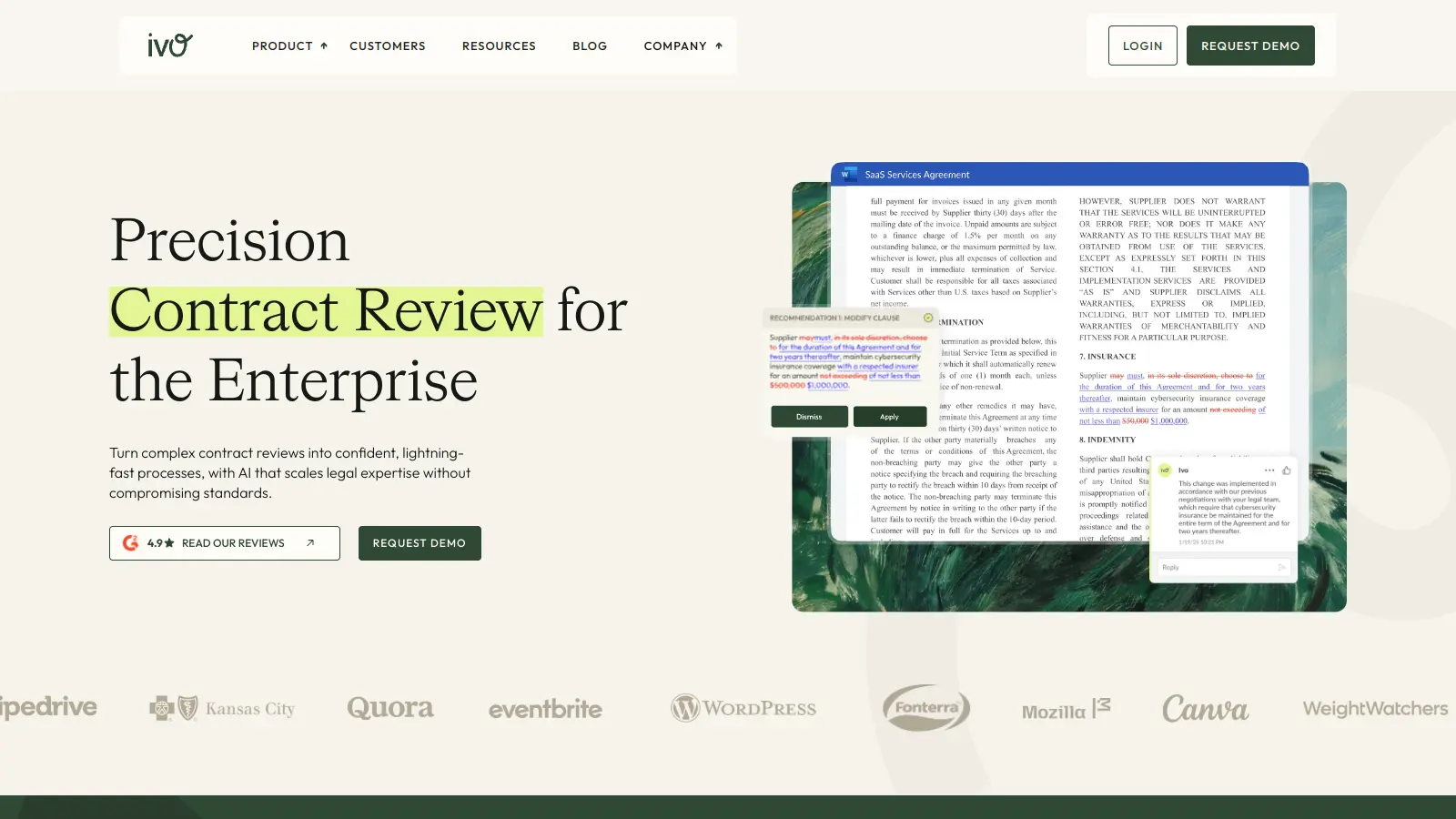
Ivo AI is an advanced AI-powered contract review and intelligence platform designed to help legal teams efficiently analyze, redline, and manage agreements. It integrates directly into Microsoft Word and includes a centralized contract repository that uses agentic AI to surface business insights, detect contract relationships, and enable plain-language queries across all agreements.
best deal
Schedule a personalized demo to see how Ivo's AI-powered contract intelligence can reduce your legal team's contract cycle times.

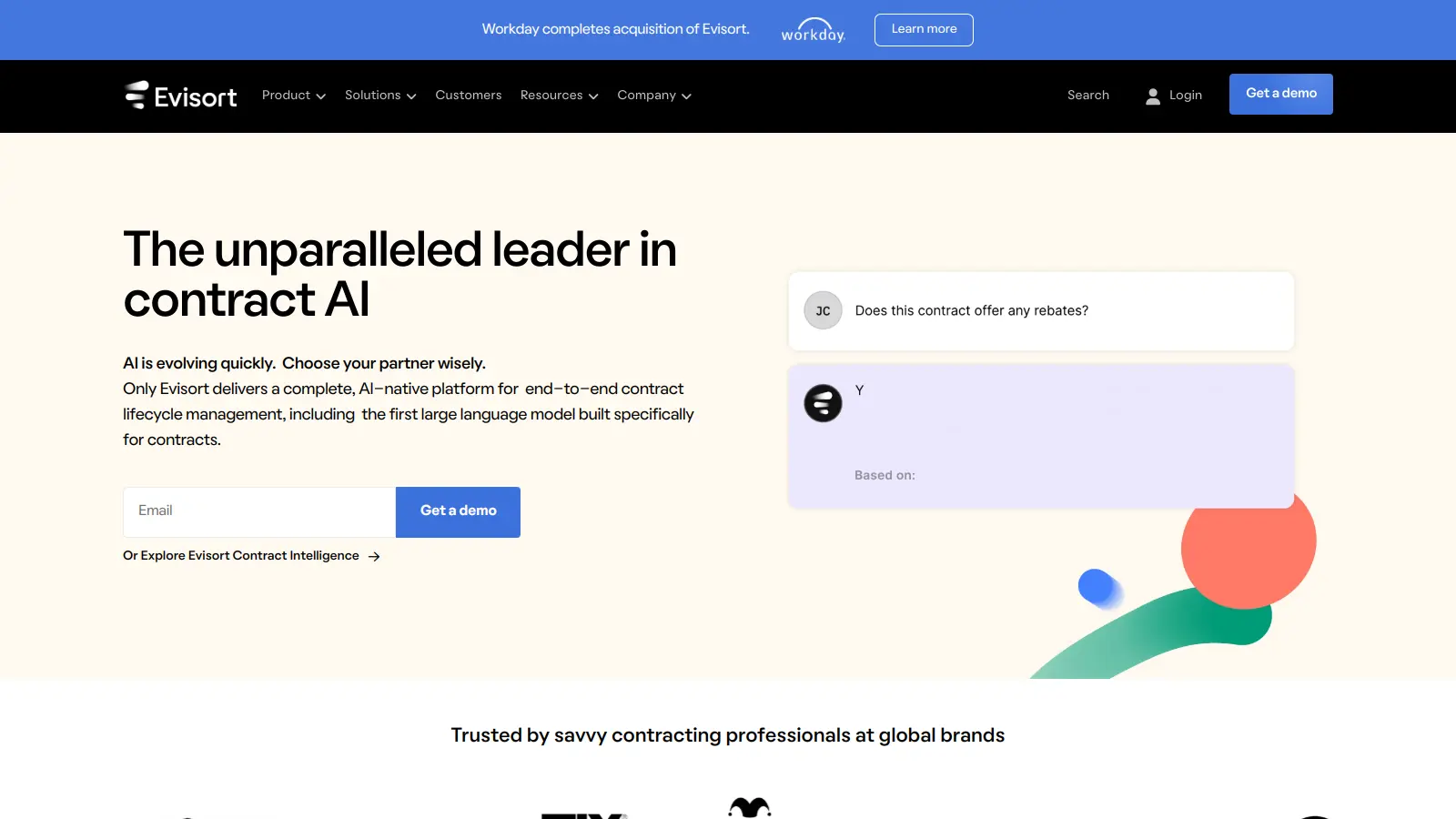
Evisort is an AI-powered contract management platform that helps enterprises streamline their contract lifecycle. Utilizing advanced artificial intelligence trained on millions of contracts, it offers features like intelligent contract analysis, automated drafting, multi-system integration, and comprehensive contract repository management. Best suited for midsize and enterprise organizations, Evisort excels in AI-driven contract processing but has limitations in customization and international support.
best deal
Request a Demo | Starting from $15k/year for AI-powered contract management

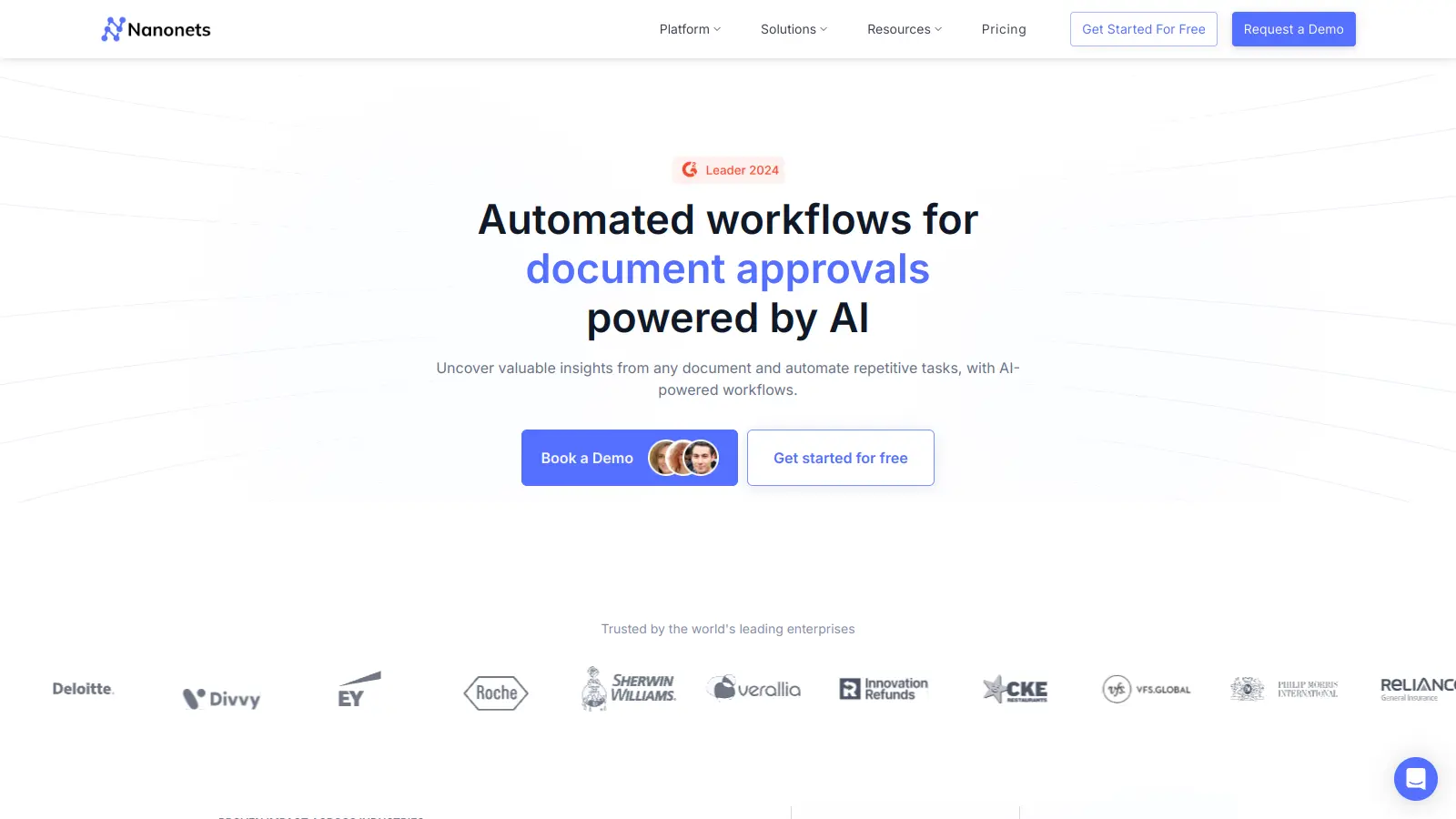
Nanonets is an AI-powered platform that automates document processing and data extraction using OCR and machine learning. Founded in 2017, it helps businesses across finance, healthcare, logistics, and retail streamline operations by extracting structured data from PDFs, images, and emails, customizing workflows, and integrating with existing systems.
best deal
Start for free with $200 in credits, then pay $0.30 per page with no monthly fee

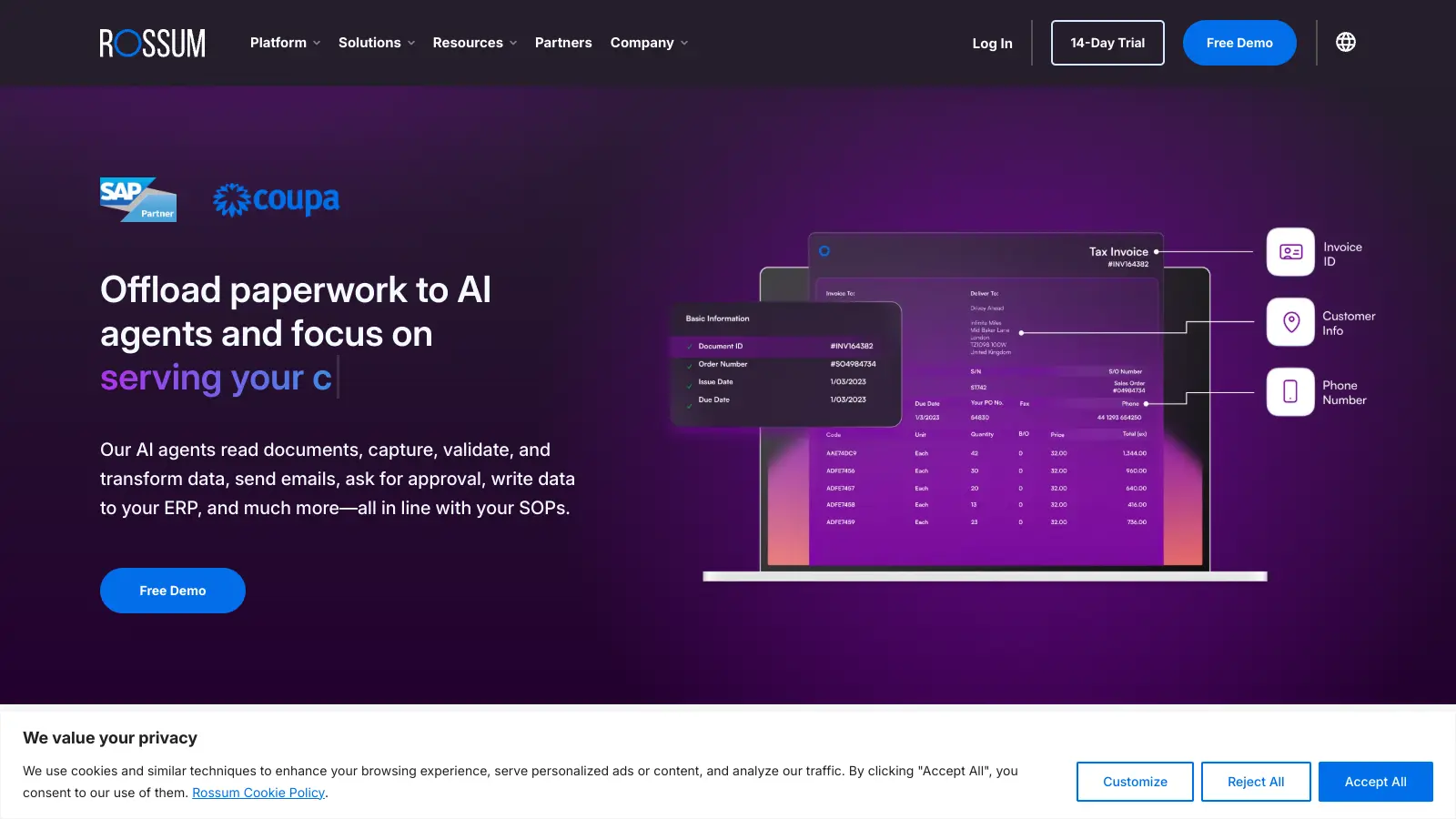
Rossum is an AI-powered Intelligent Document Processing (IDP) platform that automates document processing workflows. Founded in 2017, it uses machine learning and deep learning to extract data from documents without requiring templates. The platform offers over 98% accuracy, supports 276 languages including handwriting, and provides continuous AI improvement, enabling businesses to reduce manual intervention and save time across multiple industries.
best deal
14-day free trial available, no credit card required. Paid plans start at $18,000/year with unlimited users.