Ai Powered Contract Analysis Platform+2 more

eBrevia
best deal
Get a 14-day free trial with no credit card required - test AI-powered contract analysis today
redeem now
eBrevia
best deal
Get a 14-day free trial with no credit card required - test AI-powered contract analysis today
redeem nowWe start with direct ratings from our readers, then look at what real users are saying in practitioner forums and community spaces. We pair that with search demand data and profession-level persona analysis.
Editorial note: this was originally published in june of 2024
quick take
based on real user feedback, community sentiment, pricing value, and fit for target audience. see our full methodology
used eBrevia? we'd love to know your thoughts
reader ratings shape our score
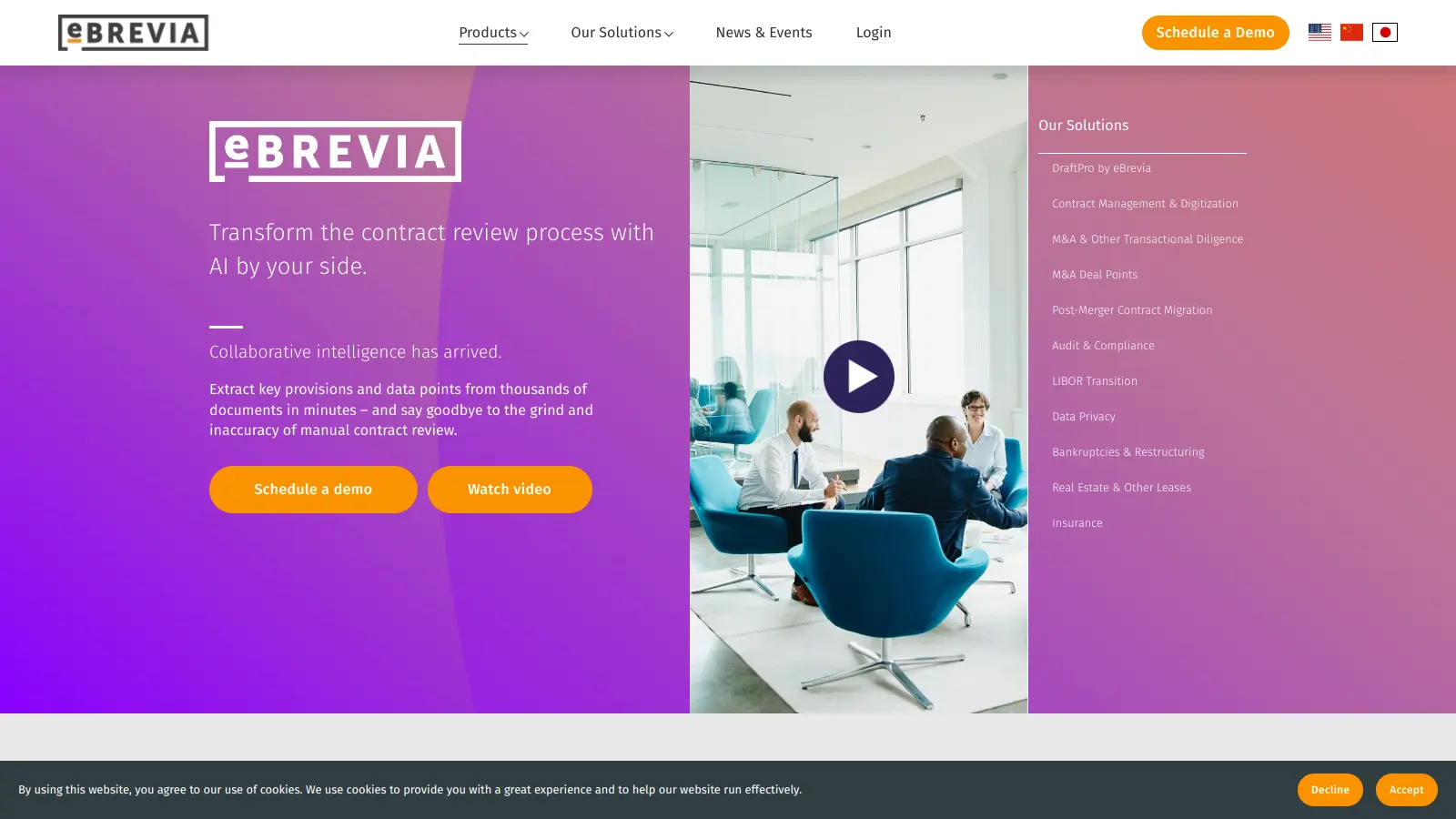
eBrevia is an AI-powered contract review and management tool that helps legal teams and businesses process large volumes of documents efficiently. The software uses natural language processing and machine learning to analyze contracts and extract important data automatically.
Founded in 2011 as a project at Columbia University, the platform serves law firms, corporations, and consulting companies. Clients include Baker McKenzie, Norton Rose Fulbright, SAP, Intel, PwC, EY, Kroll, and MUFG. The software can scan over 50 documents per minute while maintaining high accuracy levels. Users can customize the tool to detect specific provisions and data points relevant to their needs.
The system offers both cloud and on-premise options, integrating with over 2,000 business tools through eBrevia Connect, including SharePoint, Box, Salesforce, iManage, and DocuSign. Security features include strong encryption and SOC 2 Type 2 certification. Recently, eBrevia expanded its offerings with DraftPro, a tool that helps create and manage agreements using an extensive clause library, and eBrevia Lens, which uses generative AI to answer natural language queries across documents.
Pricing varies based on document volume, with custom enterprise licenses available. A 14-day free trial is available with no credit card required, giving teams a chance to test the platform before committing to a purchase.
monthly search interest
260/mo now
eBrevia peaked at around 720 monthly searches in early 2024 and has since declined to roughly 260 by late 2025, a drop of more than 60% from peak. The pattern suggests the tool caught some tailwind from the broader AI contract review hype cycle in 2023 and 2024, and is now settling back toward its core audience of legal professionals actively evaluating enterprise tools. With 260 searches a month, this is a niche product serving a narrow market, not a mainstream one. The hype has passed, which actually makes it a better time to evaluate it: you're seeing the real product now.
Whether eBrevia is worth it depends almost entirely on your volume and your role. Pick your type below to see the honest breakdown for your situation.
overall sentiment
select your role to see what people like you are saying
Corporate In-House Counsel
mixedIf your legal team regularly deals with large contract portfolios or compliance reviews, eBrevia's trainable AI is a genuine time-saver. It learns your company's specific clause language over time and connects to over 2,000 systems. The catch is the admin interface: it's clunky, and there's no multi-level approval workflow, so complex review governance requires workarounds. Worth it at volume; hard to justify for lighter use.
strengths
concerns
Law Firm Partner/Associate
mixedFor client-facing contract review and due diligence, eBrevia's speed is real: it processes documents fast and the tagging system requires minimal onboarding. You'll likely need someone to own the technical setup, because the admin dashboard is not intuitive. Deployment at major firms like Baker McKenzie gives it credibility, but the lack of multi-attorney approval workflows is a gap if your review process has multiple sign-off stages.
strengths
concerns
Due Diligence / M&A Analyst
positiveThis is where eBrevia earns its price. If you're running a deal that involves thousands of contracts across weeks rather than months, the processing speed and customizable clause extraction directly affect your timeline. The admin interface will slow you down during setup, and multi-level approval workflows are absent, which matters when you have a cross-functional deal team. Run a pilot on your actual document types before committing.
strengths
concerns
Legal Operations Manager
mixedeBrevia fits well in a legal ops stack if your primary goal is reducing manual review time at volume. The 2,000+ system integrations and trainable AI are genuine advantages for building repeatable workflows. The administrative interface is the biggest operational friction point, and the lack of approval workflow depth means you may need to build governance processes around it rather than inside it. Budget and volume thresholds matter: the per-document pricing only makes sense above a certain scale.
strengths
concerns
“At roughly $10,000 per 1,000 documents reviewed, eBrevia only makes sense if you're processing high volumes in compressed timescales. For occasional contract review, the cost per document makes no sense at all.”
Public community discussion on eBrevia is essentially nonexistent. There are no Reddit threads, no independent blog posts, and no forum debates to draw from. That silence is itself informative: this is enterprise legal software that gets evaluated in private procurement cycles, not Reddit comment sections. What's available comes from the tool's own positioning and the realities of its pricing structure. At roughly $10,000 per 1,000 documents reviewed, eBrevia is priced squarely at large law firms and corporate legal teams running M&A due diligence at volume. For teams processing thousands of contracts in a compressed deal timeline, that cost-per-document calculus can work out. For smaller teams or occasional use, it doesn't come close to adding up. The administrative interface draws consistent criticism in structured evaluations: it's described as cumbersome, and the absence of multi-level approval workflows is a real gap for any firm running complex multi-attorney reviews. Deployment at firms like Baker McKenzie signals enterprise-grade reliability, but there's no meaningful public record of how smaller or mid-market teams get on with it.
For the right use case, yes. At approximately $10,000 per 1,000 documents, it's only cost-effective if you're processing high volumes in compressed timescales, such as M&A due diligence or large compliance reviews. For a team reviewing a few dozen contracts a month, the cost per document makes no sense. Enterprise licensing is negotiated individually, so the actual number you pay depends on your volume commitments. If you're not regularly handling thousands of documents, look elsewhere.
Due Diligence and M&A Analysts get the clearest value: the ability to process thousands of contracts quickly and extract deal-critical clauses is the core case the tool was built for. Corporate In-House Counsel running compliance reviews or contract portfolio work also fit well, particularly when they need trainable AI that learns company-specific language. Law Firm Partners and Associates benefit from the speed on client deliverables, though the administrative complexity means someone needs to own the technical setup.
Two limitations come up consistently. First, the administrative interface is genuinely cumbersome: setup and configuration require real technical investment, and the dashboard complexity can slow down teams that need to iterate quickly. Second, there are no multi-level approval workflows, which is a serious gap for any firm running reviews that require multiple attorneys or cross-functional sign-off before a document moves forward. Public documentation and community support are also thin, so when something breaks or behaves unexpectedly, you're largely on your own or waiting on vendor support.
Both tools do high-volume contract extraction with trainable AI, and both are enterprise-grade. Kira has a longer market track record and, since the Litera acquisition, a broader document workflow ecosystem. If your firm is already using other Litera products, the integration argument for Kira is strong. eBrevia is the better choice if you want a standalone contract review tool with a clean per-document pricing model and you don't need the broader platform. For pure M&A due diligence throughput, the tools are comparable enough that your pilot results on your own document types should drive the decision rather than the brand name.
Yes, and this is one of its genuine strengths. The AI is trainable on company-specific or deal-specific clause language and risk profiles, which means it gets more accurate for your use case over time rather than relying on generic legal models. The catch is that the administrative interface is where you do this training, and that interface is the most-cited friction point. Expect to invest setup time upfront, and ideally have someone internally who owns the configuration. The 14-day free trial is worth using specifically to test how well the training workflow fits your team's capacity before you commit.
toolsforhumans editorial team
Reader ratings and community feedback shape every score. Since 2022, ToolsForHumans has helped 600,000+ people find software that holds up after launch. how we research →
is this your tool?
claim your listing to update details, respond to our review, or upgrade to a featured partnership.
claim this listing →
Harvey AI is an AI platform built for legal professionals, offering AI-powered legal research, contract analysis, document drafting, and clause extraction. Trained on legal datasets, it helps lawyers automate complex workflows, enhance research capabilities, and improve efficiency across multiple practice areas.
best deal
Join the waitlist to explore Harvey AI's legal solutions starting at approximately $500 per lawyer annually

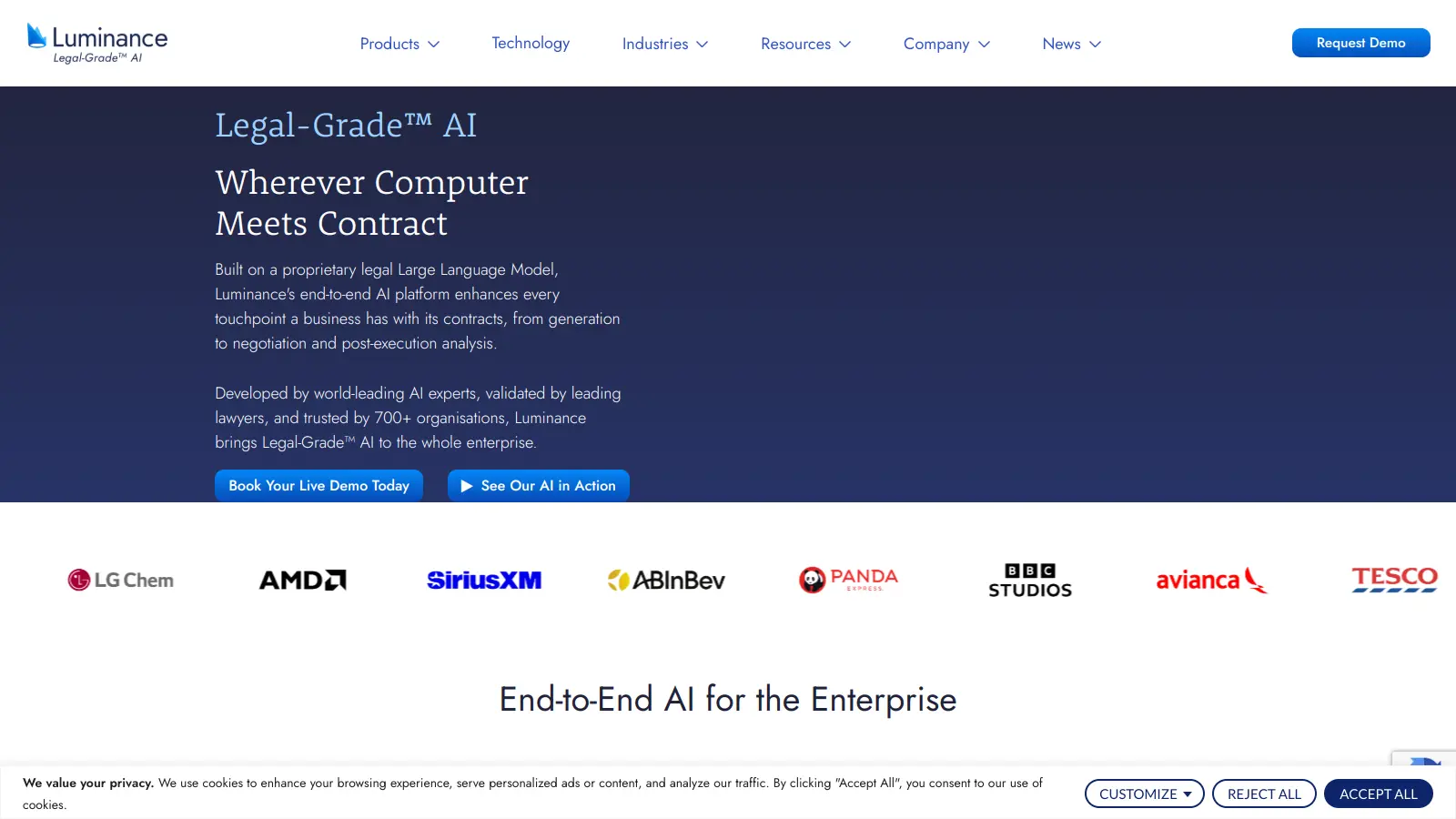
Luminance is an AI-powered legal technology platform that automates contract management, review, drafting, and negotiation using its proprietary Large Language Model. Founded in 2015 by Cambridge mathematicians, it serves over 1,000 organizations worldwide including law firms, corporate legal teams, and global consultancies. The platform offers deep document analysis, integration with Microsoft Word, and AI-driven features that reduce contract processing time while ensuring compliance and data security.
best deal
Get Your Personalized Luminance Quote And See How AI Legal Tools Can Transform Your Contract Management

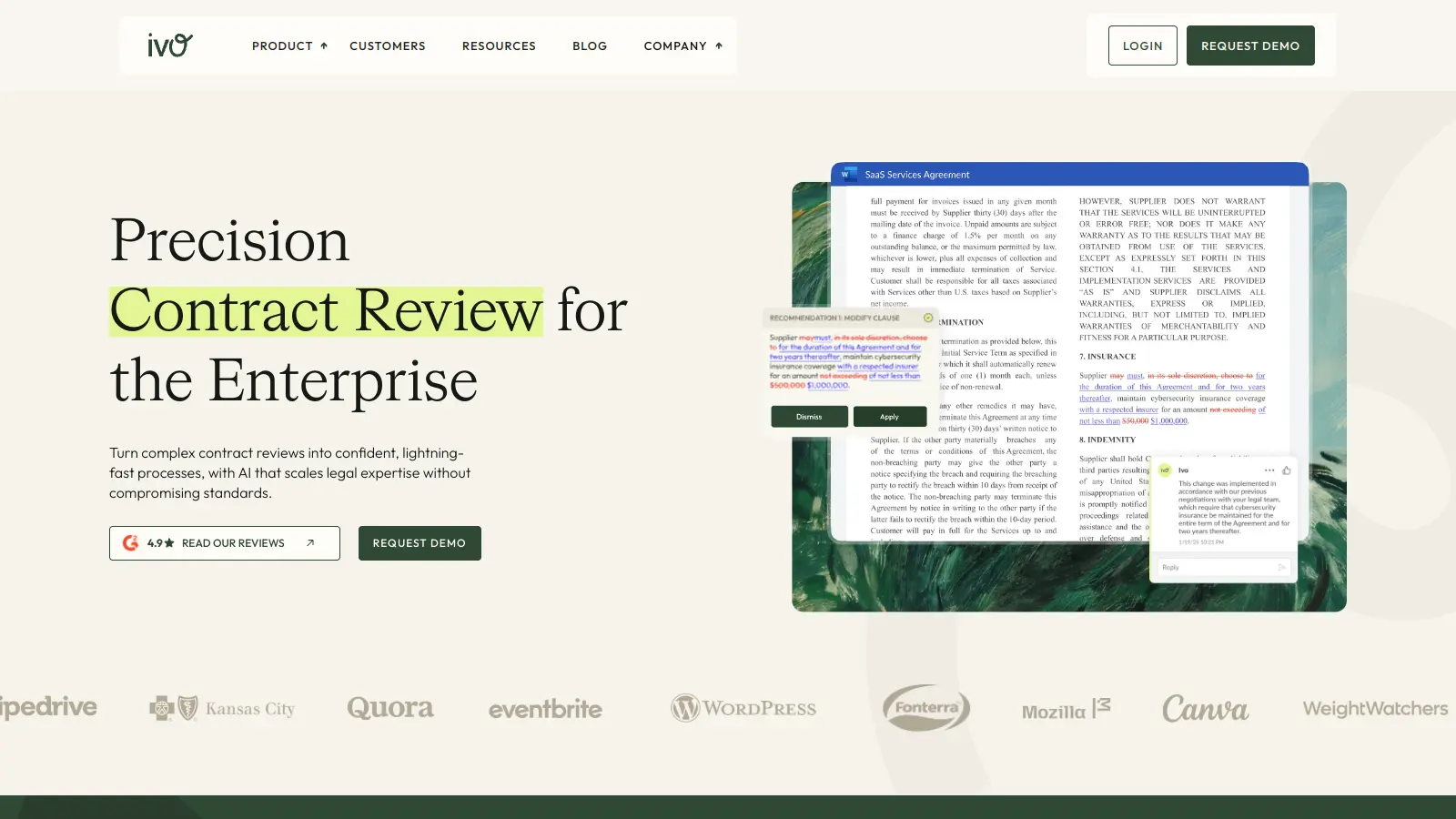
Ivo AI is an advanced AI-powered contract review and intelligence platform designed to help legal teams efficiently analyze, redline, and manage agreements. It integrates directly into Microsoft Word and includes a centralized contract repository that uses agentic AI to surface business insights, detect contract relationships, and enable plain-language queries across all agreements.
best deal
Schedule a personalized demo to see how Ivo's AI-powered contract intelligence can reduce your legal team's contract cycle times.

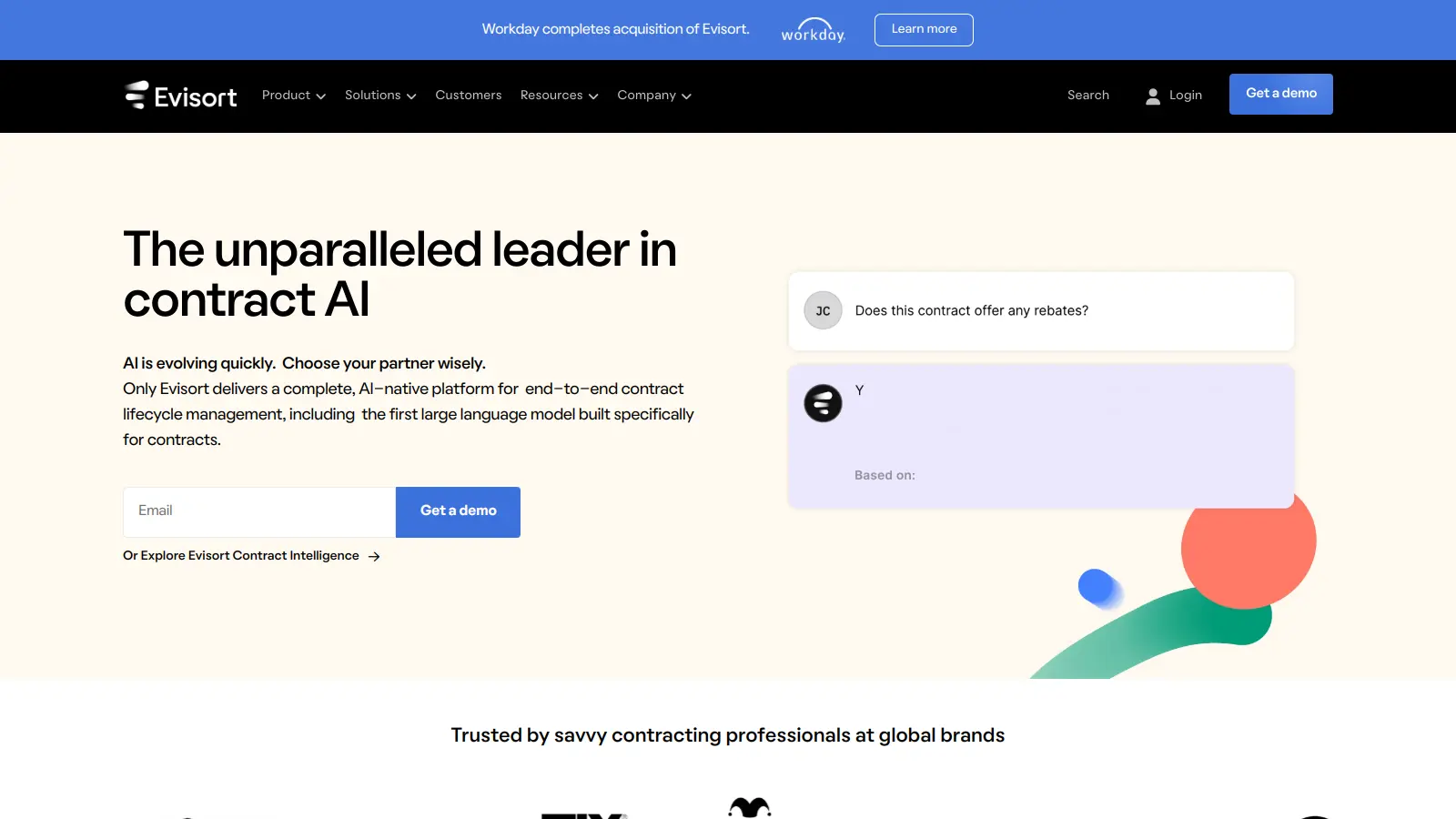
Evisort is an AI-powered contract management platform that helps enterprises streamline their contract lifecycle. Utilizing advanced artificial intelligence trained on millions of contracts, it offers features like intelligent contract analysis, automated drafting, multi-system integration, and comprehensive contract repository management. Best suited for midsize and enterprise organizations, Evisort excels in AI-driven contract processing but has limitations in customization and international support.
best deal
Request a Demo | Starting from $15k/year for AI-powered contract management

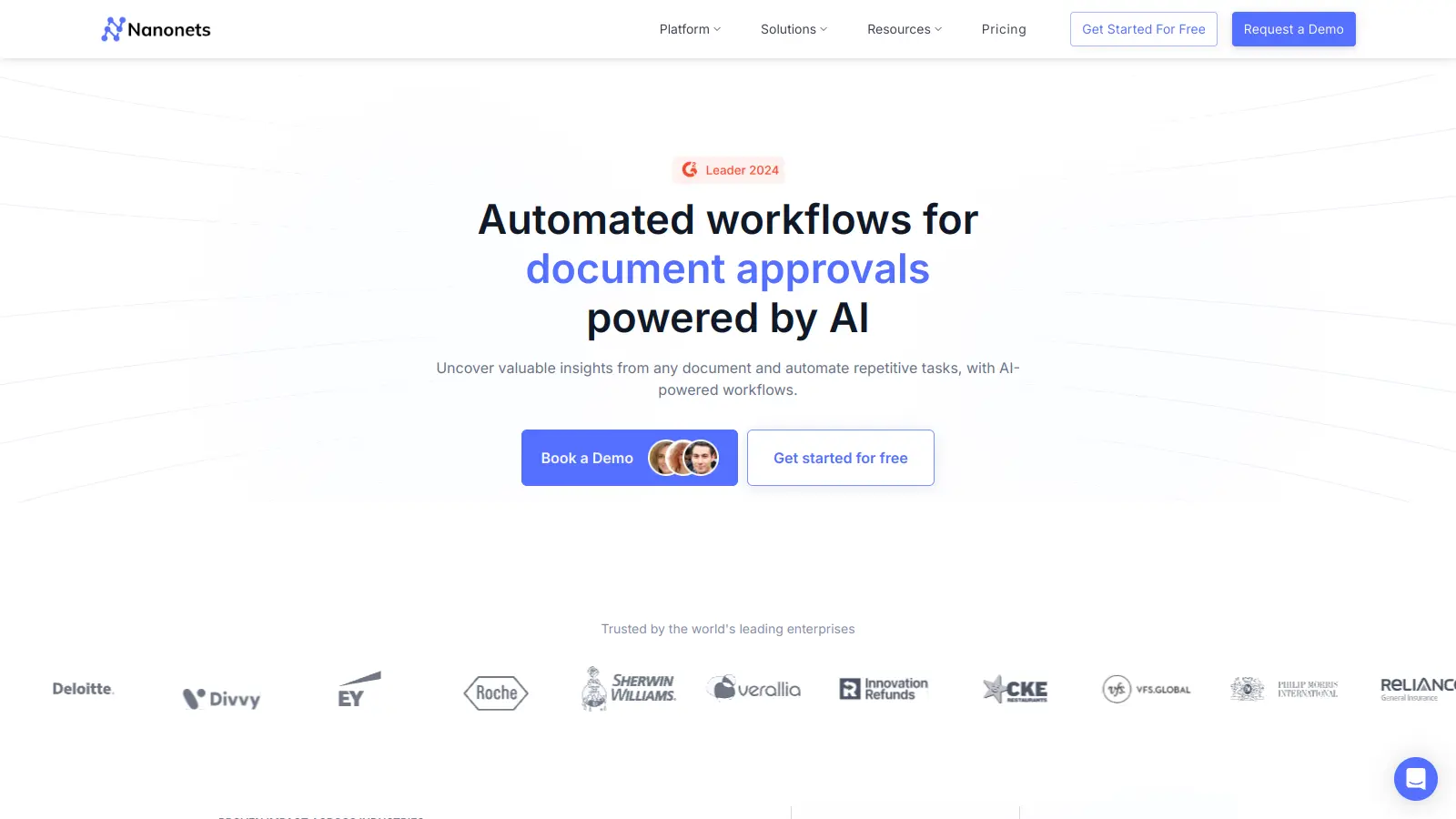
Nanonets is an AI-powered platform that automates document processing and data extraction using OCR and machine learning. Founded in 2017, it helps businesses across finance, healthcare, logistics, and retail streamline operations by extracting structured data from PDFs, images, and emails, customizing workflows, and integrating with existing systems.
best deal
Start for free with $200 in credits, then pay $0.30 per page with no monthly fee

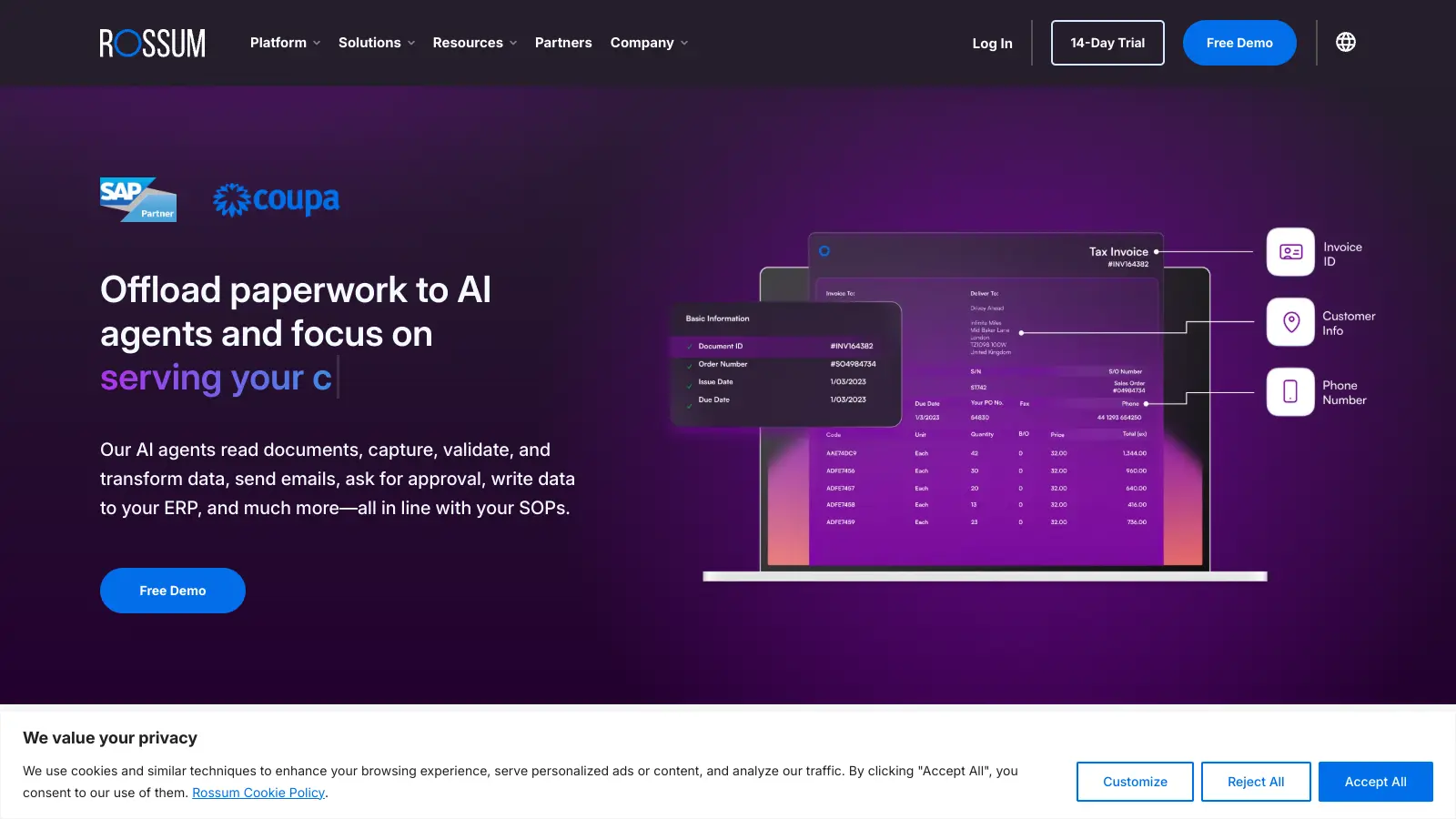
Rossum is an AI-powered Intelligent Document Processing (IDP) platform that automates document processing workflows. Founded in 2017, it uses machine learning and deep learning to extract data from documents without requiring templates. The platform offers over 98% accuracy, supports 276 languages including handwriting, and provides continuous AI improvement, enabling businesses to reduce manual intervention and save time across multiple industries.
best deal
14-day free trial available, no credit card required. Paid plans start at $18,000/year with unlimited users.