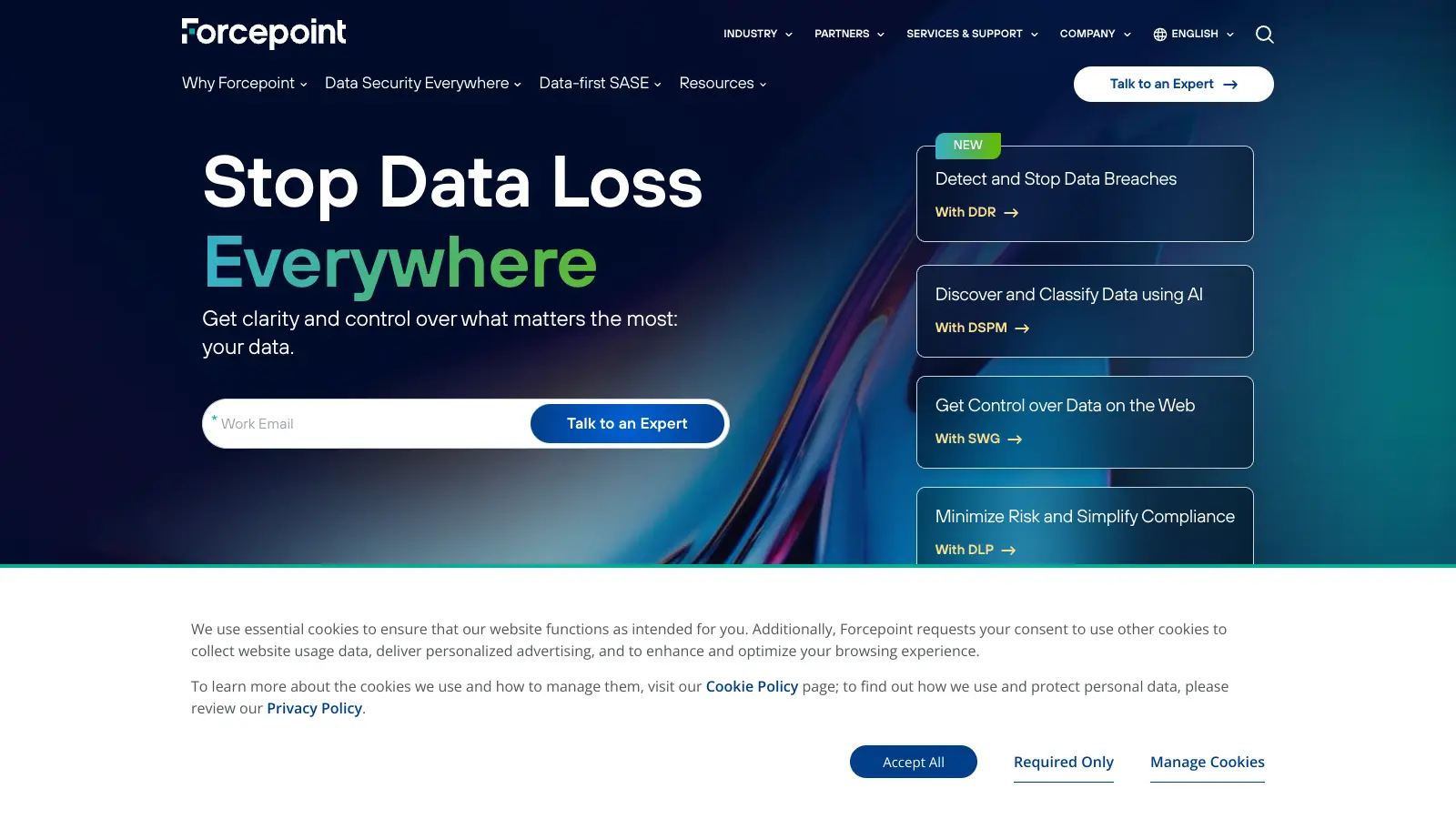
Forcepoint provides AI-powered cybersecurity solutions that protect data across cloud, web, email, and endpoint platforms. Founded in 1994 as NetPartners and later rebranded, the company now serves over 12,000 customers in both government and enterprise sectors.
The platform combines several key security elements into one unified solution called Forcepoint ONE. Its data loss prevention tools work to stop sensitive information from leaving your network, while behavioral analytics help spot potential insider threats. The system uses AI Mesh architecture to adapt its security responses based on real-time user behavior and context, which helps maintain protection without disrupting work.
Companies can manage their entire security setup through a single dashboard, making it simpler to enforce policies and monitor activity across all channels. The platform supports over 800,000 cloud applications and includes tools for maintaining compliance with data security regulations in over 80 countries. The AI classifiers and machine learning models scan data across AWS, Azure, Google Drive, SharePoint, and endpoints for automated discovery and classification.
Forcepoint offers their services through a subscription model called Forcepoint Advantage, which provides unlimited access to security solutions for a single per-user fee. The company claims this can reduce costs by over 30% compared to alternatives. While the initial setup requires some technical knowledge, the platform aims to streamline ongoing security management for IT teams.
Forcepoint works best for organizations dealing with sensitive data across multiple platforms, especially those facing regulatory requirements or insider threat risks.
The platform fits teams where data protection failures carry heavy costs—either in regulatory fines, reputation damage, or compromised customer trust.
Users praise Forcepoint's cloud security and DLP features for actually preventing data leaks. The visibility into user activities and threats gets good marks, as does deployment in enterprise environments. Integration with Microsoft 365 and other cloud apps works smoothly, and the threat protection maintains low false positive rates. The behavioral analytics for spotting insider threats catches problems other tools miss.
It's expensive. Smaller businesses struggle to justify the cost, and even larger organizations complain about the price tag. Configuration is complex with a steep learning curve. Some users report performance hits on endpoints that slow down work. Customer support response times are slow. The blocking can be overly aggressive, catching legitimate traffic along with threats. Frequent updates disrupt operations and require IT attention to manage.
Forcepoint's DLP helps stop sensitive data from leaving your company. It works across cloud apps, email, web, and devices. The solution uses AI and machine learning to spot risky behavior and can change protection levels based on what users are doing. Think of it as a security guard that watches all the doors where your data might exit, but gets smarter about who to stop based on their actions.
How does risk-adaptive protection work?Risk-adaptive protection watches how people use your systems and assigns risk scores through User and Entity Behavior Analytics (UEBA). If someone starts doing unusual things with sensitive data, the system notices and can step up security right away. For example, if an employee who never downloads customer lists suddenly tries to download thousands of records at 2 AM, the system might block the action or ask for extra verification. It's like having a security system that gets more careful when it spots weird behavior.
Can I use Forcepoint to protect data in cloud applications?Yes! Forcepoint extends protection to over 800,000 cloud apps through its Cloud Access Security Broker (CASB). This means your data stays safe whether it's in Office 365, Salesforce, Dropbox, AWS, Azure, Google Drive, SharePoint, or thousands of other cloud services. The system applies the same security rules across all these apps, so you don't need different policies for each one. You can block sensitive data from being uploaded or shared inappropriately, even when employees use their personal devices to access work apps.
How hard is it to set up and manage Forcepoint's security solutions?Setting up Forcepoint can take some work up front, and users report the configuration has a steep learning curve. You'll need to define what counts as sensitive data and set up policies, which might take a few weeks depending on your company's size. After that, you can control everything from the Forcepoint ONE unified console instead of jumping between different security tools. Having IT staff familiar with security tools will help smooth the process, as the complexity can be challenging for teams without strong technical expertise.
Does Forcepoint help with compliance requirements?Absolutely. Forcepoint comes with over 1,700 pre-built data classifiers that help you meet rules in more than 80 countries. Whether you need to follow GDPR in Europe, HIPAA for healthcare, or financial regulations, the system can identify and protect the right kinds of data. It can spot credit card numbers, patient information, and other sensitive data automatically using AI-powered classification. You'll also get reports that help prove to auditors that you're protecting data properly.


Our newsletter comes with exclusive discounts, trials and practical insights from within the industry