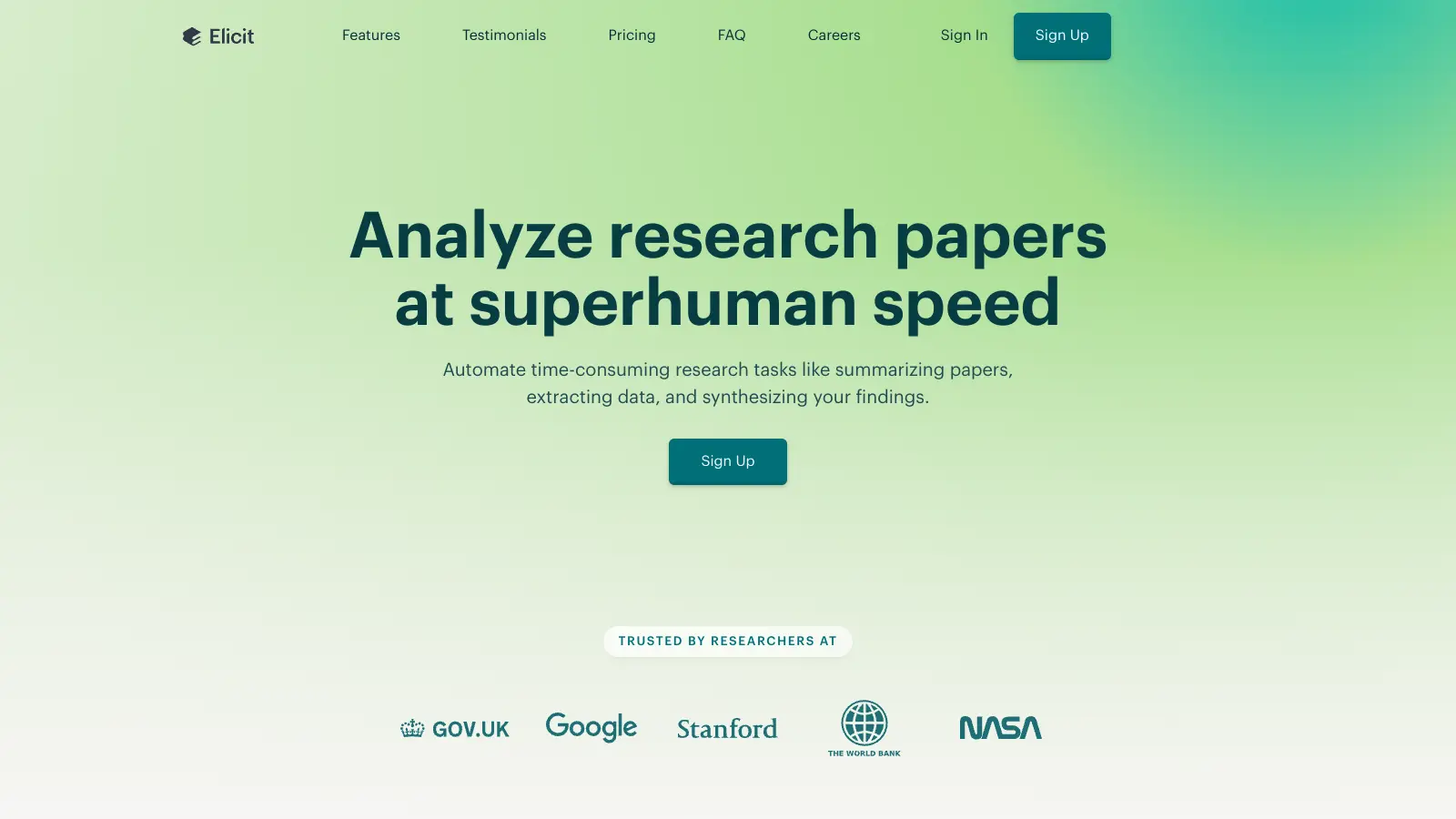
Elicit is an AI-powered research assistant that helps users streamline their academic research process. It finds relevant papers, pulls out important information, and helps make sense of complex data.
The platform uses language processing to understand research queries. It can search through 138 million academic papers from Semantic Scholar and other sources, using semantic similarity matching to identify relevant papers even without exact keyword matches. It creates summaries of key findings and can even help with systematic reviews. For organizing your work, it connects with reference management tools like Zotero.
Elicit handles literature reviews, data extraction from PDFs, and detailed research summaries. The Research Agent feature on Pro and higher plans can search beyond academic publications to include clinical trial data, regulatory documents, and press releases. The tool also offers team features for collaborative research projects.
The service comes with several pricing options. While there's a free basic plan for casual users, paid plans start at $12 per month for independent researchers. More comprehensive plans are available for professional researchers and teams who need advanced features and collaborative tools.
Elicit is suited for researchers, academics, and students who need to streamline their literature review process and save hours of manual research work. The AI research assistant finds relevant papers, extracts key information, and helps users make sense of complex academic information with minimal effort.
This tool is used by over 2 million researchers across academic disciplines including medicine, social sciences, computer science, and by professionals who need to stay current with research literature in their fields.
Elicit has been getting positive reactions from the over 2 million researchers using it. Users love its ability to quickly summarize complex research papers and navigate through academic literature with semantic search that finds relevant papers even without exact keyword matches. The tool's ability to save hours on literature reviews and generate high-quality summaries has been particularly praised. Many describe it as having a personal research assistant for finding papers in niche topics where Google Scholar falls short.
The free version has strict limits that push users toward paid plans quickly. At $12 per month or $120 per year for Plus, some researchers find the pricing steep for what they get. The tool occasionally misses highly relevant papers or includes irrelevant ones in results. It struggles with very recent papers or preprints not yet indexed in its database. The PDF upload feature is paywalled and sometimes produces inaccurate results. Customer support is slow and lacks phone or chat options, which frustrates users when they run into issues.
Elicit Plus offers more research power than the free Basic plan. Both give you unlimited search across 138 million papers. The Basic plan includes 2 Automated Research Reports per month and 2 columns per data extraction table. Plus lets you do more with 48 reports per year (delivered all at once if you pay annually), more columns for data extraction, and additional workflow features. The Plus plan costs $12 monthly or $120 yearly, making it a good fit for independent researchers who need more capacity.
Can Elicit help with systematic reviews?Yes! Elicit Pro and Team plans include special features for systematic reviews. The guided systematic review flow helps you search, screen, extract data, and generate reports - often cutting research time by up to 80%. Elicit can automatically extract key information from papers, organize findings into customizable tables, and help you track your progress. This makes it much easier to maintain consistency and thoroughness in your review process. The Pro plan includes 12 reports or systematic reviews per month (144 per year), unlimited high-accuracy columns, and the ability to analyze up to 20,000 data points and find up to 1,000 relevant papers at once.
How accurate is Elicit's data extraction from PDFs?Elicit's data extraction is highly accurate, especially when using the high-accuracy mode feature available on paid plans. High accuracy mode reduces errors by 50% compared to standard extraction. The system can pull both quantitative and qualitative data from PDFs, including information from tables and text. All extracted data includes sentence-level citations with exact quotes from the original sources, so you can verify everything. While no AI system is perfect, Elicit is designed to maintain research integrity by making the extraction process transparent and allowing you to check and edit any information it gathers.
Can I collaborate with my research team using Elicit?Collaboration features are available exclusively on the Elicit Team plan. This plan lets multiple researchers work together with collaborative live-editing and sharing of notebooks and systematic reviews. Your team can work on the same projects simultaneously, share findings, and maintain consistent research approaches. The Team plan also includes an admin panel for tracking usage across your group, unified billing, and priority support. It costs $79 per seat monthly or $780 per seat yearly with a minimum of 2 seats.
Does Elicit use semantic search or just keyword matching?Elicit uses semantic similarity matching, which means it can find relevant papers even without exact keyword matches. This is different from traditional keyword search tools. When you enter a research question, Elicit understands the meaning and context to identify papers that are conceptually related, not just ones that contain your exact search terms. This makes it much better at finding relevant research in niche topics or when you're not sure of the exact terminology used in a field. The system searches through 138 million papers from Semantic Scholar and other sources to return the 8 most relevant papers in a customizable table format.


Our newsletter comes with exclusive discounts, trials and practical insights from within the industry