Ai Content Generation Tool+2 more

AssemblyAI
best deal
Get free API access to start building with AssemblyAI, plus $50 in usage credits during a 90-day free trial on AWS Marketplace
redeem now
AssemblyAI
best deal
Get free API access to start building with AssemblyAI, plus $50 in usage credits during a 90-day free trial on AWS Marketplace
redeem nowWe start with direct ratings from our readers, then look at what real users are saying in practitioner forums and community spaces. We pair that with search demand data and profession-level persona analysis.
Editorial note: this was originally published in may of 2023
quick take
based on real user feedback, community sentiment, pricing value, and fit for target audience. see our full methodology
used AssemblyAI? we'd love to know your thoughts
reader ratings shape our score
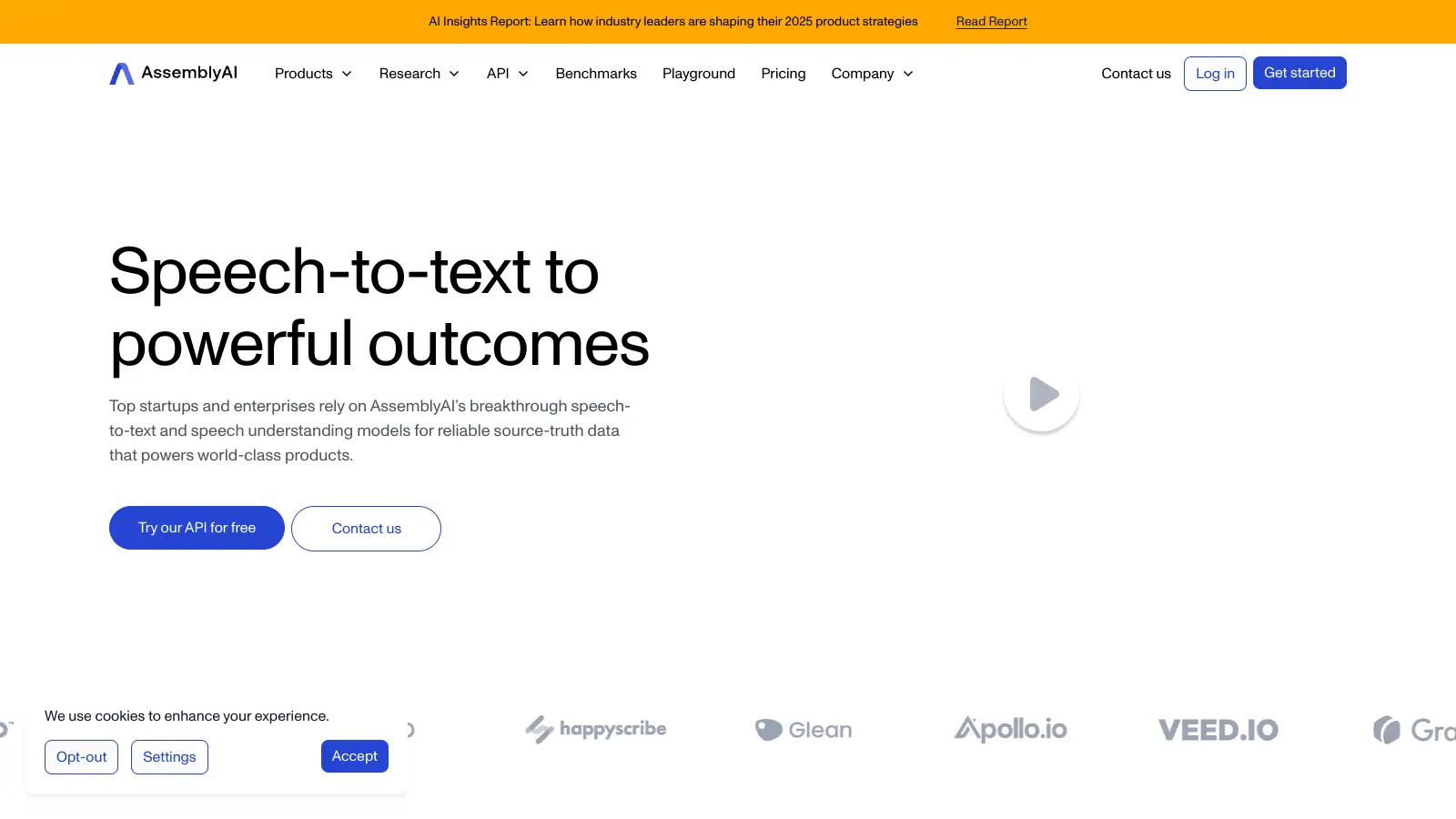
AssemblyAI makes it easy for developers and businesses to work with voice data through its speech recognition and audio analysis API. The platform handles tasks like turning speech into text, finding different speakers in conversations, and picking up on the emotions behind what people say.
The service helps companies make sense of their audio content, whether that's from customer calls, media files, or live conversations. The API transcribes speech with over 93% accuracy and works across 20+ languages. It also includes real-time transcription, automatic summarization of recordings, and content moderation through Voice AI Guardrails.
The platform follows GDPR, PCI-DSS, and SOC 2 standards for data security. For developers, the API comes with clear documentation and a no-code playground for testing before integration. The service provides free API access to start building, with pay-as-you-go pricing at $0.15 per hour for both pre-recorded and streaming transcription.
AssemblyAI needs an internet connection to work and doesn't offer mobile apps.
monthly search interest
2.4k/mo now
AssemblyAI's search interest grew steadily through 2022 and into early 2023, then settled into a relatively stable band for nearly two years before spiking to its highest point in mid-2025. That pattern suggests a core developer audience that keeps coming back, with the mid-2025 peak likely tied to renewed interest in voice AI and the Universal-3 Pro model launch. The slight pullback since the peak is normal post-launch settling, not a decline signal. It's a tool with a stable, technically engaged user base and it's still growing.
Whether AssemblyAI is worth it depends a lot on what you're actually building and how much accuracy variance you can tolerate. Pick your role below to see the honest breakdown for your situation.
overall sentiment
select your role to see what people like you are saying
Backend Developer / API Integration Engineer
positiveAssemblyAI is a strong default choice if you're integrating speech-to-text into an application and don't want to spend a week wrestling with documentation. The playground lets you verify output quality before writing a single line of integration code, and the $0.15/hour rate is genuinely competitive. The one real caveat: if you hit a production issue, don't expect a fast resolution from support.
strengths
concerns
Customer Service / Contact Center Manager
mixedFor call recording analysis, AssemblyAI does the core job well: it separates agent from customer, runs sentiment scoring, and turns around transcripts fast enough to support same-day QA workflows. Costs scale up when you add premium intelligence features across high call volumes, so run the numbers for your actual monthly minutes before assuming the base rate is what you'll pay. Accuracy with background noise or cross-talk still requires a human review layer for anything that feeds into coaching or compliance.
strengths
concerns
Content Creator / Podcaster / Journalist
positiveIf you're transcribing interviews or podcast episodes regularly, AssemblyAI is a cost-effective alternative to freelance transcription, and the accuracy across most accents and recording conditions means minimal post-editing for clean audio. Technical jargon and proper nouns will still need a manual pass, and very long recordings require splitting. The free tier is enough to test it on your actual content before spending anything.
strengths
concerns
Compliance / Security Officer
mixedAssemblyAI supports self-hosted deployment options for teams with data residency or privacy requirements, which clears the biggest barrier for regulated industries. That said, out-of-the-box accuracy for domain-specific terminology in healthcare or finance is a known weakness, and custom model options that close that gap come at higher cost. If your compliance use case requires verbatim accuracy for legal or regulatory records, build in a manual review step and evaluate the custom vocabulary features carefully during the free trial.
strengths
concerns
“If you're running it in production at scale and something goes wrong, slow ticket responses become a real operational problem.”
Community discussion about AssemblyAI is thin and skewed toward commercial comparisons rather than genuine user feedback. The available sources are competitor-authored pieces from Deepgram and Gladia, both positioning themselves favourably against AssemblyAI, so treat them as marketing with a footnote rather than independent analysis. What they do confirm is that AssemblyAI competes directly with Deepgram on accuracy benchmarks and pricing at the API level, and that the main axes of comparison are latency, multilingual support, and production-scale reliability. Developers who've written about AssemblyAI independently tend to highlight the documentation quality and the no-code playground as genuine time-savers during integration. The consistent criticism that surfaces is around support responsiveness when something breaks in production, and accuracy drops with heavy accents, background noise, or domain-specific jargon.
Yes, for most use cases. Pre-recorded transcription at $0.15/hour is competitive against Google Cloud Speech and AWS Transcribe, and the free tier includes enough credits to properly evaluate the service before committing. Where costs can climb is when you stack premium features like audio intelligence, custom vocabulary, or high-volume real-time streaming. If you're processing call recordings at scale in a regulated industry, build out the full cost model before assuming the base rate tells the whole story.
It's strongest for backend developers and API integration engineers who want clean documentation and a working integration quickly, and for customer service and contact center managers who need automated call analysis with speaker diarization and sentiment tagging. Content creators and podcasters doing regular volume also get good value, since it replaces expensive freelance transcription without requiring technical depth to use the API via third-party tools.
Two stand out. First, accuracy degrades noticeably with heavy background noise, overlapping speech, or specialized terminology in fields like healthcare and finance, meaning you'll still need manual review for anything high-stakes. Second, customer support response times are frequently flagged as slow, which matters a lot if you're hitting an unexpected outage or a production bug at an inconvenient moment. Long-form audio files can also require workarounds around batch limits.
Choose Deepgram if sub-300ms latency for real-time voice agents is your primary requirement, or if you need self-hosted deployment. Choose AssemblyAI if you want a broader suite of audio intelligence features out of the box, including sentiment analysis and topic detection, at a comparable price point. For async transcription with analysis layered on top, AssemblyAI has the fuller feature set. For raw real-time speed, Deepgram wins.
It's decent but not uniform. AssemblyAI supports 20+ languages and handles many accents well under clean audio conditions. The accuracy drops when accents are combined with background noise or when speakers talk over each other, which is common in podcast interviews and call recordings. If your content has a lot of non-native English speakers in variable recording conditions, run a representative sample through the free tier before committing, and factor in editing time for anything that needs to be publication-ready.
toolsforhumans editorial team
Reader ratings and community feedback shape every score. Since 2022, ToolsForHumans has helped 600,000+ people find software that holds up after launch. how we research →
is this your tool?
claim your listing to update details, respond to our review, or upgrade to a featured partnership.
claim this listing →
ChatGPT is an AI chatbot by OpenAI that uses language models to hold conversations, generate content, and complete tasks. It includes web browsing, image generation and analysis, voice interaction, autonomous task automation, and custom GPT creation. Available in multiple pricing tiers from free to enterprise, ChatGPT handles creative writing, data analysis, coding, and real-world automation.
best deal
Try ChatGPT Free: Basic AI conversations with GPT-5.2 Instant access (around 10 messages every 5 hours) at no cost.

Gemini is an advanced AI assistant by Google that processes text, code, images, audio, and video across Google's ecosystem. It offers content creation, coding assistance, research capabilities, and workflow automation through the Gemini app, web interface, and integrations with Google Workspace, Pixel phones, and Chrome.
best deal
Google AI Plus: Get 50% off at $3.99/month for the first 2 months (new subscribers); Google AI Pro: Try free for one month.

Microsoft 365 Copilot is an AI-powered productivity tool that integrates seamlessly with Microsoft 365 apps like Word, Excel, PowerPoint, and Outlook. It uses advanced language models and Microsoft Graph to provide intelligent, context-aware suggestions, automate tasks, and enhance collaboration by generating content, analyzing data, and offering real-time insights across various work processes.
best deal
Try Copilot Free: Experience basic AI assistance without Office integration

Claude is an AI assistant developed by Anthropic that handles coding, writing, and analysis tasks. It uses Constitutional AI for safety-focused interactions, supports multiple languages, and offers models like Sonnet and Opus with different capabilities. Claude prioritizes user privacy and context-aware responses.
best deal
Try Claude Free - 30-100 daily messages with code generation, image analysis, web search, and access to Claude's latest models

Perplexity AI is an AI-powered search engine that provides real-time, conversational responses to user queries. Founded in 2022, it uses natural language processing and large language models to deliver answers with source transparency. The platform offers multiple search modes, supports file and image uploads, and provides both free and paid plans for individual users and businesses.
best deal
Try Perplexity Free - Get unlimited basic searches with citations, 5 daily Pro Searches, and save your search history with access to basic AI models.

PhotoAI.me is an AI-powered platform that transforms personal photos into unique, high-resolution images across 100+ styles for various social media platforms. Users can upload a photo, select a themed package, and receive AI-enhanced images within hours, making profile personalization simple and quick for those seeking professional or creative profile pictures without advanced editing skills.
best deal
Transform your profile photo with 100+ AI styles starting at $19/month