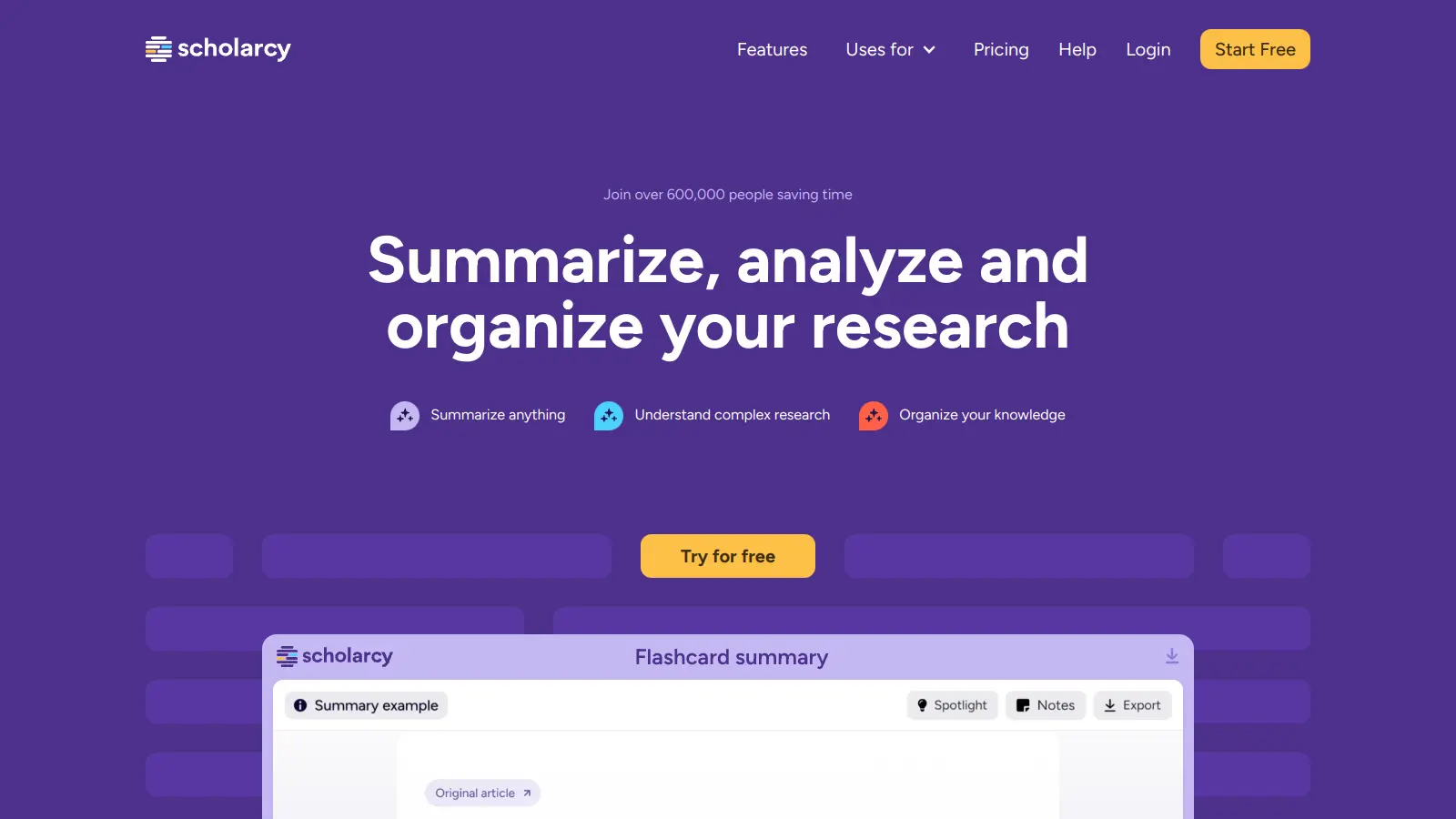
Scholarcy is an AI-powered research assistant that helps students, researchers, and scholars make sense of complex academic content. The tool transforms lengthy documents into flashcards and summaries.
This document analysis tool breaks down academic papers, book chapters, and research articles into interactive learning materials. It highlights key points, extracts references, and creates customizable summaries. The tool processes documents in seconds and can import from PDFs, DOCX files, URLs, and Zotero.
Students with learning difficulties like ADHD and dyslexia will find Scholarcy helpful. The structured approach to presenting information reduces distractions and makes complex texts more approachable. It offers features like text-to-speech and adjustable text sizes.
Users can access basic features through a free plan, while paid subscriptions start at $9.99 monthly or $90 yearly. These premium plans unlock unlimited summarization, enhanced flashcard features, and the ability to create literature matrices. Institutional licenses are also available.
Whether you're screening research papers, preparing for exams, or conducting literature reviews, Scholarcy streamlines the academic reading process. The tool is available as a web app and browser extension, and integrates with Obsidian, Notion, and Excel.
Scholarcy is for anyone who needs to quickly understand and process academic content. This AI research tool saves time by transforming lengthy research papers into summaries and flashcards.
The tool is used across higher education, scientific research, and academic publishing where understanding complex information quickly matters.
Users like how much time Scholarcy saves when dealing with long research papers and articles. The flashcard feature is popular for quick study and revision, and the interface is easy to work with. Researchers and students handling heavy reading loads report that it highlights key points, figures, and references accurately. The integration with reference managers like Zotero is well-received.
The free version is too limited with its monthly summary cap. The paid subscription feels expensive for people who only need it occasionally. The tool sometimes misses context or nuances in complex scientific papers, and flashcards can oversimplify or inaccurately represent content. Some users report struggles with non-English languages or poorly formatted PDFs. Customer support response times can be slow.
The free plan lets you create up to 10 summaries per month with the ability to import file formats like PDFs and DOCX, but you can only export flashcards one at a time. The paid plans (starting at $9.99/month or with a 25% discount on annual billing) offer unlimited summarization, enhanced summaries, note-taking features, and the ability to organize flashcards into collections. With paid plans, you can also export up to 100 flashcards at once, create Literature Matrices, and generate one-click bibliographies. A 7-day free trial is available with no payment required upfront.
How does Scholarcy help students with learning difficulties?Scholarcy helps students with ADHD and dyslexia by isolating key facts in a format that reduces distractions. The flashcard system improves memory retention by presenting information in chunks that are easier to recall. The library and search functions help with organization, making it simpler to find and review important content. By making reading less daunting, it also helps decrease procrastination.
Can Scholarcy handle different types of academic content?Yes, Scholarcy works with PDFs, DOCX files, URLs, and can import directly from Zotero. It also extracts tables and figures from documents and can export them to Excel for easy reference. The tool provides section-by-section breakdowns, so you can focus on specific parts like methodology or results. This makes it useful for reviewing research papers, textbook chapters, and other academic materials.
How accurate are Scholarcy's summaries?Scholarcy uses AI to create its summaries, which are generally reliable for catching key points in academic papers. The "Robo-Highlighter" feature identifies important sections and phrases. You can customize summaries to different lengths and levels of detail based on your needs. The Research Quality Indicator helps you assess papers, and Dig Deeper question prompts support critical analysis. Some users report it occasionally misses context or nuances in complex scientific papers, so review the original text along with the summary for critical research.
Does Scholarcy integrate with other tools and platforms?Yes, Scholarcy integrates with several research and productivity tools. It works with Zotero for importing papers, and you can export data to Obsidian, Notion, and Excel. The browser extension lets you create summaries directly on web pages without leaving your browser. These integrations make it easier to fit Scholarcy into your existing research workflow and share information across the tools you already use.


Our newsletter comes with exclusive discounts, trials and practical insights from within the industry