tools for
humans

LlamaIndex reviews — what users really think

published 30 august 2023last updated 18 march 2026
how we review

we track global search demand across every software category, monitor what real users are saying online, identify which professions rely on each tool, and surface the questions people are actually asking. reviews are consistently updated and reviewed for reliability.

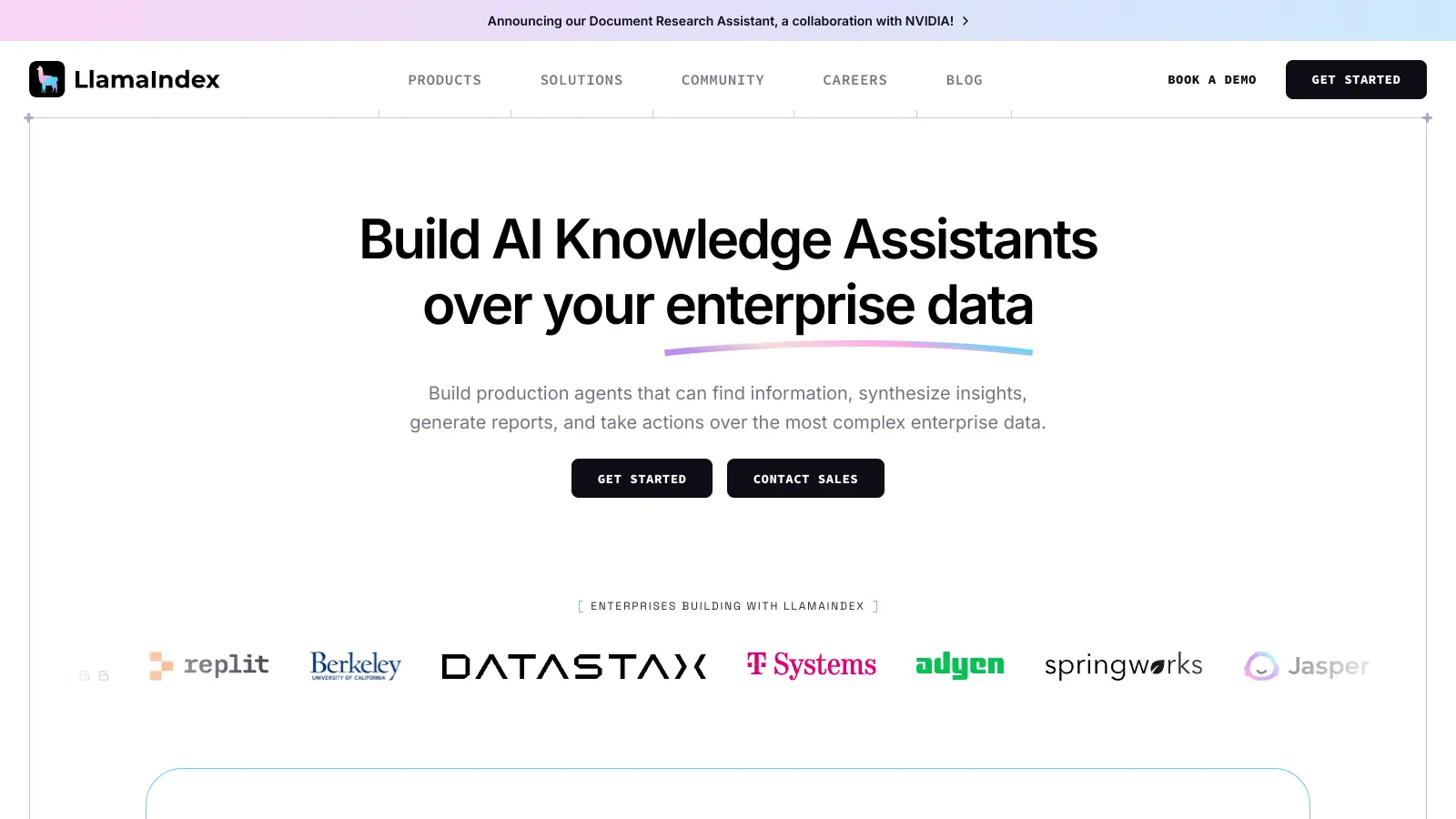
LlamaIndex is an open-source data orchestration framework that helps developers connect large language models (LLMs) with different data sources. It serves as a bridge between AI models and both private and public data, making it easier to build practical AI applications like document Q&A systems, chatbots, and knowledge agents.

The framework handles everything from PDFs and databases to APIs and documents. It offers tools for the complete process of working with LLMs: data loading, organizing, and searching. Through its built-in query and chat engines, users can interact with their data using natural language, while the system takes care of the technical details behind the scenes.

One of LlamaIndex's main strengths is its compatibility with over 160 data sources through LlamaHub, a collection of pre-built data connectors. The framework also includes AI agents with ReAct reasoning and OpenAI function calling, plus workflow capabilities for event-driven multi-step AI processes. It offers both high-level and low-level APIs to match different developer needs.

The framework itself is open-source and free to use. For managed services, LlamaCloud offers tiered pricing starting with a free tier that includes 10,000 credits per month (about 1,000 pages). LlamaCloud provides services like LlamaParse for document parsing, LlamaExtract for structured extraction, and managed indexing. Users can test their applications and estimate costs before committing to production use.

who is LlamaIndex for?

LlamaIndex is perfect for developers and data teams who need to connect large language models with their existing data sources quickly and efficiently. This open-source data orchestration framework saves countless hours of integration work while making it possible to create powerful AI applications that can access both public and private information.

  • AI Application Developers building products that reference company documents, databases, or APIs without starting from scratch
  • Data Scientists experimenting with LLMs using their own datasets without building complex data pipelines
  • Software Engineers with limited AI experience who need practical tools to integrate language models into existing systems
  • Technical Product Managers overseeing AI initiatives who need flexible, cost-effective solutions for connecting data to language models
  • Enterprise IT Teams creating internal knowledge bases or search tools that use both proprietary data and AI capabilities
  • Businesses building chatbots, Q&A systems, and intelligent agents that need to reference specific information

This tool is commonly used across industries like finance, healthcare, legal services, and technology, especially by teams building search applications, chatbots, or knowledge management systems.

overall sentiment

select your role to see what people like you are saying

AI Application Developer

positive

LlamaIndex directly addresses their core need to build production RAG applications quickly without reinventing data integration. The flexible connectors and query engines significantly reduce development time compared to building retrieval systems from scratch, though mastering the framework's abstractions requires upfront investment.

strengths

  • Seamless integration with multiple LLM providers beyond Llama models
  • Comprehensive data connectors for PDFs, databases, and various sources
  • Well-documented quickstart guides that accelerate time-to-production
  • Active community with frequent updates keeping the framework current

concerns

  • Steep learning curve due to numerous abstractions and design patterns
  • Performance degradation with large datasets without careful optimization
  • Some data loaders have bugs or incomplete format support

online reviews (last 6 months summarised)

Developers building RAG applications praise LlamaIndex for its easy integration with Llama models and other LLM providers, flexible data connectors for sources like PDFs and databases, and query engines that handle retrieval well. The documentation and quickstart guides get positive mentions, and many developers appreciate how it saves time compared to building retrieval systems from scratch. The active community and frequent updates keep the framework current.

The learning curve is steep due to many abstractions, especially for beginners. Performance issues crop up with large datasets without proper optimization. Some data loaders are buggy or lack support for certain formats. The framework is overly complex for simple use cases. Dependency conflicts with LangChain in some workflows cause headaches. The built-in evaluation tools are limited compared to what some teams need.

features

  • Extensive Data Ingestion: Connects large language models with over 160 data sources, including APIs, PDFs, SQL, and NoSQL databases through hundreds of pre-built data loaders via LlamaHub.
  • Advanced Vector Indexing: Transforms ingested data into vector embeddings with customizable indexing options, enabling semantic search capabilities and efficient storage in vector databases.
  • Natural Language Query and Chat Engines: Allows users to interact with indexed data using conversational prompts through dedicated query and chat engines, making complex data retrieval intuitive and straightforward.
  • AI Agents with ReAct Reasoning: Introduces intelligent agents with ReAct reasoning and OpenAI function calling that can ingest, modify, and process data from multiple tools, enhancing traditional retrieval-augmented generation (RAG) systems.
  • Flexible Document Management: Enables developers to insert, delete, update, and refresh documents within indexes, providing full control over data lifecycle management.
  • LlamaCloud Managed Services: Offers managed parsing with LlamaParse, structured extraction with LlamaExtract, and managed indexing and retrieval, simplifying deployment and scaling.
  • Event-Driven Workflows: Supports building multi-step AI processes with workflow capabilities that handle complex, event-driven operations across different stages of data processing.

pricing

  • The core LlamaIndex framework is open-source and free to use, with no direct base cost. Users incur expenses through underlying Large Language Model (LLM) calls during indexing and querying when using external LLM services.
  • LlamaCloud Free tier includes 10,000 credits per month (about 1,000 pages), agentic OCR, structured extraction, 1 user, 1 project, 5 indexes, 50 files per index, and basic support.
  • LlamaCloud Starter plan costs $0/month with 40,000 credits included, up to 400,000 pay-as-you-go credits with a $500 cap, 5 users, 1 project, 50 indexes, and 250 files per index.
  • LlamaCloud Pro plan costs $0/month with 400,000 credits included, up to 4,000,000 pay-as-you-go credits with a $5,000 cap, 10 users, 5 projects, 100 indexes, 1,250 files per index, Slack support, and 5x rate limits.
  • LlamaCloud Enterprise plan offers custom pricing with custom credits, unlimited users, projects, and indexes, volume discounts, Enterprise SSO, and dedicated support.

frequently asked questions

What data sources can LlamaIndex connect with?

LlamaIndex connects with over 160 data sources and formats. You can pull in data from PDFs, SQL databases, NoSQL systems, APIs, web pages, and many other sources. The tool comes with hundreds of pre-built data loaders through LlamaHub, making it easy to connect your custom data to large language models. This flexibility means you can bring almost any type of information into your AI applications without writing complex code.

How does LlamaIndex handle my queries?

When you ask LlamaIndex a question, it processes your natural language query through several steps. First, it searches through your indexed data using vector embeddings to find the most relevant information. Then it uses prompt engineering to format this information for the language model. The query engine takes care of retrieving and presenting the right data, so your questions get accurate answers based on your specific information. You can use different query engines depending on your data type, and there's also a dedicated chat engine for conversational interactions.

Do I need coding experience to use LlamaIndex?

You'll need some basic Python skills to use LlamaIndex effectively. The framework is designed to be developer-friendly, but it isn't a no-code solution. That said, many common tasks have simple patterns you can follow without deep programming knowledge. If you can write basic Python scripts and follow examples, you'll be able to set up data ingestion, indexing, and queries. The documentation includes plenty of sample code to help you get started, though beginners may face a learning curve due to the framework's many abstractions.

What's the difference between LlamaIndex and LangChain?

LlamaIndex focuses specifically on the complete data flow for RAG applications, from ingestion to indexing to querying. While LangChain is broader and handles many aspects of building LLM applications, LlamaIndex specializes in connecting models with external data sources. LlamaIndex offers more built-in data connectors and indexing strategies than LangChain. The two frameworks can work together, so you don't have to choose one or the other. Some developers use LlamaIndex for data handling and LangChain for orchestrating broader application logic.

How much does LlamaCloud cost and what's included?

LlamaCloud starts with a free tier that gives you 10,000 credits per month (about 1,000 pages), which includes agentic OCR, structured extraction, and basic support. If you need more, the Starter plan offers 40,000 credits with pay-as-you-go up to 400,000 credits capped at $500. The Pro plan includes 400,000 credits with a pay-as-you-go cap of $5,000, plus more users, projects, Slack support, and 5x rate limits. Enterprise plans offer custom pricing with unlimited resources and dedicated support. The core open-source framework remains free regardless of which cloud tier you choose.

other tools to check out

Miro screenshot
online buzz250k+ Searches
trend (1M)50%

Miro

Miro is an AI-powered visual collaboration platform with an infinite canvas for teams to brainstorm, plan, design, and manage projects. It includes real-time collaboration tools, AI features for automating tasks like organizing sticky notes and generating user stories, and integrations with 250+ apps.

best deal

Explore Miro's free plan with unlimited team members, 3 boards, 5 Talktracks, and 10 AI credits monthly

P
online buzz100k+ Searches
trend (1M)-18%

Purple Wave

Purple Wave is an AI-powered digital marketing tool that helps businesses and marketers automate marketing tasks, including creating sales funnels, email campaigns, websites, and mobile apps. With features like AI-driven content generation, Stripe integration, and no-code interfaces, it enables users to handle their marketing efforts without technical knowledge, offering pricing plans starting at $99 per month.

best deal

Get 40% off Purple Wave plans (up to $100 savings available)

InVideo screenshot
online buzz50k+ Searches
trend (1M)22%

InVideo

InVideo AI is an online video editing platform that uses AI to generate complete videos from text prompts, including scripts, visuals, voiceovers, and edits. It offers text-based editing, a library with 16M+ royalty-free media assets, voice cloning, and multilingual support. The platform serves 25 million users, from beginners to marketers and businesses, with free and paid plans.

best deal

Try InVideo AI's Free Plan: 2 video minutes and 1 AI credit weekly, 4 exports with watermark. Annual plans save 20%.

Namelix screenshot
online buzz25k+ Searches
trend (1M)28%

Namelix

Namelix is an AI-powered tool that generates short, brandable business names using advanced language models. It helps entrepreneurs and businesses create unique names by analyzing keywords and preferences, with features including domain availability checks, instant logo generation, and adaptive learning that refines suggestions based on user feedback.

best deal

Start Your Free Name Search - Generate AI Brand Names Instantly

Seamless.Ai screenshot
online buzz10k+ Searches
trend (1M)50%

Seamless.Ai

Seamless.AI is an AI-powered sales intelligence platform that helps B2B sales and marketing teams find verified contact information in real-time. Founded in 2015, it provides emails, direct phone numbers, mobile numbers, and company data to connect with decision makers. The platform includes a web app, Chrome extension, CRM integrations, and AI-powered outreach tools.

best deal

Try Seamless.AI free with 50 lifetime credits to find verified B2B contacts with real-time search