Lovable vs Replit: AI app builder vs cloud IDE (2026)
Editorial note: originally published in april of 2026

quick verdict
Lovable is the better pick for most non-technical builders and product-focused teams. It turns a plain-language description into a deployed full-stack app with predictable credit-based pricing and a visual editor that doesn't eat your budget.
If you already write code and want a cloud IDE with full language flexibility, Replit is the better choice because it gives you a real editor, a terminal, and support for 50+ languages that Lovable simply doesn't have.
choose Lovable if you want to ship a product without touching a terminal
visit lovablechoose Replit if you want to write and run code in the browser with AI assistance
visit replitpick your side
Lovable and Replit both use AI to help you build software faster, but they're solving different problems. Lovable is a no-code AI app builder that takes you from a text description to a deployed full-stack application. Replit is a cloud-based IDE that removes the friction of local setup and adds an AI agent on top.
This comparison covers pricing, AI autonomy, code quality, deployment, collaboration, and learning curve, so you can decide which tool fits your actual workflow rather than just the marketing pitch.
feature comparison
We collect first-hand reviews from people who use these tools every day — what works, what doesn't, whether it's worth paying for. We research pricing, features, and comparisons so that feedback has real context behind it. For this comparison, we paid particular attention to billing transparency and pricing predictability. Read our full research methodology.
pricing and billing
Lovable winsPro at $25/mo, visual edits free
$20/mo Core, effort-based billing with surprise charges reported
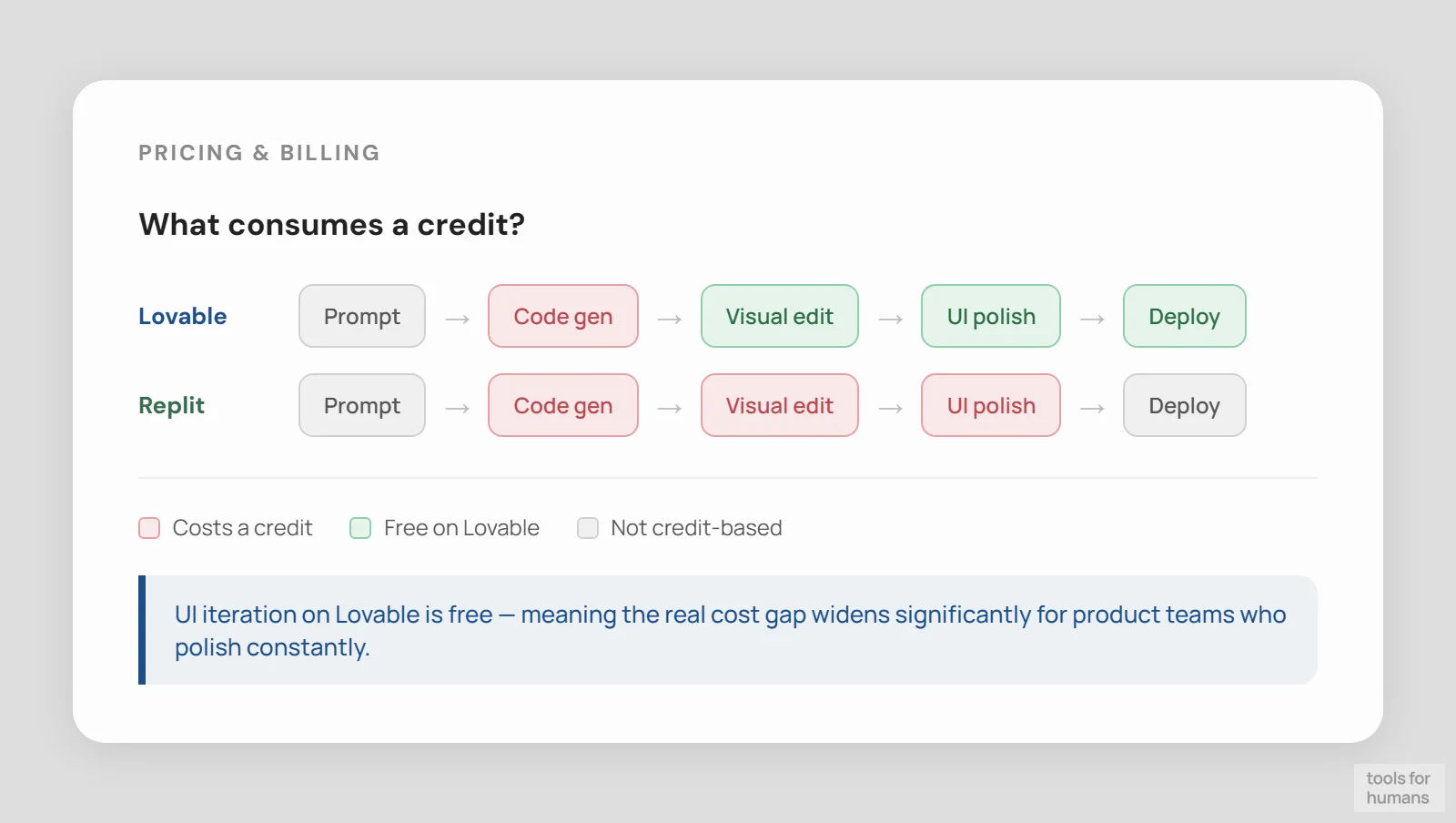
Lovable's free tier gives you a limited number of monthly messages, and the Pro plan costs $25/month. Critically, visual edits (color changes, font tweaks, spacing adjustments) consume zero credits, so UI polish doesn't drain your budget. That makes the effective cost of Pro much lower than the sticker price suggests for design-heavy work.
Replit's Core plan costs $20/month and includes $25 in monthly credits. The problem is that billing is effort-based: the same type of task can cost different amounts depending on complexity, and the Replit community forum has documented cases of users being charged $20-$50 per prompt and $300 in a single session after the Agent 3 rollout. Users also report charges for failed or idle agent actions.
Lovable's credit system isn't perfect either — complex agentic builds can burn through credits quickly — but the pricing model is more predictable. Replit's effort-based billing creates real financial risk for active builders, especially those who iterate frequently on agent tasks.
AI autonomy and agent quality
drawAgent Mode with prompt queue, codebase exploration, and verification
Agent 4 with parallel tasks and kanban-style task management
Lovable's Agent Mode handles full-stack changes end to end: it explores your codebase, writes code across multiple files, connects frontend to backend, runs tests, inspects console output and network requests, and verifies fixes before finishing. You can queue multiple prompts, reorder them, and repeat a prompt up to 50 times. Plan Mode lets you think through an approach before committing any credits.
Replit's Agent (now Agent 4) can also build applications from natural language and handles auth, database, and design in parallel. The kanban-style task view is a genuine differentiator for teams managing multiple concurrent features. Agent 4 also sequences requests intelligently rather than executing them in the order submitted.
Both agents are capable of producing working full-stack apps from a single prompt. Lovable's agent is tighter for solo product builders because the verification and debugging loop is built into the same workflow. Replit's agent is more suited to developer teams that want to manage tasks like tickets and maintain direct code access alongside AI-generated output.
language and platform support
Replit winsReact + Supabase only, web apps exclusively
50+ languages, mobile via React Native/Expo
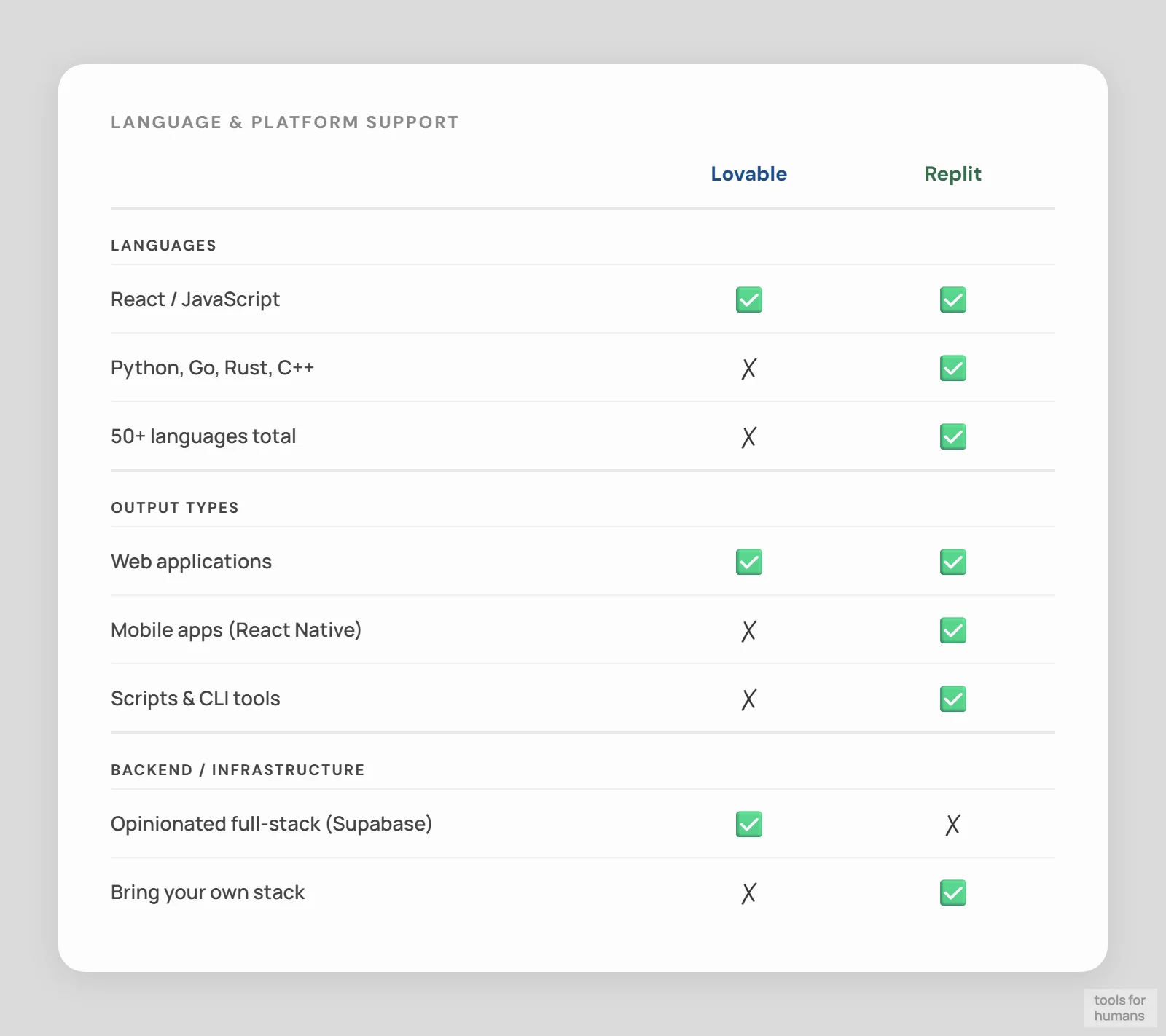
Lovable is focused exclusively on web application development. It generates React frontends backed by Supabase and doesn't support other languages or frameworks directly. If your project requires Python, Go, C++, or any backend language outside its stack, you'll hit a hard wall. There's no native mobile app output either — you'd need a wrapper to approximate a native experience.
Replit supports 50+ programming languages including Python, JavaScript, TypeScript, Go, C++, Java, Rust, and more, with pre-configured environments and package managers. It can generate React Native mobile apps with AI and deploy via Expo. For developers who switch languages frequently, work on backend-only projects, or need to prototype in a specific language, Replit has no real competition in this category.
This is the single biggest structural difference between the two tools. If your work lives outside the React/Supabase stack or involves anything other than web apps, Lovable simply isn't an option.
deployment and hosting
drawOne-click deploy, auto GitHub sync, Supabase backend
Built-in hosting, auth, database, monitoring from IDE
Lovable handles deployment as part of its core flow. You can publish a working app with one click, and every change syncs automatically to GitHub so there's always a code backup ready for a developer or for moving off the platform. The GitHub integration works without any Git commands. Supabase handles the database and auth backend automatically.
Replit also includes built-in hosting and deployment directly from the IDE. Apps go live from the same environment where you write code, and the platform includes authentication, database, and monitoring with zero additional setup. For developers who want to see their app running immediately without configuring a separate hosting service, Replit's all-in-one approach works well.
Both platforms handle deployment cleanly. Lovable's automatic GitHub sync is a meaningful advantage if you want an exit path or plan to hand off to a developer. Replit's deployment is tighter for developer-driven projects because the IDE and host share the same environment, making debugging live apps easier.
visual editing and UI control
Lovable winsClick-to-edit visual editor, zero credits for UI changes
New design space launched in 2025, less mature
Lovable has a direct visual editor that lets you click any element and change text, colors, fonts, margins, or layout in real time. These changes apply directly to the live application without writing a prompt, and they consume zero credits. For non-technical users who want to polish a UI without writing CSS or prompting the AI in circles, this is a significant quality-of-life feature.
Replit recently introduced a design space that lets you explore and tweak designs visually before applying them to your app. This is newer than Lovable's visual editor and less mature, but it does exist. Replit's primary interface is still a code editor, so visual changes outside that new design space require either manual code edits or AI prompts.
If UI iteration speed matters to you and you're not comfortable editing CSS or React components directly, Lovable's visual editor is meaningfully better. Replit's approach assumes you're comfortable in code when the AI falls short.
learning curve and target user
Lovable wins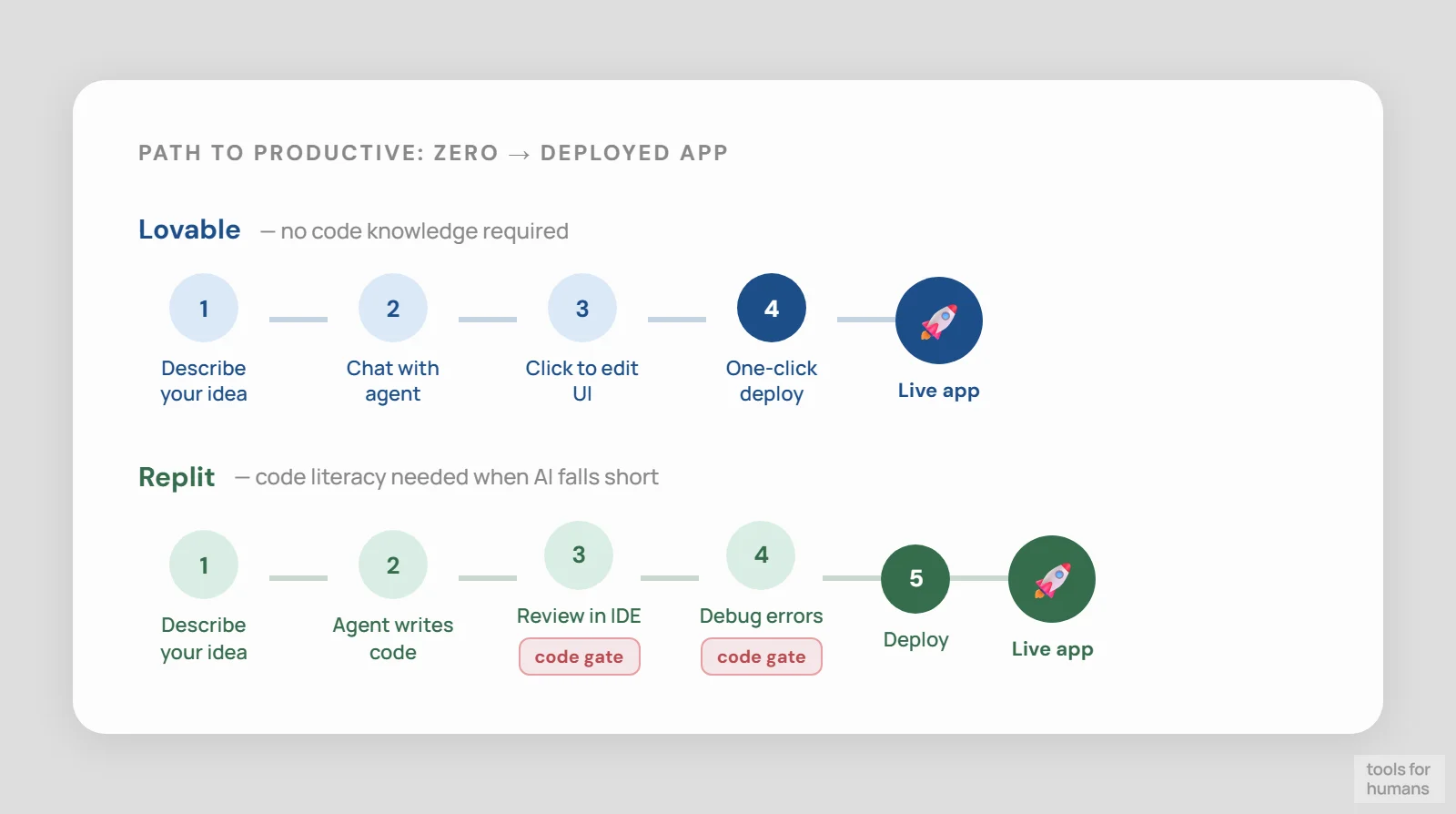
No coding required, chat-plus-click workflow
Cloud IDE, assumes code literacy for debugging
Lovable targets product builders, founders, and non-technical users who think in product descriptions rather than code. There's no terminal, no package manager, no syntax to learn. The entire workflow is chat-plus-click. A non-developer can go from idea to deployed app in an afternoon without writing a single line of code or understanding what React is.
Replit removes the friction of local setup but still assumes you're comfortable with code. You need to understand how files, terminals, and language-specific tooling work to get the most out of it. Its AI agent lowers the barrier significantly, but when the agent produces bad code, you're expected to debug it directly in the editor. Computer science students and junior developers are Replit's strongest audience for the AI-assisted workflow.
The gap matters most when things go wrong. In Lovable, you describe the problem and the agent fixes it. In Replit, you often need to read the code and understand what broke. That's a real difference in accessibility for non-technical users.
team collaboration
Replit winsGitHub sync for async collaboration, no live co-editing
Real-time co-editing, Agent 4 kanban, SSO/SAML on enterprise
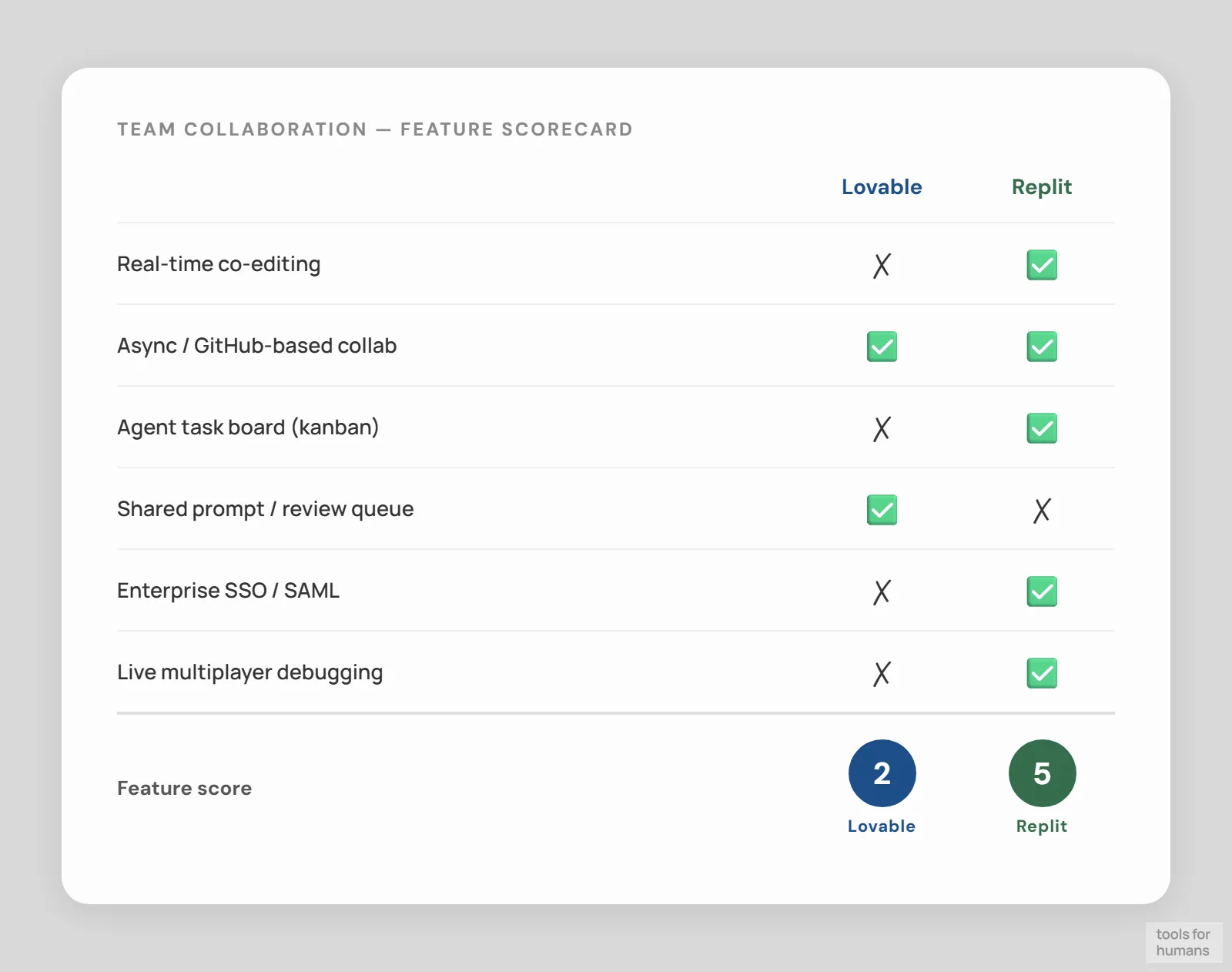
Lovable's collaboration features are primarily async: the GitHub sync means multiple people can work from the same codebase, and teams can manage iterations through the prompt queue. It's not built around real-time multi-user editing in the same session.
Replit has stronger real-time collaboration features. Multiple users can work in the same environment simultaneously, which is useful for pair programming or live code reviews. Agent 4's kanban task board is specifically designed for teams to submit and manage requests in parallel, with the agent sequencing them intelligently. Replit's enterprise tier also includes SSO/SAML and admin controls.
For solo builders and small founding teams, the gap isn't large in practice. But for engineering teams that want real-time co-editing, structured task management, and enterprise security controls, Replit is the better fit.
integrations and extensibility
Replit winsSupabase + GitHub natively, limited third-party integrations
100+ integrations, install any package or SDK
Lovable integrates natively with Supabase for database and auth, and syncs to GitHub automatically. Its integration surface is deliberately narrow: it's designed to handle the full stack within its own opinionated setup rather than connect to arbitrary services. If your app needs Stripe, third-party APIs, or custom backend logic outside the Supabase stack, you're working against the grain of the platform.
Replit connects to 100+ integrations including OpenAI, Stripe, and Google Workspace, and because it's a full code environment, you can install any package or call any API directly. There's no constraint on what backend services you use. This makes Replit dramatically more flexible for apps that need complex integrations or custom infrastructure from day one.
For a simple CRUD app or SaaS product, Lovable's Supabase integration covers most needs. For anything requiring custom APIs, payments, or third-party services with specific SDKs, Replit gives you the control to wire it together properly.
the verdict
Choose Lovable if you're a non-technical founder, product manager, or solo builder who wants to ship a full-stack web app without writing or reading code. Its visual editor, zero-credit UI edits, automatic GitHub sync, and end-to-end agent workflow make it the fastest path from idea to deployed product for people who don't live in a terminal.
Choose Replit if you write code and want a cloud IDE with AI assistance, need to work in a language other than JavaScript/React, require mobile app output, or are part of a team that wants real-time co-editing and structured task management. Its 50+ language support and 100+ integrations also make it the only option for projects that need custom backend services or complex API wiring.
For the largest share of people asking this question — product builders who want to ship without becoming developers — Lovable is the better tool in 2026.
frequently asked questions
humans
toolsforhumans editorial team
Reader ratings and community feedback shape every score. Since 2022, ToolsForHumans has helped 600,000+ people find software that holds up after launch. The picks here come from that.
keep reading

best Replit alternatives
7 Replit alternatives compared, including Bolt and GitHub Codespaces, ranked by pricing, features, and real limitations. For developers and non-technical builders.

best ChatGPT alternatives
7 ChatGPT alternatives including Claude and Perplexity, ranked by pricing, features, and use case fit. For writers, developers, and privacy-focused users.

best GitHub Copilot alternatives
7 GitHub Copilot alternatives compared, including Cursor, Tabnine, and Cody. Ranked by pricing, features, and ease of switching for developers in 2026.

custom ai agents vs. chatgpt: when to build vs. when to subscribe
A practical decision framework for choosing between a ChatGPT subscription and a custom AI agent, with real numbers on cost, ROI, and when each approach actually makes sense.