Grok vs ChatGPT: Features, Pricing & Real Differences (2026)
Editorial note: originally published in april of 2026

quick verdict
ChatGPT is the better choice for most users. It has a larger ecosystem, more consistent output quality, better memory and conversation continuity, and a mature set of tools for writing, coding, and data analysis.
If you want real-time data from X, fewer content restrictions, or strong math and coding benchmarks at a lower price, Grok is worth a serious look, especially if you're already paying for X Premium.
choose Grok if you want live social data and fewer guardrails
visit grokchoose ChatGPT if you need reliability, integrations, and a proven track record across professional workflows
visit chatgptpick your side
Grok and ChatGPT are both general-purpose AI chatbots, but they come from very different places. ChatGPT is built by OpenAI and has been the dominant consumer AI product since late 2022. Grok is built by xAI, Elon Musk's AI company, and runs on the same X platform that gives it access to live social data no other major chatbot has.
This comparison covers pricing, real-time data access, coding ability, content moderation, and which tool holds up better for day-to-day professional use. Both tools have improved significantly in 2025 and 2026, so we're focusing on where each one actually wins rather than repeating the same benchmark numbers.
feature comparison
We collect first-hand reviews from people who use these tools every day — what works, what doesn't, whether it's worth paying for. We research pricing, features, and comparisons so that feedback has real context behind it. For this comparison, we prioritised real-world task performance and pricing transparency over benchmark scores alone, since the two tools attract users with different day-to-day needs. Read our full research methodology.
pricing
Grok winsChatGPT has a functional free tier running on GPT-4o mini, a Plus plan at $20/month with access to GPT-4o and most standard features, and a Pro plan at $200/month that unlocks o1 Pro, higher rate limits, and extended thinking. Teams and Enterprise plans add shared workspaces, admin controls, and higher context limits.
Grok is free to use on the web and in the X app at a basic level. Full access to Grok's best models, including DeepSearch and Big Brain mode, requires either an X Premium subscription ($8/month) or an X Premium+ subscription ($16/month). There is also a standalone SuperGrok plan at $30/month that gives API-level access and higher usage limits outside the X ecosystem.
For users who already pay for X Premium, Grok is essentially free to use at a capable level. That's a real pricing advantage. ChatGPT's free tier is more generous in terms of general usability, but hitting rate limits on GPT-4o pushes you toward the $20/month plan quickly. At the mid-tier, Grok is cheaper if you factor in X Premium.
real-time data access
Grok winsThis is Grok's clearest advantage. Because it's built into the X platform, Grok can pull live posts, trending topics, and breaking news directly from X as part of its answers. The DeepSearch feature also scours the broader web in real time. This means Grok can answer questions about events that happened an hour ago, track live market reactions, or summarize what people are saying about a product launch right now.
ChatGPT has web browsing built into GPT-4o for Plus and Pro users, so it can search the internet during a conversation. But it doesn't have access to X's firehose of social data, and its web search is more document-retrieval than social-signal aggregation. For breaking news and social sentiment, there's a meaningful gap.
If your work involves monitoring real-time information, Grok's X integration is a concrete feature advantage, not just a marketing claim. For most general tasks where the information is more stable, the distinction matters less.
coding and math
draw93.3% AIME 2025; Big Brain mode for reasoning
Code Interpreter with Python execution; GPT-4.1 coding model
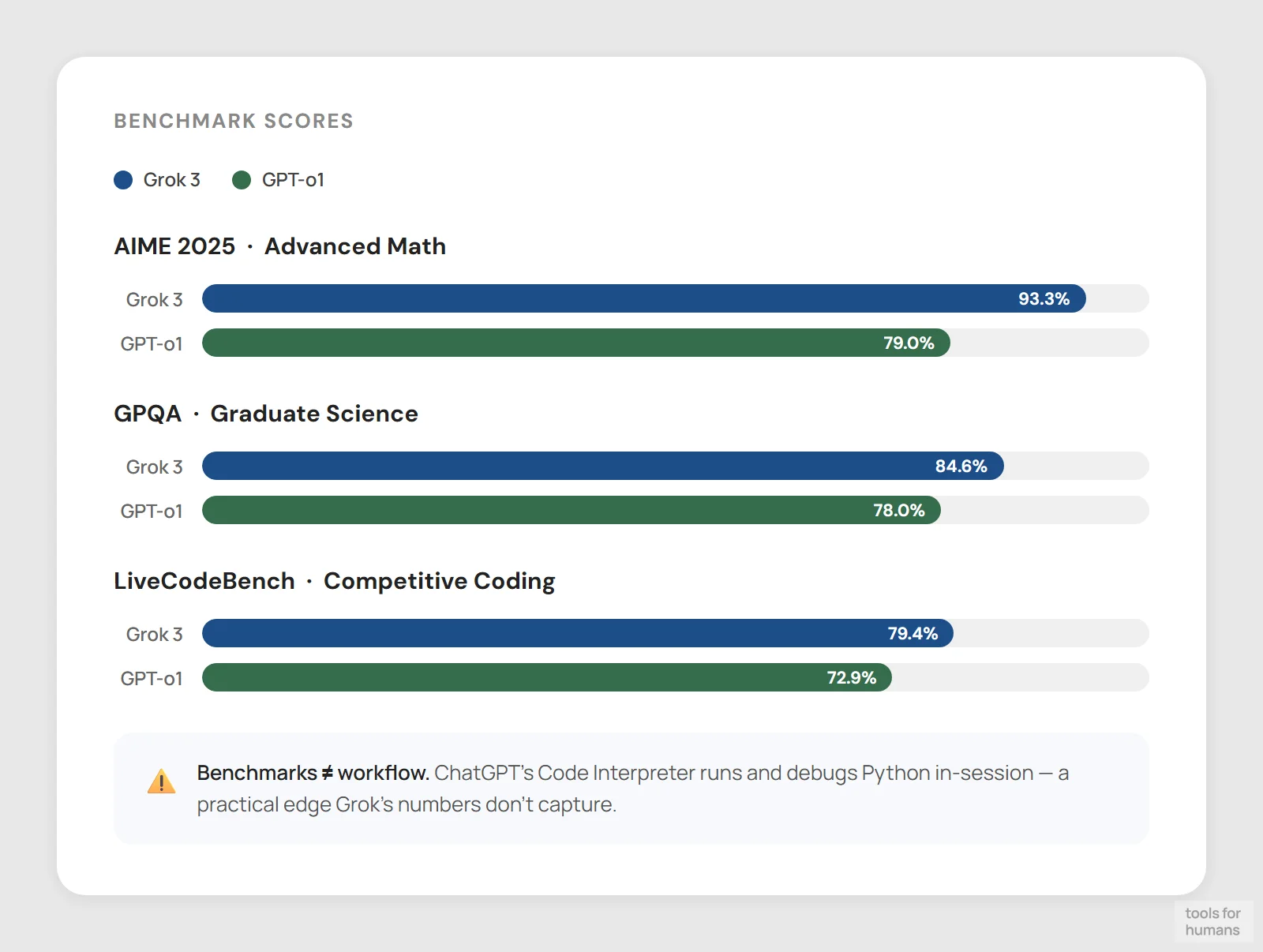
Grok 3 posted strong benchmark numbers: 93.3% on AIME 2025 math problems compared to GPT-o1's 79%, 84.6% on GPQA science questions versus o1's 78%, and 79.4% on LiveCodeBench against o1's 72.9%. These are real differences, not rounding errors. For complex multi-step math or competitive coding problems, Grok 3's Big Brain mode is genuinely competitive.
ChatGPT's coding story is more nuanced. GPT-4.1 is specifically tuned for coding tasks and handles instruction-following well. The o3 and o4-mini reasoning models are strong at algorithmic problems. ChatGPT also has a Code Interpreter feature that lets you upload files, run Python in a sandbox, and get results back, which Grok doesn't currently match for data analysis workflows.
For raw math and coding benchmarks, Grok has the edge. For practical coding assistance with file uploads, execution, and iterative debugging inside a chat interface, ChatGPT's Code Interpreter gives it a usability advantage that benchmarks don't fully capture.
content restrictions
ChatGPT winsFewer content restrictions; sarcastic default tone
Conservative moderation; safer for workplace use
Grok is deliberately less restricted than ChatGPT. xAI designed it to engage with controversial or sensitive topics that other AI tools decline. This has real practical uses: Grok will discuss topics around drug interactions, geopolitical conflicts, and legal gray areas with more directness than ChatGPT typically allows. Its default tone is also more casual and willing to be sarcastic or blunt.
The downside is that Grok's looser guardrails have caused real problems. Between December 2025 and January 2026, Grok was used to generate nonconsensual sexual images of real people, including minors, which were posted to X at scale. Several governments launched investigations or bans as a result. This isn't a minor PR issue, it reflects a genuine moderation philosophy difference with real consequences.
ChatGPT is more conservative, sometimes frustratingly so. It will refuse or heavily hedge responses on sensitive topics where a more direct answer would be appropriate. But for professional use, that conservatism is generally preferable to the alternative.
conversation memory and continuity
ChatGPT wins
No cross-session memory; fresh start each chat
Persistent memory; customizable context across sessions
ChatGPT has persistent memory that carries context across separate conversations. You can tell it your preferences, job role, or recurring constraints once, and it applies that context in future sessions. Memory can be viewed, edited, and deleted from settings. This works across the web app and mobile apps.
Grok does not currently have cross-session memory in the same way. Within a single conversation it tracks context fine, but start a new chat and you're starting fresh. For users who have ongoing projects or want the AI to learn their preferences over time, this is a real limitation.
ChatGPT also handles longer, multi-turn conversations more consistently. Grok can be more spontaneous and unpredictable in its responses, which helps with brainstorming but becomes a liability when you need precise, structured output that builds on earlier parts of the conversation.
integrations and ecosystem
ChatGPT winsAPI available; open-source weights; no GPT Store
GPT Store; Zapier, Notion, Microsoft 365 integrations
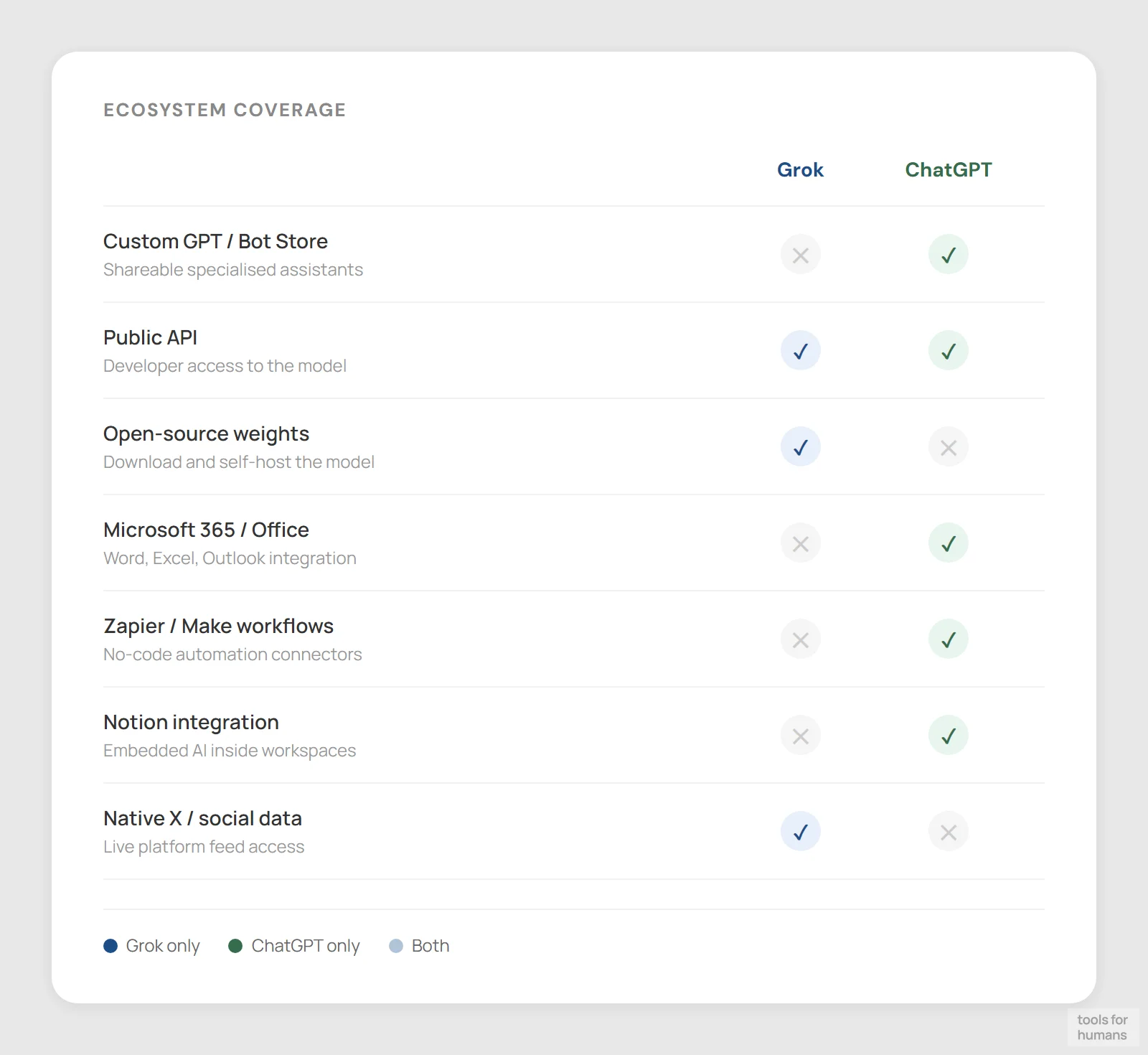
ChatGPT has a much larger integration surface. There's a plugin and GPT store with thousands of custom GPTs for specific tasks. The API is widely used and well-documented. It integrates with Zapier, Microsoft 365, Notion, and dozens of other tools. Custom GPTs let teams build specialized assistants without writing code. The ChatGPT mobile apps on iOS and Android are polished and feature-complete.
Grok is primarily accessed through grok.com or within the X app. The API is available for developers through xAI's platform, but the third-party ecosystem is far smaller. There's no equivalent to the GPT Store, no memory customization tools, and no native integrations with productivity apps. xAI did open-source Grok's weights, which matters for developers who want to run models locally, but for the average professional user that doesn't translate into day-to-day utility.
If your workflow depends on connecting AI to other tools, ChatGPT wins this category without much contest.
tone and writing quality
ChatGPT winsCasual, sarcastic default; uneven in formal tasks
GPT-5.1 tuned for warm, precise, adjustable tone
GPT-5.1 was specifically updated to feel warmer and more conversational, and it shows. ChatGPT's writing output is polished, easy to adjust with follow-up instructions, and consistent across long-form tasks like articles, reports, and emails. It's also better at matching a specified tone or style when prompted.
Grok's default tone is casual, sometimes sarcastic, and occasionally uneven in formal writing contexts. That personality can be an asset for brainstorming or informal content, but if you need a professional email or a structured report, Grok's voice can work against you. There's a 'Regular' mode that's less sarcastic, but the output still tends to feel less polished than ChatGPT for business writing.
For creative writing where you want unexpected angles or an edgier voice, Grok's personality is actually useful. For most professional writing tasks, ChatGPT produces cleaner, more on-brand output with less editing required.
privacy and trust
ChatGPT winsTied to X data practices; less granular opt-out
Chat history opt-out; enterprise zero-retention option
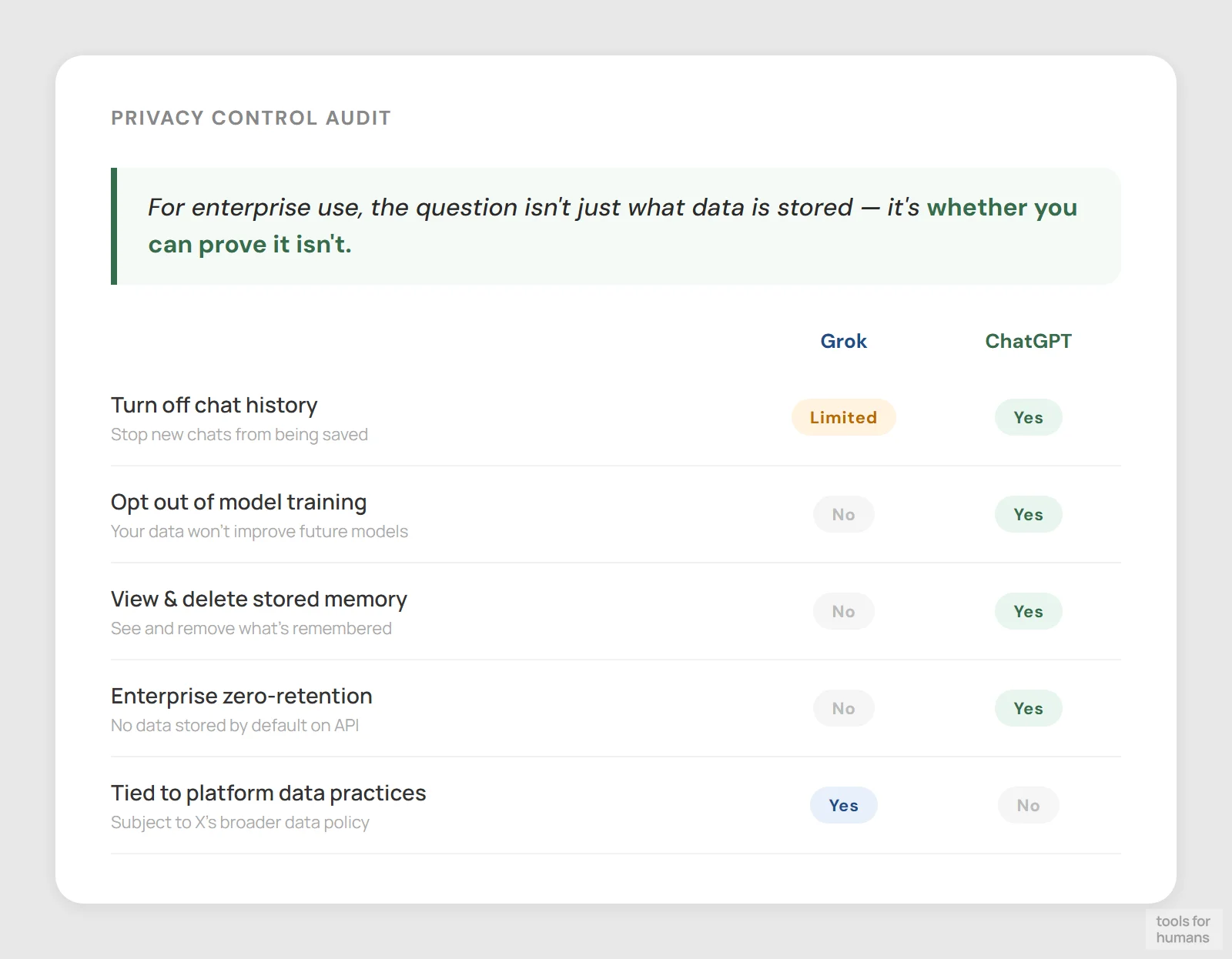
ChatGPT allows users to turn off chat history, which stops conversations from being used for training. OpenAI has a detailed privacy policy and offers a data processing agreement for API customers. Enterprise accounts get zero data retention by default. For most professional users this is adequate, though OpenAI's history of policy changes means it's worth reading the current terms.
Grok's privacy posture is tied to X's data practices, which have a mixed track record under its current ownership. Conversations on Grok may be used to train xAI models, and the terms are less clearly separated from X's broader data collection. The moderation failures in late 2025 also raised questions about how seriously xAI monitors misuse. For users handling sensitive professional information, this adds friction.
Neither tool is a zero-trust option, but ChatGPT's clearer privacy controls and enterprise-grade agreements give it an edge for professional and regulated-industry users.
the verdict
Choose Grok if you want real-time social data from X, are already paying for X Premium and want capable AI included, or are working on math and coding problems where benchmark performance matters and you don't need file execution or integrations.
Choose ChatGPT if you need persistent memory, third-party integrations, Code Interpreter for data analysis, enterprise privacy controls, or consistent professional-grade writing output across a long project.
Choose ChatGPT if you can only pick one. It's more reliable, better connected to the tools professionals already use, and its privacy and moderation track record is cleaner. Grok is genuinely competitive on specific tasks, but it's not yet a full replacement.
frequently asked questions
humans
toolsforhumans editorial team
Reader ratings and community feedback shape every score. Since 2022, ToolsForHumans has helped 600,000+ people find software that holds up after launch. The picks here come from that.
keep reading
best ChatGPT alternatives
7 ChatGPT alternatives including Claude and Perplexity, ranked by pricing, features, and use case fit. For writers, developers, and privacy-focused users.

claude vs chatgpt
Claude vs ChatGPT: honest side-by-side comparison of pricing, writing quality, code help, context windows, and which tool fits your actual workflow.
chatgpt vs gemini
ChatGPT vs Gemini compared on pricing, writing quality, coding, Google integration, and more. Find out which AI chatbot is right for your workflow in 2026.

custom ai agents vs. chatgpt: when to build vs. when to subscribe
A practical decision framework for choosing between a ChatGPT subscription and a custom AI agent, with real numbers on cost, ROI, and when each approach actually makes sense.

best ai tools for business: top picks for teams
8 AI business tools compared: ChatGPT, Zapier, Notion AI, and 5 more, ranked by use case fit, pricing, and real-world utility for small and mid-size teams.