Base44 vs Replit: no-code builder vs cloud IDE (2026)
Editorial note: originally published in april of 2026
quick verdict
Base44 is the better pick for most non-technical users who want a working app fast. It handles backend setup, authentication, and hosting automatically, so you never touch a terminal or choose a framework.
If you already know how to code and need full control over your stack, Replit is the better choice because it gives you a real Linux environment, GitHub integration, and the ability to debug and extend your app without hitting a ceiling.
choose Base44 if you want to go from idea to deployed app without writing code
visit base44choose Replit if you need a real IDE with AI assistance and deployment in one place
visit replitpick your side
Base44 and Replit both promise to turn natural language into working apps, but they're built for different people. Base44 is a no-code AI app builder aimed at founders, product managers, and anyone who needs a functional product without coding knowledge. Replit is a cloud-based IDE that adds an AI agent on top of a full development environment.
This comparison covers pricing, ease of use, code control, deployment, collaboration, and the real limitations of each platform. The goal is to help you pick the right tool for your actual situation, not the one with the better marketing page.
feature comparison
We collect first-hand reviews from people who use these tools every day — what works, what doesn't, whether it's worth paying for. We research pricing, features, and comparisons so that feedback has real context behind it. For this comparison, we prioritised feedback from non-technical builders and early-stage startup teams who have used both platforms to take a product from idea to deployment. Read our full research methodology.
ease of use and setup
Base44 wins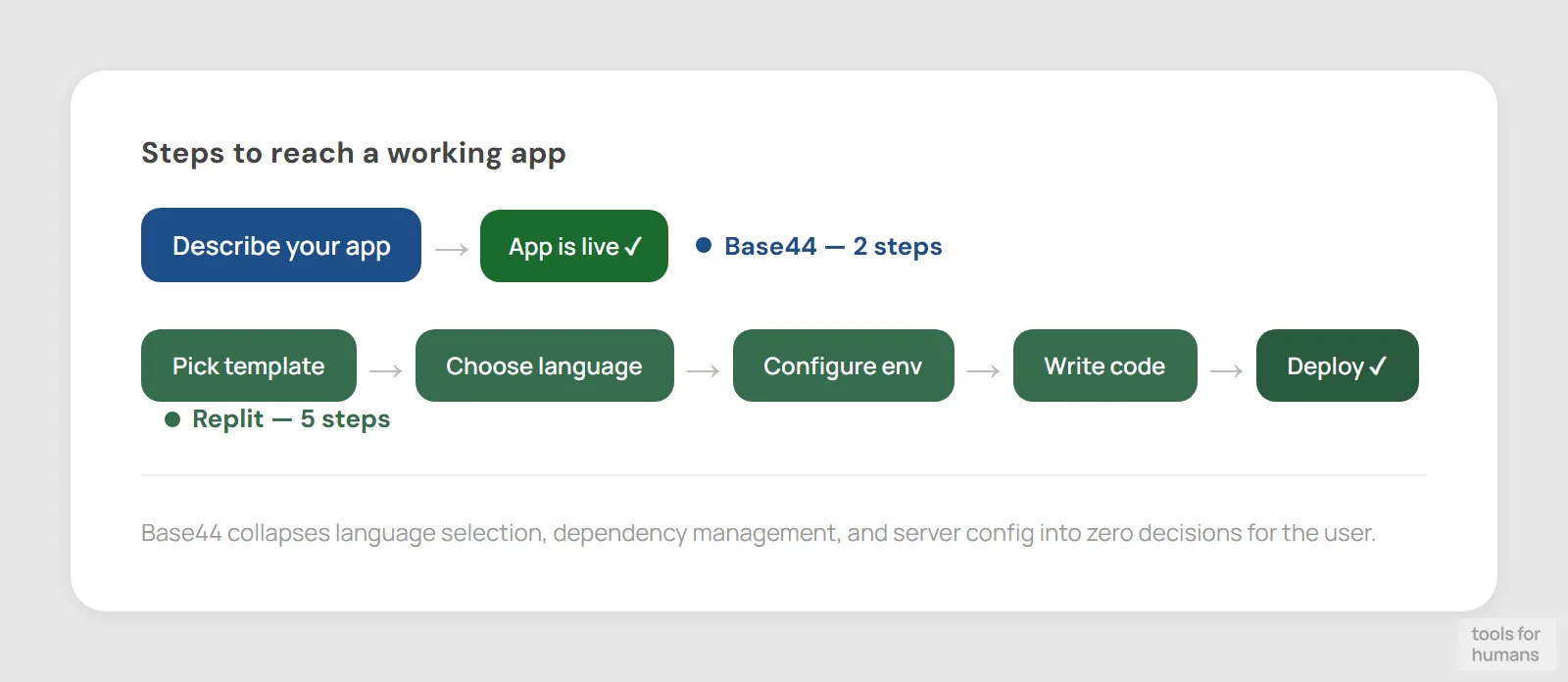
Base44 is as close to zero setup as an app builder gets. You sign in, type a description of what you want to build, and the platform generates pages, data models, user authentication, and backend logic automatically. There's no language selection, no dependency management, no server configuration. The app is live in a hosted environment before you've had time to wonder what framework to use.
Replit requires a few more decisions upfront. You pick a template or language, and the Replit Agent can scaffold a full-stack project from a natural language prompt. But you're still working inside an IDE, which means you'll encounter a file tree, a terminal, and configuration files. For developers, that's a feature. For non-coders, it's friction.
Replit has improved its onboarding significantly with Agent 4, but the underlying model assumes you're comfortable reading and editing code. Base44 doesn't make that assumption at all. If your team has no developers, Base44 wins this category without a close contest.
pricing
Replit winsBase44 offers paid plans starting at a discounted yearly rate, with the main pitch being credit-based usage that scales with your project. The homepage shows promotions like 44% off select yearly plans, but transparent per-month pricing for each tier isn't prominently published. This can make cost forecasting harder than it should be for teams comparing options.
Replit's pricing is clearer. There's a free tier with limited credits and CPU throttling. The Core plan is $20 per month and includes $25 in monthly credits, private apps, access to the latest AI models, and live hosting. There are higher tiers for teams and enterprise use. The $20 Core plan is genuinely competitive for what it includes, especially since it bundles hosting and AI usage credits together.
Both platforms use credit systems for AI features, which means heavy users can run out of credits before the billing cycle ends. Replit's credit allotment at the Core tier is spelled out clearly. Base44's equivalent isn't as visible from the homepage, which makes direct comparison harder. On transparency alone, Replit has the edge.
code control and customization
Replit wins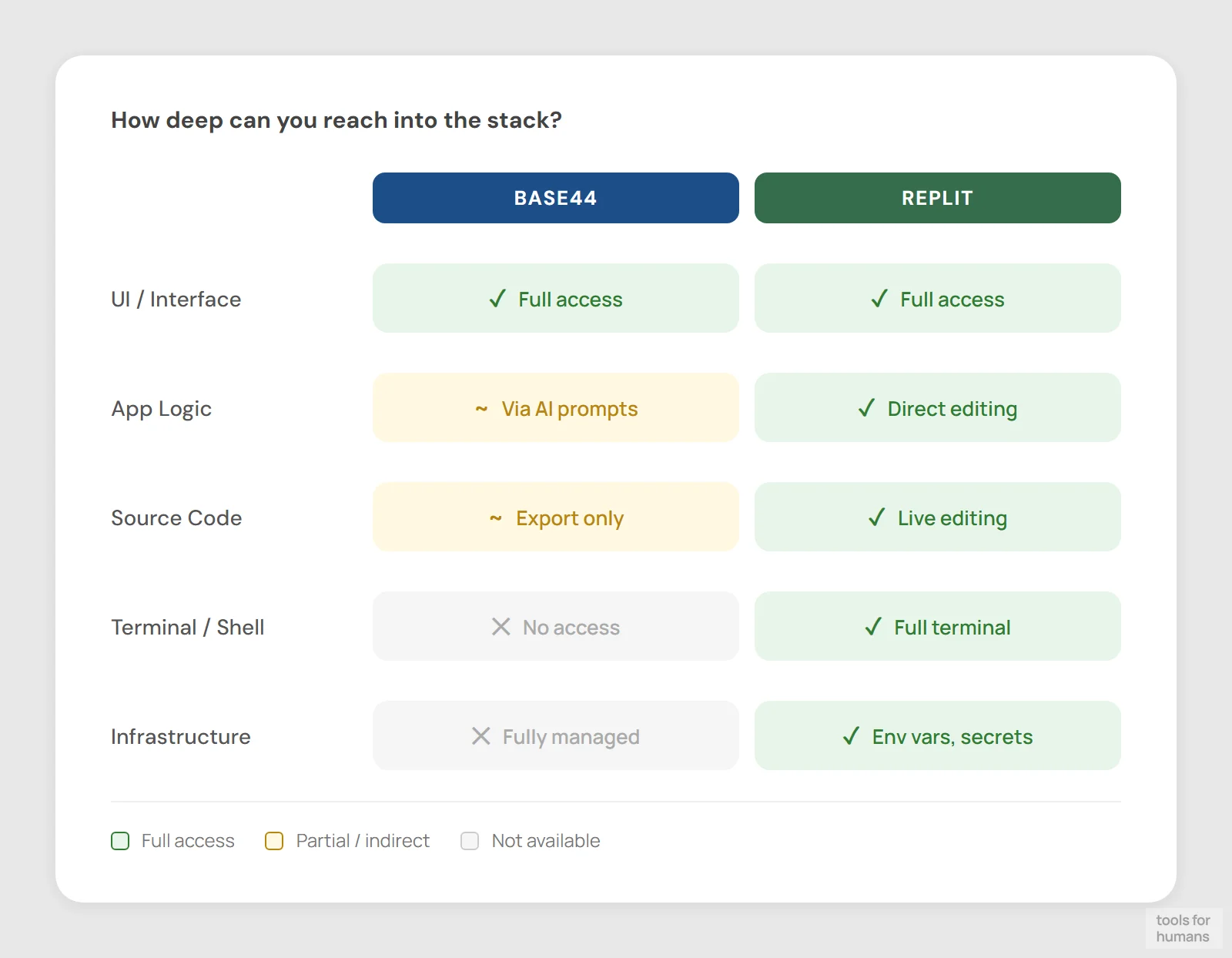
Base44 abstracts the code almost entirely. You build through natural language and a visual interface. There is an optional code export feature, but the platform is designed so you never need to look at the underlying code. This is a deliberate choice that makes it fast for simple use cases but creates a hard ceiling on customization. If your app needs a custom algorithm, a third-party API that isn't in Base44's connector list, or a non-standard data structure, you'll likely hit a wall.
Replit gives you the full source. Every file, every dependency, every config is accessible. You can edit code directly, run terminal commands, install packages, and add any integration you can write code for. The Replit Agent can generate a starting point, but you can extend it in any direction. This is the fundamental difference: Base44 is a product for users who don't want to write code, Replit is a product for developers who want AI to write more of it for them.
For teams that know they'll need custom logic, integrations, or performance tuning, Base44's abstraction becomes a liability rather than an asset.
deployment and hosting
drawOne-click publish, built-in domains, analytics
Autoscaling via Azure, env vars, secrets
Base44 includes built-in hosting, custom domains, and one-click publishing. When your app is ready, you press publish and it's live. There's nothing to configure on a server, no DNS headaches beyond pointing your domain, and no separate hosting bill. Analytics are also built in. For straightforward apps, this is genuinely impressive and removes a step that trips up a lot of non-technical builders.
Replit also includes integrated deployment, backed by an autoscaling infrastructure through a Microsoft Azure partnership. You can deploy from within the IDE, and apps can scale beyond a single instance. Replit's deployment is more flexible and better suited to apps that need to handle real user traffic or run background processes. It also supports environment variables and secrets management properly, which matters for production apps.
Both tools handle deployment without needing a separate service like Vercel or Heroku. Base44's approach is simpler. Replit's approach is more capable and better suited to apps with real scalability requirements. For a quick internal tool or MVP, Base44's one-click publish is hard to beat. For anything that needs to scale, Replit's infrastructure is more reliable.
AI capabilities and agent quality
drawBase44 automatically selects the best AI model for your project from the current available options, and it lets you choose your preferred model if you want control. The AI is optimized specifically for app generation: it produces pages, data schemas, authentication flows, and UI components from a single prompt. The output is immediately usable rather than being raw code that you then wire together.
Replit's Agent 4 is its flagship AI feature. It can generate full-stack applications from a natural language description, handle database setup and authentication, and write, test, and deploy code. Agent 4 is designed for developers and produces actual code that you can read, modify, and extend. Replit also gives users access to the latest AI models as part of the Core plan, so you're not stuck on an older model.
The agents serve different purposes. Base44's AI is optimized for speed and accessibility: the goal is a working app with no follow-up required. Replit's agent is optimized for flexibility: the goal is a code scaffold that a developer can take anywhere. If you plan to customize the output significantly, Replit's approach is more practical. If you want something usable immediately, Base44's is faster.
collaboration and team features
drawReal-time collaborative editing, no coding required
Multiplayer IDE, GitHub integration, pair programming
Base44 supports real-time collaborative editing described as similar to Google Docs, which means multiple people can work on the same project simultaneously. This is a strong feature for small teams building internal tools where designers, product managers, and non-technical stakeholders all need input. There's no need for a developer to be the gatekeeper for every change.
Replit's collaboration model is built for developer pairs and small engineering teams. It supports real-time pair programming, shared workspaces, and multiplayer editing within the IDE. The Core plan supports collaboration with up to a certain number of users, and higher tiers extend this for larger teams. Replit also tracks changes through its version control integration with GitHub, which is standard for developer teams.
For cross-functional teams where not everyone is a developer, Base44's collaboration model is more accessible. For developer teams doing pair programming or code review, Replit's environment is more appropriate. Neither tool has enterprise-grade project management built in, so both assume you're handling planning and communication in a separate tool.
scalability and production readiness
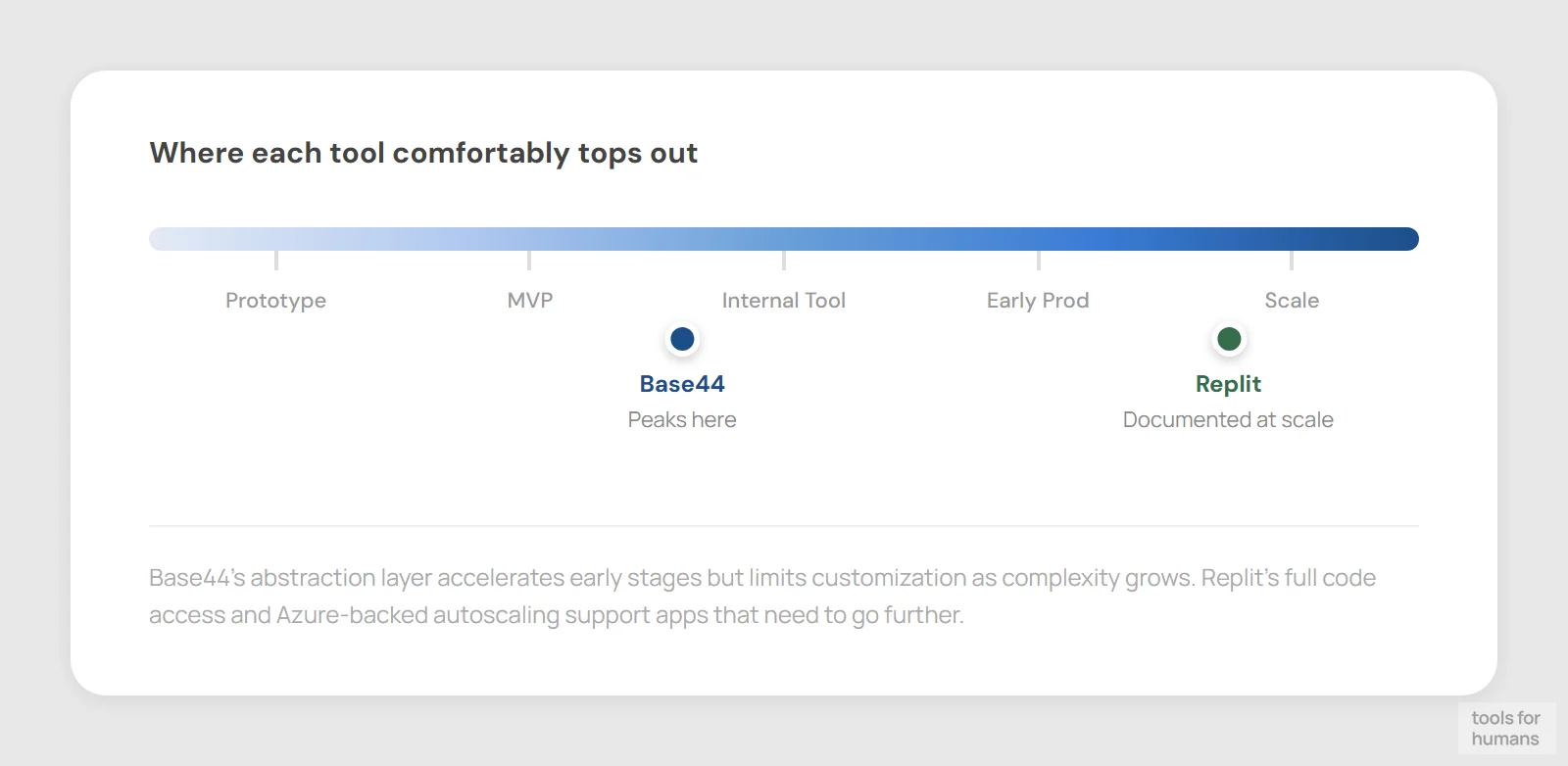
Replit winsBase44 is designed to get you to a working app quickly, and it does that well. But the platform's abstraction layer creates real questions about long-term scalability. If your app grows beyond a simple internal tool or MVP, you'll eventually want custom logic, better performance controls, or integrations that Base44 doesn't natively support. The code export option exists, but migrating out of a no-code platform is rarely smooth in practice.
Replit has documented production use cases with real companies. Zinus reportedly reduced development costs by $140,000 and halved delivery time using Replit for dashboards. AllFly rebuilt a production web app in days. These aren't just prototype stories. Replit's autoscaling deployment, proper secrets management, and full code access make it a more credible choice for apps that need to stay in production and grow over time.
If you're building something that might become a real product with paying users, Replit gives you a more sustainable foundation. Base44 is better suited to internal tools, prototypes, and use cases where the app's requirements are unlikely to change dramatically.
learning curve and target audience
Base44 wins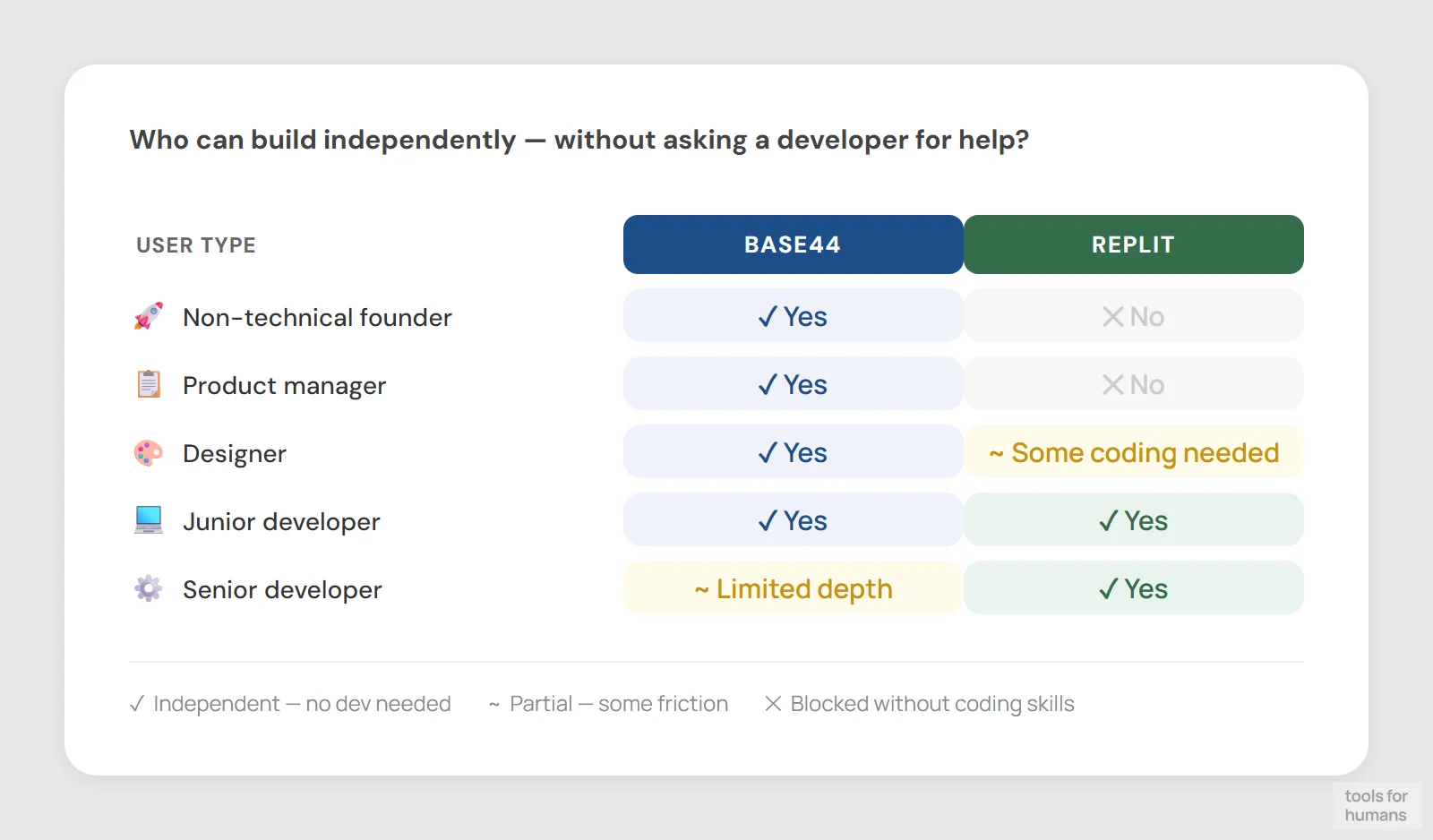
Base44 is built for people who don't code. The interface hides technical decisions entirely, and the marketing is explicit: no coding necessary. This makes it genuinely accessible to founders, product managers, operations teams, and anyone with an app idea but no technical background. The tradeoff is that developers will find the constraints frustrating, and there's limited ability to learn programming from using it.
Replit was originally built as an educational platform and still serves that use case well. Students can spin up a working coding environment in seconds without installing anything. The AI agent lowers the initial barrier, but you're still expected to read code, understand error messages, and make decisions about your stack. This makes Replit a better fit for developers, learners, and technical teams, not for non-technical users who want to avoid the code layer entirely.
The audience split between these two tools is about as clear as it gets in this category. If your users need to code, use Replit. If they don't want to, use Base44.
the verdict
Choose Base44 if you're a non-technical founder, product manager, or operations professional who needs a working app, internal tool, or customer portal without writing or reading any code. The all-in-one setup, instant deployment, and no-code model mean you can ship something real in hours rather than days.
Choose Replit if you're a developer, a technical team, or a student who wants AI assistance inside a real coding environment. Replit's full Linux container, GitHub integration, and Agent 4 give you the flexibility to build, debug, and scale apps that won't hit a customization ceiling six months from now.
For the largest single group of people likely to compare these two tools — technical founders and developers who want speed without giving up code control — Replit is the stronger long-term choice.
frequently asked questions
humans
toolsforhumans editorial team
Reader ratings and community feedback shape every score. Since 2022, ToolsForHumans has helped 600,000+ people find software that holds up after launch. The picks here come from that.
keep reading

best Replit alternatives
7 Replit alternatives compared, including Bolt and GitHub Codespaces, ranked by pricing, features, and real limitations. For developers and non-technical builders.

best Base44 alternatives
7 Base44 alternatives including Lovable and Glide, ranked by pricing, code ownership, and production readiness. For founders, developers, and no-code teams.

base44 vs lovable
Base44 vs Lovable: honest comparison of pricing, code ownership, backend setup, and which AI app builder fits your project in 2026.

lovable vs replit
Lovable vs Replit compared on pricing, AI quality, autonomy, and real use cases. Find out which tool fits your workflow in 2026.

best ai tools for business: top picks for teams
8 AI business tools compared: ChatGPT, Zapier, Notion AI, and 5 more, ranked by use case fit, pricing, and real-world utility for small and mid-size teams.