Base44 vs Lovable: all-in-one vs open stack (2026)
Editorial note: originally published in april of 2026

quick verdict
Base44 is the better pick for most non-technical builders who want a working app fast, without touching infrastructure. Its fully managed backend means zero configuration and you're live in minutes.
If you need to own your code, export to GitHub, or hand a project off to a developer later, Lovable is the right call. It generates real React and TypeScript in your own repo, not locked inside a proprietary stack.
choose Base44 if you want to launch a tool or portal without writing a line of code
visit base44choose Lovable if code ownership and long-term flexibility matter more than setup speed
visit lovablepick your side
Base44 and Lovable are both AI app builders that take a plain-English description and produce a working full-stack application. They compete directly for the same audience: founders, solo builders, and non-technical creators who want to ship without hiring a dev team.
The difference is architectural. Base44 is a fully managed, closed platform where the backend, database, and hosting live on its infrastructure. Lovable generates exportable React and TypeScript code, syncs to GitHub, and uses Supabase for data storage. One prioritises launch speed. The other prioritises ownership.
This comparison covers pricing, code quality, backend setup, autonomy features, learning curve, and which platform is actually worth paying for depending on what you're building.
feature comparison
We collect first-hand reviews from people who use these tools every day — what works, what doesn't, whether it's worth paying for. We research pricing, features, and comparisons so that feedback has real context behind it. For this comparison, we prioritised real differences in code ownership, backend architecture, and long-term project flexibility over surface-level feature checklists. Read our full research methodology.
pricing
drawFree tier + paid plans from ~$20/mo
Free tier + paid from ~$20/mo, $50/mo for Agent Mode
Base44 has a free tier that lets you build and publish apps, with paid plans starting at roughly $20-$25/month for more credits and custom domains. The site advertises 44% off select yearly plans and positions itself as accessible for individuals scaling up gradually. Credits are consumed per build action, so complex apps cost more tokens per session.
Lovable also has a free tier, but the free allowance is limited in monthly messages. Paid plans start at around $20/month for the Starter tier, with higher tiers at $50/month and above for more AI interactions, GitHub sync on all plans, and access to Agent Mode. The credit-based model is similar to Base44, but Lovable's paid tiers more explicitly gate power features like agent workflows.
Both tools are competitively priced at entry level. Where they diverge is at the top: Lovable's advanced agentic features and full GitHub sync are available on paid plans, while Base44's premium tiers focus on higher credit limits and team collaboration. Neither has a meaningful free tier for serious production use.
code ownership and portability
Lovable winsFrontend exportable; backend stays on Base44 servers
Full React and TypeScript export with GitHub sync
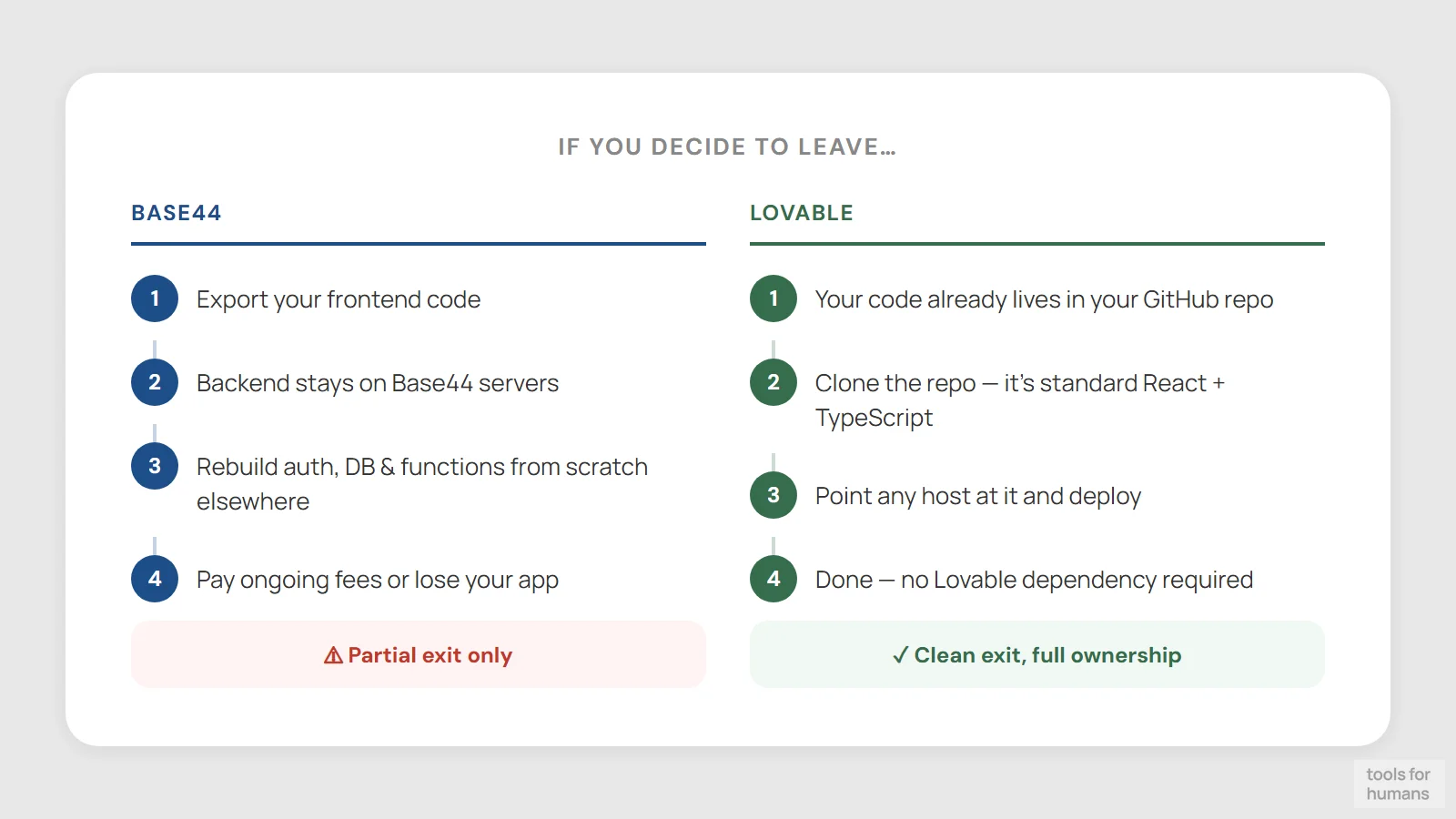
This is the sharpest difference between the two platforms. Base44 generates and hosts your app inside its own managed infrastructure. You can export frontend code, but the backend, database, and serverless functions stay on Base44's servers. If you want to migrate to your own infrastructure, you're rebuilding the backend from scratch. Following the Wix acquisition in June 2025, Base44 now operates as a Wix business unit, which adds a layer of platform dependency risk for long-term projects.
Lovable takes the opposite approach. It generates real React and TypeScript code that you own from the first prompt. GitHub sync is a core feature, not an add-on, so your codebase lives in your own repository. Database and authentication are handled via Supabase, a well-supported open-source platform. A developer can clone your Lovable-generated repo and keep building without touching the Lovable editor at all.
If you ever need to hand a project to an external developer, raise funding and move to custom infrastructure, or simply avoid platform lock-in, Lovable's approach is categorically better. Base44's managed stack is fast to start but hard to leave.
backend and infrastructure setup
Base44 winsFully managed: auth, DB, hosting auto-generated
Supabase integration: more control, slightly more setup
Base44's main advantage is that there is genuinely nothing to configure. You describe your app, and authentication, data storage, role-based permissions, HTTPS, and hosting are all generated automatically. There is no Supabase project to create, no database schema to approve, no deployment pipeline to connect. For non-technical builders, this is a real time saver, especially for internal tools, portals, and back-office apps where the priority is function over flexibility.
Lovable uses Supabase as its backend layer, which is a popular and well-documented choice, but it does require slightly more hands-on setup. You connect a Supabase project, and Lovable generates the schema and auth logic, but you're working with an external service that has its own dashboard, billing, and configuration. This is not complicated, but it is a step that Base44 simply skips.
For builders who want zero friction on the backend side, Base44 wins. For builders who want to understand their data layer and control it directly, Lovable's Supabase integration is more transparent, even if it takes a few more minutes to configure.
agentic and autonomous workflows
Lovable wins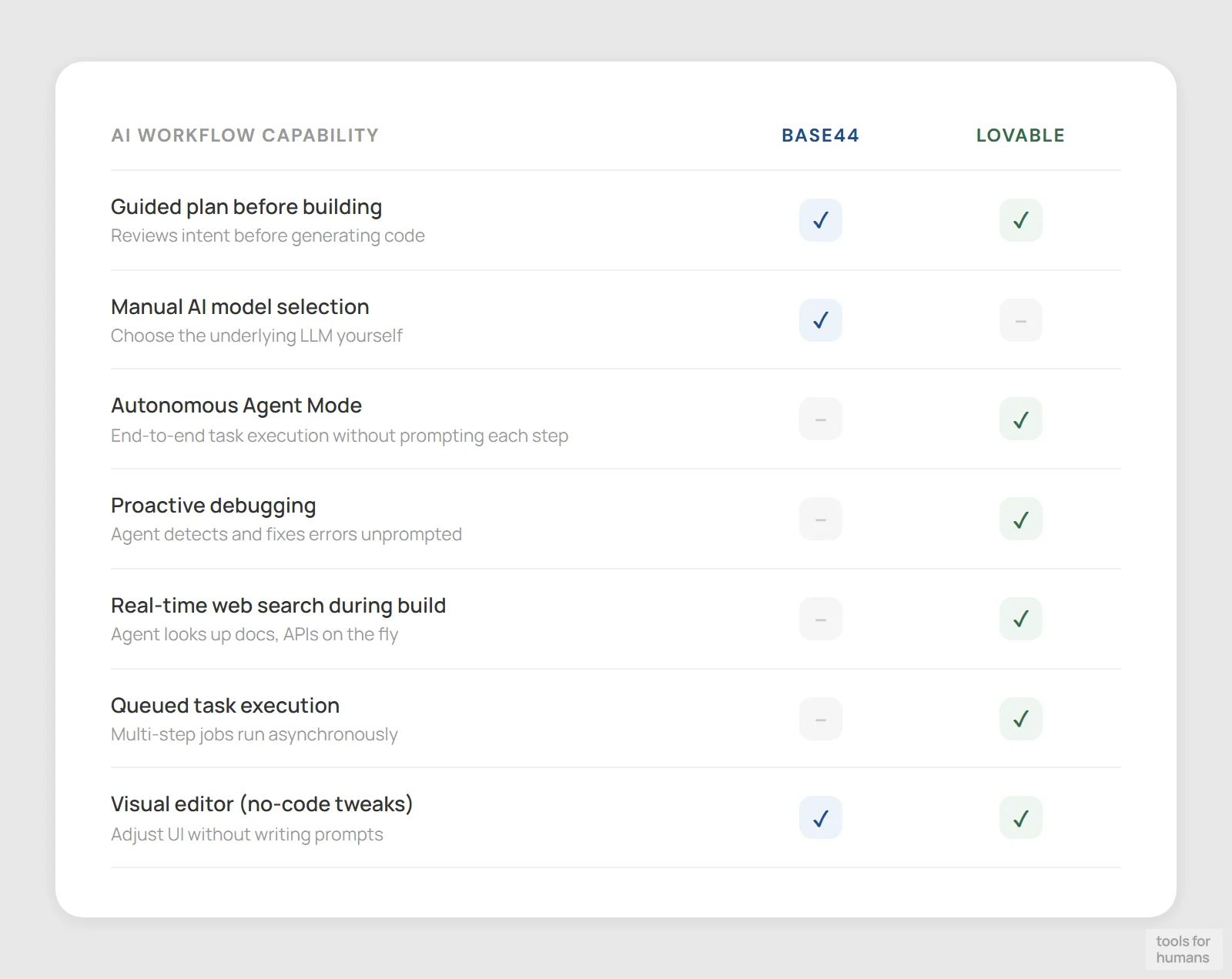
Plan Mode before build; manual model selection available
Agent Mode, Chat Mode, and Visual editor as distinct workflows
Lovable has invested heavily in what it calls Agent Mode: an autonomous AI development workflow that explores the codebase independently, runs proactive debugging, performs real-time web searches, and processes tasks end-to-end through a queued execution model. It also has Chat Mode for iterative planning and a Visual editor. This three-mode structure gives experienced users real control over how the AI operates during a session.
Base44 uses a Plan Mode before building, which lets you specify flows, roles, and constraints before credits are consumed. This is useful for getting a higher-quality first build, but it is less sophisticated than Lovable's Agent Mode in terms of autonomous multi-step problem solving. Base44 also notes that it automatically selects the best AI model for your project or lets you choose manually, which suggests access to multiple underlying models.
For users who want the AI to work through complex problems independently without constant prompting, Lovable's Agent Mode is more capable. Base44's approach is more guided and predictable, which suits non-technical users but limits advanced autonomy.
learning curve and target user
draw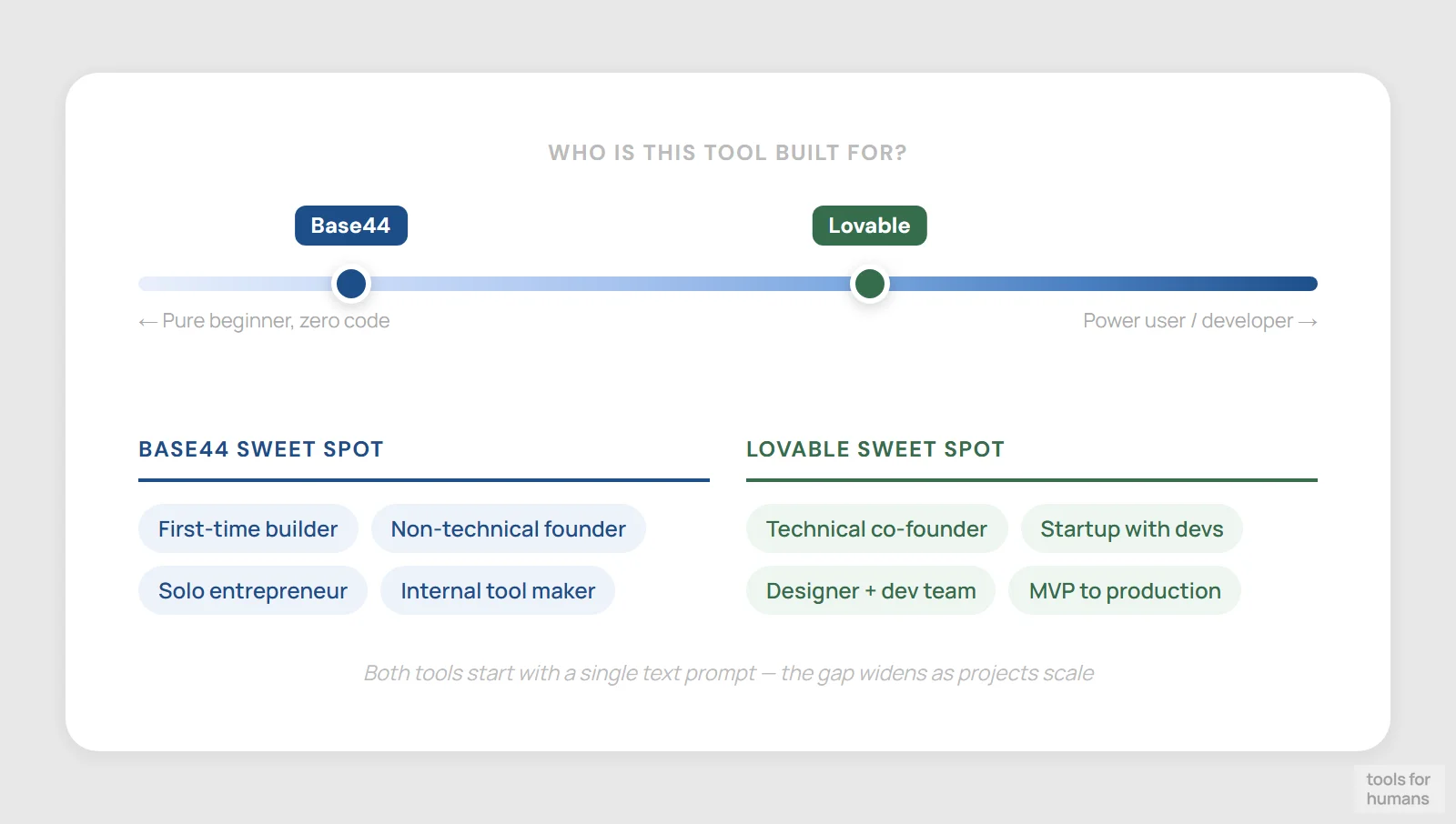
Zero coding required; visual editor for adjustments
Natural language plus Code Mode for developers on paid plans
Base44 is explicitly designed for non-technical users. The onboarding is a single text prompt, and the visual editor lets you adjust UI components without code. The platform's documentation and tone target people who have never built software before. This makes it genuinely accessible for entrepreneurs, operations staff, and hobbyists who want a functional tool without learning React or SQL.
Lovable positions itself similarly but also has a Code Mode on paid plans, which lets developers view and edit the raw generated codebase directly in the editor. This makes it useful for a wider skill range: a non-technical founder can use natural-language prompts, while a developer teammate can drop into the code and fix specific issues. The GitHub sync reinforces this by making the project legible to any developer.
Base44 is easier to start with if you have no technical background at all. Lovable scales better as your team's technical ability increases. If you're building alone with no coding knowledge, Base44 removes more friction. If you'll ever involve a developer, Lovable's architecture makes that collaboration much smoother.
version control and collaboration
Lovable winsBuilt-in proprietary versioning with revert history
Native GitHub sync with full Git workflow on all paid plans
Base44 includes built-in versioning through its chat interface and editor: each update creates a snapshot you can revert to. This works for solo builders and small teams, but it is a proprietary system inside Base44's platform rather than a standard Git workflow. There is no pull request process, no branch management, and no way to connect external CI/CD tools.
Lovable's version control is GitHub-native. Because your project lives in a real GitHub repository, you get all the standard Git features: commit history, branches, pull requests, and integration with any deployment or testing pipeline that works with GitHub. This is a meaningful advantage for any project that will grow beyond a solo builder or a simple prototype.
For teams or projects with any level of technical oversight, Lovable's GitHub-based version control is far more practical than Base44's internal snapshot system. It also means audits, rollbacks, and code reviews all happen in tools developers already know.
platform stability and backing
Lovable wins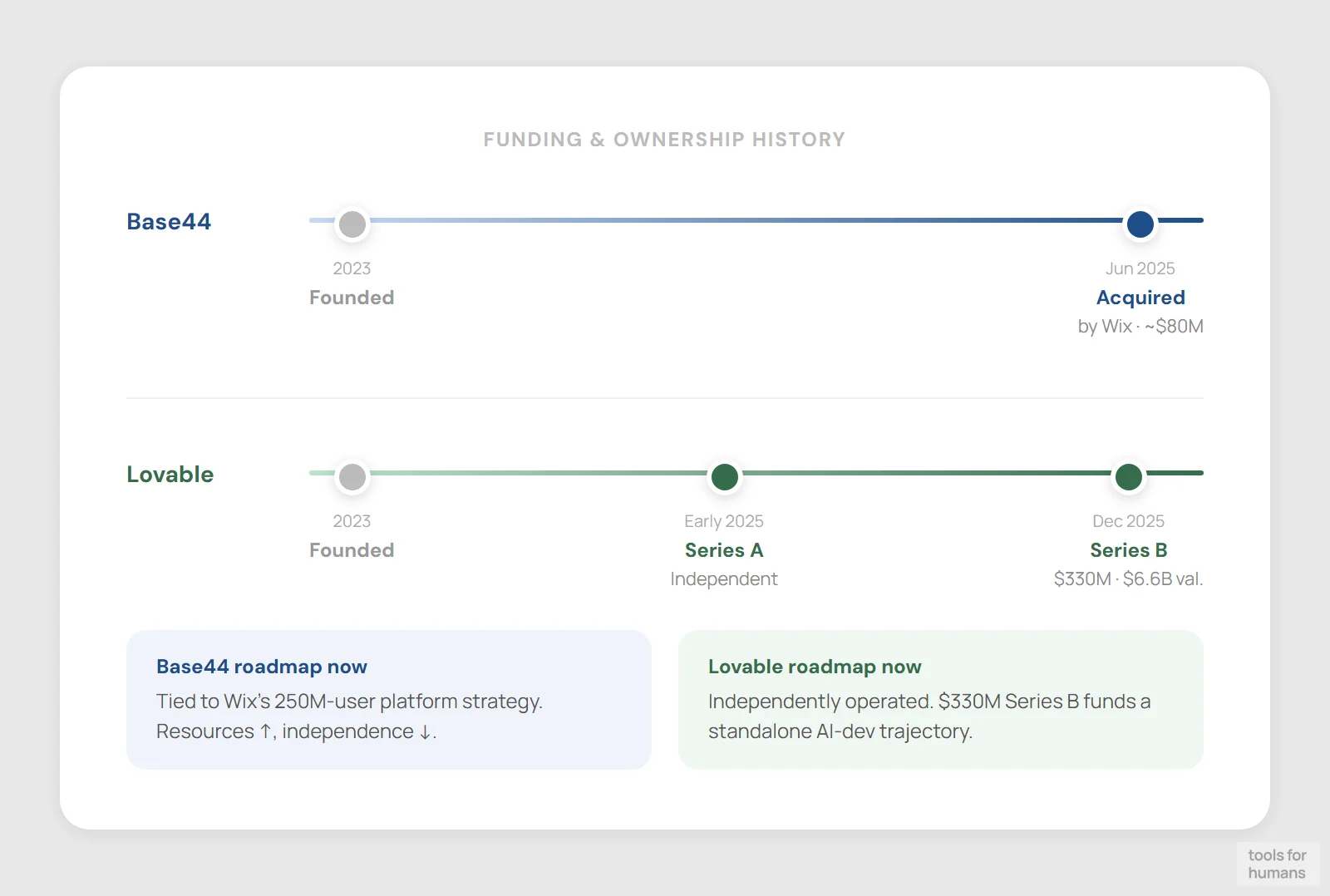
Both platforms have received significant external validation, but the nature of that backing is different. Base44 was acquired by Wix in June 2025 for a reported ~$80 million. This gives it resources and distribution through Wix's 250-million-user base, but it also means Base44's roadmap is now driven by a larger parent company. Integration with Wix infrastructure is expected over time, which could be useful or could shift the product away from its original standalone focus.
Lovable raised $200 million at a $1.8 billion valuation in July 2025, then followed with a $330 million Series B at a $6.6 billion valuation in December 2025, led by CapitalG and Menlo Ventures. It reached unicorn status eight months after its November 2024 launch. Lovable operates independently with significant runway and investor pressure to grow its standalone product.
Both tools are financially stable by startup standards. Base44's Wix acquisition provides a safety net but introduces uncertainty about product direction. Lovable's independent funding trajectory suggests it will continue investing in its own feature set without a parent company's priorities shaping decisions.
the verdict
Choose Base44 if you are building an internal tool, customer portal, or back-office app and you want it live today with no infrastructure decisions to make. Its fully managed backend, automatic authentication, and zero-setup hosting make it the fastest path from idea to working app for non-technical users.
Choose Lovable if you care about owning your code, plan to involve a developer at any point, or want a project that can grow beyond a single platform. The GitHub sync, exportable React codebase, and Agent Mode make it more capable for anything beyond a simple prototype.
Choose Lovable if you're building for the majority use case of a solo founder or small team that wants to eventually ship a real product. The code ownership alone is worth it.
frequently asked questions
humans
toolsforhumans editorial team
Reader ratings and community feedback shape every score. Since 2022, ToolsForHumans has helped 600,000+ people find software that holds up after launch. The picks here come from that.
keep reading

best Base44 alternatives
7 Base44 alternatives including Lovable and Glide, ranked by pricing, code ownership, and production readiness. For founders, developers, and no-code teams.

base44 vs replit
Base44 vs Replit: honest comparison of pricing, features, and which AI app builder is right for non-coders, developers, and startup teams in 2026.

lovable vs replit
Lovable vs Replit compared on pricing, AI quality, autonomy, and real use cases. Find out which tool fits your workflow in 2026.

best Replit alternatives
7 Replit alternatives compared, including Bolt and GitHub Codespaces, ranked by pricing, features, and real limitations. For developers and non-technical builders.

best Supabase alternatives
7 Supabase alternatives including Firebase, Convex, and PocketBase, ranked by pricing, features, and ease of switching. For developers and small teams.

best Webflow alternatives
7 Webflow alternatives including Wix, Framer, and WordPress — ranked by pricing, features, and ease of switching. For designers, freelancers, and dev teams.