We start with direct ratings from our readers, then look at what real users are saying in practitioner forums and community spaces. We pair that with search demand data and profession-level persona analysis.
Editorial note:this was originally published in september of 2024
quick take
✓Best for: compliance officers and IT security managers running recurring audit cycles
✗Skip if: you're a lean startup treating SOC 2 as a one-time hurdle or can't absorb a 2-month setup
£Best value: Fundamentals at $625/month if you're replacing consultant costs; Complete only if managing multiple frameworks
★★★½★3.8/ 5 — editorial rating
based on real user feedback, community sentiment, pricing value, and fit for target audience. see our full methodology
used Secureframe? we'd love to know your thoughts
reader ratings shape our score
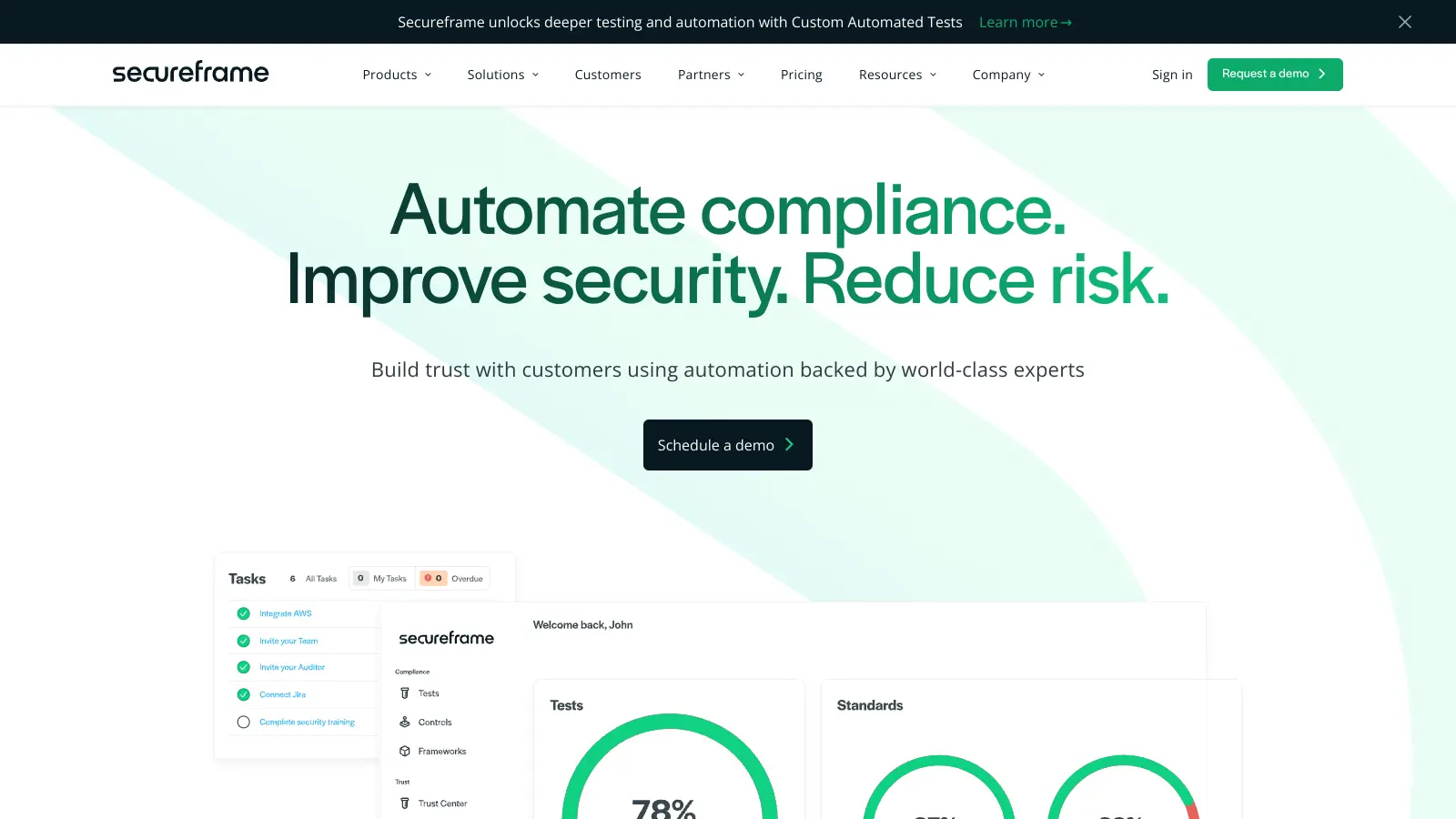
Secureframe is an AI-powered compliance automation platform that helps organizations manage their security and privacy requirements. The platform streamlines the often complex process of maintaining compliance across frameworks including SOC 2, HIPAA, PCI DSS, and GDPR.
At its core, the platform automates many time-consuming compliance tasks through integrations with over 150 services like AWS, Azure, Google Cloud, GitHub, and Okta. This automation extends to evidence collection, continuous monitoring, and risk assessment processes, helping teams maintain their compliance status with less manual effort.
The tool provides a central hub for all compliance-related activities, from storing documentation to managing vendor relationships. Users can access customizable policy templates, real-time compliance insights, and automated testing features. The platform includes AI-powered capabilities for handling security questionnaires, RFP responses, cloud misconfigurations, risk scoring, and policy generation.
Pricing starts at $625 per month for the Fundamentals plan, which covers small teams up to 20 employees. The Complete plan ranges from $1,167 to $1,667 per month, while Enterprise pricing is custom. Startup discounts are available for companies under 25 employees or with less than $5M raised.
Organizations can use Secureframe to simplify their audit preparation, maintain continuous compliance monitoring, and manage their overall security posture through a single platform. The system's approach to automation helps reduce the time and resources typically required for compliance management.
how popular is Secureframe?
monthly search interest
2.4k/mo now
peak interest4k/moOct 2022
searches now2k/moFeb 2026
1-month change— steadyvs prev month
Secureframe's search volume peaked in late 2022 and has settled into a stable 2,000 to 2,400 monthly searches since mid-2023, with no meaningful growth or decline over the past two years. That flatness suggests the compliance automation category has matured and Secureframe has found its steady audience rather than growing it. For you, that means you're evaluating a stable, established product rather than something still finding its footing, but also one that isn't winning new converts at the rate it once was.
who is Secureframe for?
Whether Secureframe is worth it depends almost entirely on where your company is in its compliance journey and whether someone actually owns this work. Pick your role below to see the honest breakdown.
overall sentiment
select your role to see what people like you are saying
Compliance Officer
positive
If compliance tracking still lives in spreadsheets, Secureframe will genuinely change your working week. Automated evidence collection across 150-plus integrations and built-in dashboards replace the worst parts of audit prep. The tradeoff is a rigid platform that does things its own way, and you'll spend roughly two months in setup before it delivers on that promise.
Clear dashboards and reminders keep compliance tasks organized
Streamlines SOC 2, ISO 27001, and HIPAA processes efficiently
Pre-built controls reduce time needed to establish frameworks
concerns
Rigid platform structure requires doing things Secureframe's way, limiting customization
Initial setup and configuration takes approximately 2 months
Limited reporting flexibility requiring manual adjustments for custom needs
CTO/CISO
mixed
The AWS, Okta, and Google Workspace integrations work well and the executive dashboards give you real compliance visibility without digging through control sheets. The platform's continuous monitoring has gaps though, which means audit prep still requires active effort rather than just pulling a report. At this price point, Drata's monitoring is worth comparing before you commit.
strengths
Real-time dashboards provide executive visibility into compliance gaps
Seamless integrations with AWS, Okta, Google Workspace, and IAM tools
Automated risk assessment across cloud infrastructure reduces manual review
Responsive customer support during critical onboarding phase
concerns
Continuous compliance monitoring is limited, requiring more audit preparation effort
Platform maturity concerns compared to competitors in the same price range
Limited data access flexibility without admin privileges
Startup Operations Leader
negative
The math doesn't work for most early-stage teams. At $625 a month minimum and two months of setup time that pulls focus from product work, you're paying a significant premium before you see any return. If SOC 2 is a one-time sales requirement rather than an ongoing operational need, the cost is hard to justify. Come back to Secureframe when compliance is a recurring function with someone who owns it full-time.
strengths
Enables enterprise-grade compliance without hiring dedicated compliance staff
Automates evidence collection and monitoring to free up team bandwidth
Low learning curve and intuitive interface for non-compliance experts
Reduces audit preparation time significantly once configured
concerns
High pricing is hard to justify for smaller teams with limited budgets
2-month setup and configuration timeline is prohibitive for lean startups
Rigid structure and manual workarounds offset promised time savings during implementation
IT Security Manager
positive
The cloud infrastructure integrations are the strongest part of the platform. If you're managing security posture across AWS and IAM tools, the automated risk assessment reduces your manual review load meaningfully. The main frustration is limited data access without admin privileges, which creates friction when you need to investigate something quickly without involving multiple stakeholders.
strengths
Continuous monitoring and automated risk assessment across cloud infrastructure
Smooth integrations with AWS and other cloud/IAM tools in existing tech stack
Keeps controls automatically up to date without manual intervention
Responsive support team helps resolve issues quickly
concerns
Continuous monitoring coverage has gaps affecting overall compliance confidence
Limited mobile experience compared to web interface restricts on-the-go monitoring
Manual workarounds needed when cloud setup doesn't align with platform expectations
what users are saying
“The positive ratings come almost entirely from teams that were already resourced enough to get through the setup process, which takes around two months and requires meaningful internal investment upfront.”
Community feedback on Secureframe skews notably positive across commercial review platforms, where it sits at 4.7 to 4.8 out of 5 stars across hundreds of verified reviews. The most consistent praise centres on how much time the automated evidence collection saves versus manual spreadsheet tracking, and on the quality of customer support during onboarding. Users who've completed SOC 2 or ISO 27001 audits with Secureframe frequently describe the process as significantly less painful than doing it without a platform. That said, the positive ratings come almost entirely from teams that were already resourced enough to get through the setup process, which takes around two months and requires meaningful internal investment upfront. Smaller teams and startups are underrepresented in the positive reviews for an obvious reason: many don't make it far enough to see the payoff.
Our take: Secureframe is a genuinely good product for the right buyer, but the right buyer is narrower than the marketing implies. At $625 a month for the Fundamentals plan and up to $1,667 a month for Complete, this is a significant budget line that only makes sense if you're already past early-stage chaos and have someone whose actual job is compliance. If you're a lean startup treating SOC 2 as a checkbox to unlock enterprise deals, Drata is worth comparing directly before you commit, since several users who've moved between platforms cite Drata's continuous monitoring as more mature. Don't sign up thinking the platform does the work for you. It reduces the work. There's still real work.
features
Automated Evidence Collection: Automatically gathers audit evidence from over 150 cloud service integrations, reducing manual effort and simplifying documentation processes.
Continuous Monitoring: Provides real-time tracking of cloud infrastructure, networks, and applications with daily control validation to detect security vulnerabilities and ensure ongoing regulatory compliance.
Comply AI for Risk: Automates risk scoring and generates treatment plans from risk descriptions to help organizations quickly identify and prioritize security risks.
Centralized Documentation: Creates a single repository for compliance documents, policies, and audit reports, making evidence collection and management straightforward.
Comply AI for Policies: AI-powered editor for drafting and refining compliance policies that organizations can tailor to meet specific industry and regulatory requirements.
Streamlined Audit Preparation: Automates evidence collection and control testing, reducing audit preparation time and increasing the likelihood of successful compliance reviews.
Real-Time Compliance Insights: Delivers instant feedback on compliance status through interactive dashboards and control health monitoring with real-time alerts.
Tool Integration: Connects with security and compliance platforms including AWS, Azure, GCP, GitHub, and Okta to provide a comprehensive view of organizational security posture.
Automated Tests and Remediation: Enables custom compliance tests and uses Comply AI to generate fixes for cloud misconfigurations and quickly resolve identified issues.
Multi-Framework Support: Supports compliance standards like SOC 2, HIPAA, ISO 27001, and GDPR, plus custom frameworks.
AI Evidence Validation: Reviews uploaded evidence automatically to identify issues like missing documents or outdated timestamps.
Third-Party Risk Management: Uses AI for vendor risk scoring, fourth-party assessments, and questionnaire automation to streamline vendor security reviews.
pricing
Fundamentals plan starts at $625 per month for small teams up to 20 employees, includes infrastructure monitoring, personnel management, risk management, IT asset management, cloud security remediation, trust center, questionnaire knowledge base, Comply AI, and custom frameworks.
Complete plan ranges from $1,167 to $1,667 per month ($14,000 to $20,000 annually), includes all Fundamentals features plus advanced questionnaire automation, advanced third-party risk management, advanced trust center, SSO and SCIM connections, advanced risk management, and additional workspaces.
Enterprise plan has custom pricing based on specific organizational needs and full trust and compliance features for scale.
Startup discounts are available for companies under 25 employees or with less than $5M raised.
Implementation fees are sometimes waived, and Expert Onboarding may be included free in the first year.
Price-matching against Vanta or Drata is possible in some cases.
frequently asked questions
For mid-size companies with a dedicated compliance or security function, yes. The Fundamentals plan at $625 a month is justifiable if it's replacing a compliance consultant or eliminating weeks of manual audit prep each cycle. The Complete plan at $1,167 to $1,667 a month is harder to defend unless you're managing multiple frameworks simultaneously. For startups under 20 people who are trying to get their first SOC 2 to close enterprise deals, the price is steep and the two-month setup timeline is painful. Free alternatives like building your own controls in Notion will hurt more long-term, but the cost-benefit on Secureframe only works once compliance is a recurring operational need, not a one-time milestone.
Compliance Officers who need to eliminate manual evidence collection and want clear dashboards to stay audit-ready will get the most out of it. IT Security Managers managing cloud infrastructure across AWS, Okta, and Google Workspace will find the integrations genuinely reduce their review burden. CTOs and CISOs at growth-stage companies who need executive-level compliance visibility without building a team from scratch are a solid fit too. It's a poor match for Startup Operations Leaders running lean teams where two months of setup time and a four-figure monthly bill are genuinely prohibitive.
First, the setup timeline is real: expect two months before the platform is actually doing what it promises. Second, continuous compliance monitoring has gaps, meaning you'll still need to do prep work before audits rather than just running a report. Third, the platform is rigid: it wants you to do things its way, and custom reporting or non-standard controls often require workarounds that eat into the time savings you signed up for. Finally, data access is gated by admin privileges, which creates friction for CTOs who want visibility without managing every permission themselves.
If continuous compliance monitoring maturity matters to you, look hard at Drata before committing. Multiple users who've evaluated both cite Drata's monitoring as more developed, particularly for organisations managing real-time security posture rather than just audit cycles. Secureframe has the edge on customer support responsiveness during onboarding and its interface is slightly more intuitive for non-specialist users. The honest answer: if your primary use case is getting a SOC 2 done and maintaining it with minimal specialist staff, Secureframe gets the job done. If you need continuous, gap-free monitoring as a live operational tool, Drata is the more mature choice at comparable pricing.
Yes, but with a caveat. Secureframe's pre-built controls and automated evidence collection genuinely lower the bar for non-specialists, and the interface doesn't require a compliance background to navigate. The gap is project management, not technical knowledge: someone still needs to own the two-month setup, chase down colleagues for policy sign-offs, and review what the platform flags. If that's landing on an ops leader who's already stretched, the platform reduces the compliance workload but doesn't eliminate the coordination overhead. Budget at least 5 to 10 hours a week during setup from whoever owns it.
Reader ratings and community feedback shape every score. Since 2022, ToolsForHumans has helped 600,000+ people find software that holds up after launch. how we research →
is this your tool?
claim your listing to update details, respond to our review, or upgrade to a featured partnership.
★★★★★3.8based on real user feedback, community sentiment, pricing value, and fit for target audience. see our full methodology
PowerDMS
PowerDMS is a cloud-based policy and compliance management platform for public safety agencies and healthcare organizations. It offers AI-driven tools for managing policies, training, internal affairs investigations, and accreditation through a secure, centralized system.
★★★★★3.5based on real user feedback, community sentiment, pricing value, and fit for target audience. see our full methodology
Mimecast
Mimecast is a cloud-based cybersecurity platform that provides email security, archiving, and continuity solutions. It protects against phishing, malware, ransomware, and business email compromise using AI-powered detection engines, URL scanning, attachment sandboxing, and user awareness training.
★★★★★3.8based on real user feedback, community sentiment, pricing value, and fit for target audience. see our full methodology
Vanta
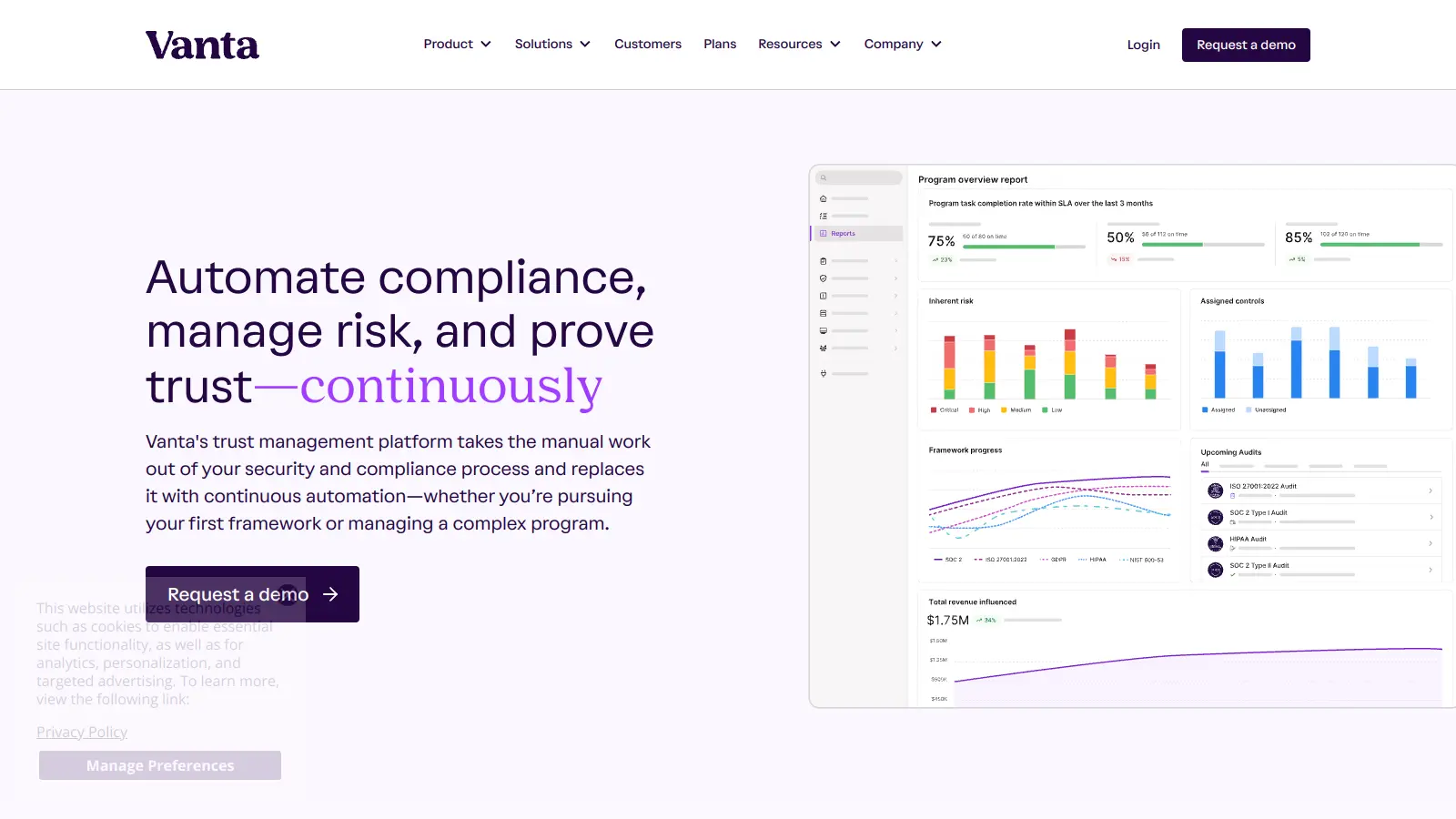
Vanta is a compliance and security platform that automates up to 90% of compliance work for major security frameworks like SOC 2 and ISO 27001. It offers automated evidence collection, policy management, access control, and AI-powered tools to help businesses streamline compliance processes, strengthen security, and build stakeholder trust.
★★★★★3.5based on real user feedback, community sentiment, pricing value, and fit for target audience. see our full methodology
LogicGate
LogicGate is an AI-powered Governance, Risk, and Compliance (GRC) platform offering the Risk Cloud solution. The platform helps organizations manage cyber risk, third-party risk, compliance controls, and operational resilience through a no-code interface with built-in Spark AI features that automate evidence testing, form completion, and risk analysis.
★★★★★3.7based on real user feedback, community sentiment, pricing value, and fit for target audience. see our full methodology
snyk
Snyk is an AI-driven developer security platform that scans code for vulnerabilities, license compliance issues, and provides AI-powered fixes using static and dynamic analysis. It integrates with IDEs, Git workflows, and CI/CD pipelines for real-time scanning across open-source dependencies, container images, infrastructure as code, and proprietary code.
★★★★★3.8based on real user feedback, community sentiment, pricing value, and fit for target audience. see our full methodology
Drata
Drata is a cloud-based compliance automation and GRC platform that helps organizations streamline audit readiness across multiple frameworks. Founded in 2020, the tool continuously monitors security controls, automates evidence collection, manages vendor risk using AI agents, and integrates with hundreds of cloud services and SaaS tools to provide real-time compliance monitoring across over 20 compliance standards.