Integration Platform As A Service Ipaas+1 more

DCKAP
best deal
Start connecting your business systems for $999/month - Try Standard Plan with annual billing
redeem now
DCKAP
best deal
Start connecting your business systems for $999/month - Try Standard Plan with annual billing
redeem nowWe start with direct ratings from our readers, then look at what real users are saying in practitioner forums and community spaces. We pair that with search demand data and profession-level persona analysis.
Editorial note: this was originally published in august of 2024
quick take
based on real user feedback, community sentiment, pricing value, and fit for target audience. see our full methodology
used DCKAP? we'd love to know your thoughts
reader ratings shape our score
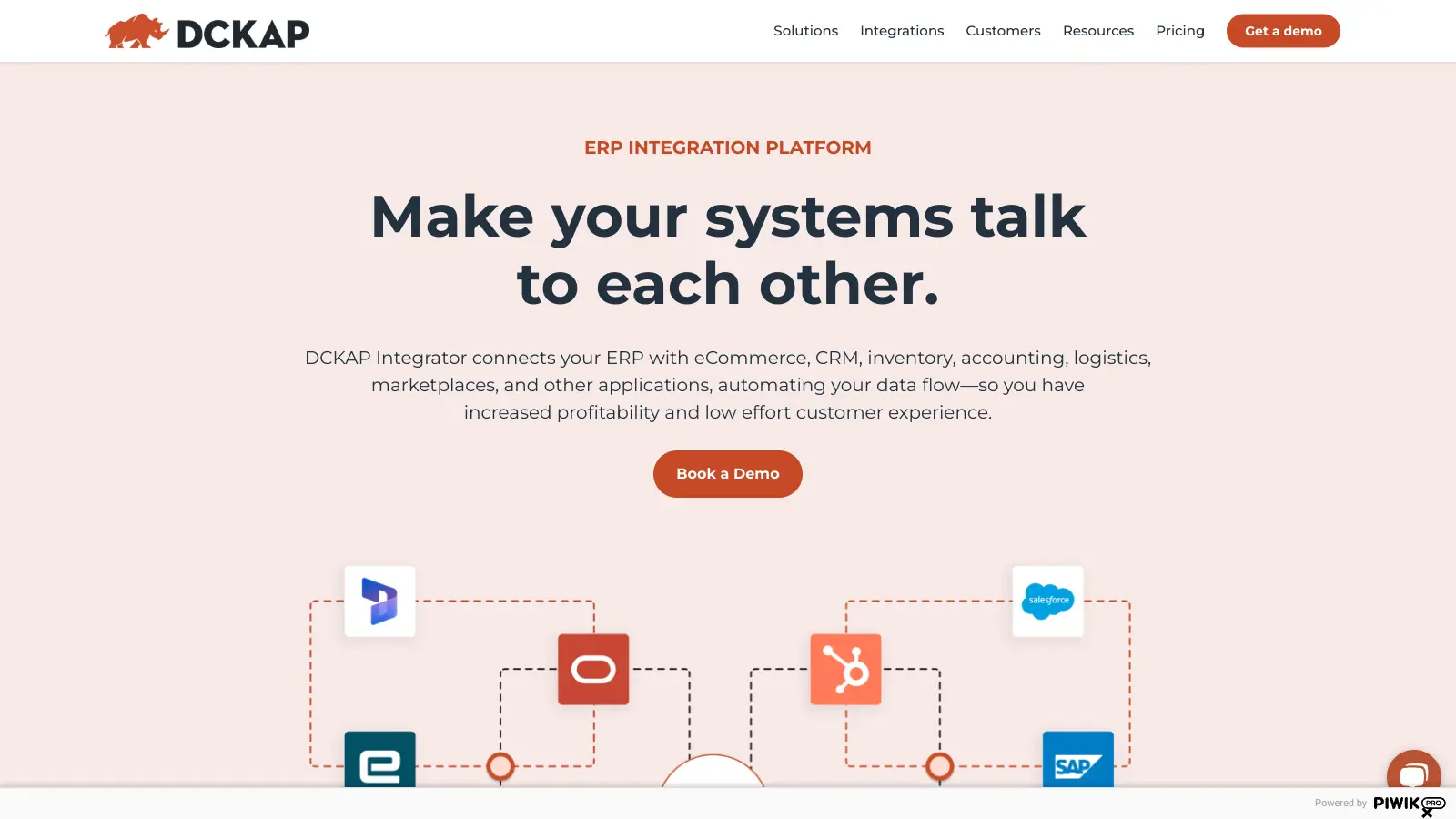
DCKAP provides a cloud-based ERP integration platform that helps distributors connect and automate their business systems. Their main product, DCKAP Integrator, links business applications like eCommerce platforms, CRM systems, EDI, PIM, payment processors, inventory management tools, and accounting software to create a unified workflow.
Headquartered in Austin, Texas, DCKAP focuses on helping fast-growing mid-market distributors and manufacturers automate their data flows and eliminate manual entry processes. The platform offers real-time synchronization between different systems, which helps reduce errors and creates a single source of truth for business information like inventory, orders, pricing, and customer data.
The software works through a simplified flow builder with an all-in-one page for building, testing, running, and debugging workflows. It supports both pre-built and custom connectors, API calls, decision builders, and even a code runner for Python. The platform can be deployed as hybrid or cloud-to-cloud, making it accessible for businesses with different infrastructure needs.
Available in Standard, Professional, and Enterprise plans, the platform caters to businesses of different sizes. Plans start at $999 per month when billed annually, with Enterprise plans at $2,499 per month that include EDI-ERP integration. Features include automated data transfer, reporting and analytics, API monitoring, workflow automation tools, and customizable integration options.
monthly search interest
170/mo now
DCKAP peaked in search interest through mid-2023 and has since dropped roughly half, settling into a narrow band of 140 to 210 monthly searches. This is a niche B2B tool with a small but stable addressable market, not a product chasing viral growth. The hype phase has passed, which means you're evaluating the real product now.
Whether DCKAP is worth it depends almost entirely on your role and your ERP stack. Pick your role below to see the honest breakdown.
overall sentiment
select your role to see what people like you are saying
Operations Manager
positiveIf your team is manually re-entering inventory or order data between systems, DCKAP's automated sync genuinely cuts that friction. The support team is responsive and has a strong track record during setup. The tradeoff is that error logs are hard to read on your own, so budget time for support involvement when something breaks rather than expecting to fix it solo.
strengths
concerns
IT Director
mixedDCKAP handles legacy ERP connections well and takes pressure off small IT teams during implementation by providing hands-on support. The catch is that the diagnostic tooling isn't built for independent troubleshooting, so you'll be dependent on their team more than you'd probably like. Lower-tier plans also restrict user roles in ways that create headaches as your access needs grow.
strengths
concerns
eCommerce Manager
positiveReal-time inventory and pricing sync across multiple sales channels is where DCKAP earns its keep. You don't need deep technical skills to manage day-to-day integrations, and the interface is approachable for non-technical team members. The reporting built into lower tiers is basic, so if you need channel-level analytics, you'll need to pull that data elsewhere or pay for a higher plan.
strengths
concerns
Data Manager
mixedDCKAP's flow builder simplifies connecting data pipelines between ERP and external systems without custom middleware, which is genuinely useful. But the error logging and sync flow visibility are weak enough that diagnosing data issues independently is frustrating. If clean, auditable data flows are a core requirement, expect to work closely with DCKAP support rather than owning that visibility yourself.
strengths
concerns
“At $12,000 a year for the entry plan, the expectation of self-sufficient troubleshooting is reasonable, but the diagnostic tooling doesn't deliver that.”
Community discussion around DCKAP is thin online, which is typical for a niche B2B integration tool serving a specific slice of the distribution sector. That said, the product's own review ecosystem points to a consistent pattern: customers who buy in at the right tier come away satisfied with the support quality and the reliability of core inventory and order syncing, while those who hit implementation snags find the diagnostic tools frustratingly opaque. Error logs are regularly cited as difficult to interpret without direct help from the DCKAP team, which creates a dependency on support that not everyone is comfortable with at these price points. At $12,000 to $18,000 per year for the base and mid tiers, the expectation of self-sufficient troubleshooting is reasonable, but the tooling doesn't always deliver that. The permission restrictions on lower plans also surface as a recurring complaint, particularly for IT teams trying to delegate access across departments without upgrading to a higher tier.
The Standard plan at $12,000 per year is only worth it if you're a distributor with genuine ERP complexity and real operational cost from manual data entry or sync failures. If you're connecting two systems and can use the support team effectively during onboarding, the ROI is there. If you're a smaller operation looking for a plug-and-play integration layer, it's overpriced for what you'll actually use.
It fits eCommerce Managers and Operations Managers at mid-market distribution businesses who need reliable real-time inventory and pricing sync across channels and can't afford to oversell or push stale pricing. IT Directors at lean teams who want to avoid custom middleware development also get value, provided they're comfortable leaning on DCKAP's support team during complex setups.
First, error logging and sync flow visibility are weak. When something breaks, reading the diagnostic output is genuinely difficult without support involvement, which slows independent troubleshooting. Second, the Standard and Professional plans have tight restrictions on user roles and access permissions, which becomes a real problem as your team grows and you need to delegate without paying for an Enterprise upgrade. Built-in analytics are also basic across all but the top tier.
Celigo is better suited to teams that want more control over their integrations and can invest time in building flows through a more self-service interface. DCKAP wins if your ERP is one of the distribution-specific systems it knows well (Epicor, Infor, Sage, TrulinX) and you want implementation support baked into the contract rather than figuring it out yourself. If your stack is more generic or you want to manage integrations without depending on a vendor's support team, choose Celigo.
It depends on how complex your ERP setup is. DCKAP's Standard plan quotes a two to four week onboarding window, and the Professional plan extends that to four to seven weeks. The support team is genuinely responsive and rated highly by existing customers. That said, complex legacy ERP setups routinely push past those estimates. Go in expecting the upper end of the range and plan your go-live date accordingly.
toolsforhumans editorial team
Reader ratings and community feedback shape every score. Since 2022, ToolsForHumans has helped 600,000+ people find software that holds up after launch. how we research →
is this your tool?
claim your listing to update details, respond to our review, or upgrade to a featured partnership.
claim this listing →
Zapier is a no-code automation platform that connects over 8,000 apps, enabling users to create automated workflows called "Zaps" without coding. It integrates different services, automating repetitive tasks through customizable triggers, multi-step processes, and real-time data transfer. Pricing ranges from free to enterprise tiers.
best deal
Start automating with unlimited Zaps and 100 monthly tasks free – no credit card needed

Cleo is an AI-powered financial management app that helps users track spending, set budgets, save money, and build credit. It offers a conversational chat-based interface with features like expense categorization, automated savings, cash advances, and a playful AI financial coach.
best deal
Try Cleo's free basic service for spend tracking, budgeting tools, and chat insights

Replicate is a user-friendly AI platform that enables developers to run, deploy, and scale open-source machine learning models through a simple API. It offers access to various AI models, one-line deployment, model customization, performance monitoring, and flexible pricing based on compute time usage. The platform supports multiple programming languages and provides tools for efficient AI model integration across different applications.
best deal
Start with Replicate's free tier to access basic features and open-source AI models

Boomi is a cloud-native integration platform that connects applications, APIs, data, and AI agents through a low-code/no-code approach. It offers solutions for integration, API management, data management, workflow automation, and AI agent management, supporting digital transformation with enterprise-grade security and scalability across cloud, on-premises, and hybrid environments.
best deal
Try Boomi free for 30 days with access to Enterprise Platform features, then start at $99/month

LlamaIndex is an open-source data orchestration framework that simplifies integrating large language models (LLMs) with external data sources. It provides tools for data ingestion, indexing, and querying, enabling developers to build AI applications like chatbots, document Q&A systems, and knowledge agents by connecting LLMs with structured, semi-structured, and unstructured data from over 160 sources.
best deal
Try LlamaIndex - Free tier includes 10,000 credits/month for building AI applications with your data

Runware is an AI platform that gives developers access to over 300,000 AI models through a single API for real-time generative media creation. Using custom hardware and a Sonic Inference Engine, it generates images, videos, and other media with costs up to 10x lower and speeds 30-40% faster than traditional infrastructure, starting at $0.0006 per image.
best deal
Get up to 30% extra credit on your first purchase - no credit card required to start building