Best Drata Alternatives in 2026: For Every Budget and Team Size
7 alternatives reviewedlast reviewed 5 april 2026
Editorial note:this was originally published in april of 2026
Drata is a capable compliance automation platform, but it's not the right fit for every organization. The pricing structure puts key modules like the Trust Center behind additional paywalls, custom frameworks cost extra, and smaller teams often find the platform overkill for their needs.
This page covers seven alternatives worth considering, ranging from startup-friendly tools with transparent flat pricing to enterprise GRC platforms with deeper risk management. Each pick includes honest notes on pricing, where it beats Drata, and where it falls short.
Selections were made based on framework coverage, automation depth, pricing transparency, and how well each tool handles real audit cycles rather than just evidence collection.
We collect first-hand reviews from people who use these tools every day — what works, what doesn't, whether it's worth paying for. We research pricing, features, and comparisons so that feedback has real context behind it. For this guide, we prioritised tools that handle continuous monitoring and multi-framework compliance rather than one-off audit prep tools. Read our full research methodology.
looking for a Drata alternative?
tell us what you're considering and why — it helps others in the same position.
What is Drata?
Drata is a cloud-based compliance automation platform founded in 2020. It continuously monitors security controls, automates evidence collection, and integrates with tools like AWS, GitHub, Okta, and hundreds of other SaaS services to maintain audit readiness across more than 20 compliance frameworks, including SOC 2, ISO 27001, HIPAA, GDPR, and PCI DSS.
It's mainly used by mid-size SaaS companies and enterprises running multiple compliance programs simultaneously. The platform handles control mapping, real-time alerts, vendor risk management, and policy management from a single dashboard.
People look for alternatives because Drata's pricing is opaque and modular, meaning features like the Trust Center, custom frameworks, and auditor access cost extra on top of the base plan. Some teams also find the risk register too rigid, the policy templates too limited, and the audit support too hands-off for the price they're paying.
Risk-based compliance that skips the feature bloat.
Small security teams with limited compliance budgets
PaidFrom ~$5,000/yr
vs DrataPick Vanta over Drata if your sales team needs a polished, customer-facing Trust Center included without paying for it as a separate add-on module.
our top pick
1
Vanta
Compliance automation built around speed to certification.
Paid
Best for · Series A-B SaaS companiesPricing · From ~$7,500/yr
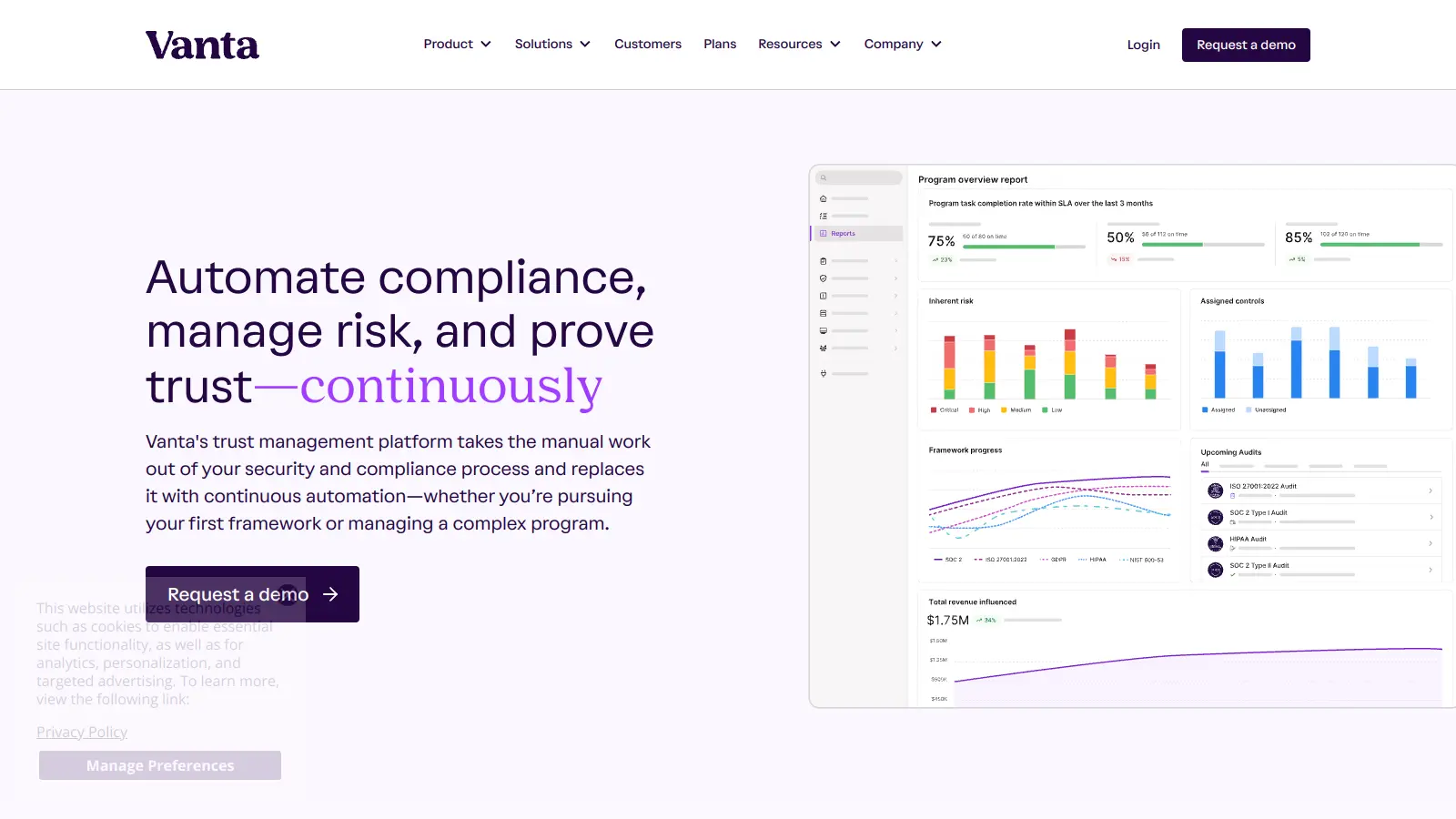
Vanta is one of the most widely used SOC 2 and ISO 27001 automation platforms, particularly among Series A and B SaaS companies. It connects to over 375 integrations, continuously monitors controls, and includes a Trust Center for sharing compliance status with prospects. Pricing is modular, similar to Drata, with costs scaling by framework and team size.
Pros
✓375+ integrations, broader than most competitors
✓Trust Center included in standard plans
✓Strong SOC 2 and ISO 27001 audit partner network
Cons
✗Pricing scales steeply with additional frameworks
vs DrataPick Sprinto over Drata when you have no internal compliance expertise and need the platform to scope, manage, and run the program with minimal hand-holding from your side.
2
Sprinto
Autonomous compliance that acts without waiting for your input.
Paid
Best for · Startups without a compliance teamPricing · From ~$8,000/yr
Sprinto positions itself as a compliance operator for startups and scale-ups that don't have dedicated compliance staff. It scopes your SOC 2, ISO 27001, or HIPAA program, connects to your systems, runs continuous control checks, and handles multi-framework overlap so the same control doesn't get mapped twice. The platform also covers AI governance and vendor risk as part of its core offering.
Pros
✓Handles multi-framework overlap automatically
✓AI governance and vendor risk included
✓Guided remediation without needing a compliance hire
Cons
✗Less granular control customization than Drata
✗Pricing not publicly listed, requires a sales call
vs DrataPick Thoropass over Drata when you want the software and the audit itself managed in one place, rather than Drata's model of connecting you with an external auditor and stepping back.
3
Thoropass
Compliance software and in-house auditors in a single platform.
Custom
Best for · Teams doing their first SOC 2 or ISO 27001Pricing · Pricing on request
Thoropass combines a compliance automation platform with its own in-house audit team, removing the handoff between preparation and the actual audit. It supports SOC 2, ISO 27001, HIPAA, and PCI DSS, and integrates with AWS, GitHub, and common ticketing tools for automated evidence collection. The model is particularly useful for companies doing their first audit who don't know how to work with external auditors.
Pros
✓In-house auditors eliminate the third-party coordination cost
✓Continuous evidence validation before audit windows
✓Practical guidance on how to handle individual controls
Cons
✗In-house auditor model limits auditor choice
✗Less suitable for teams already with an established auditor relationship
vs DrataPick Scrut over Drata when Drata's modular pricing is pushing your total cost up and you want a risk-first approach rather than a compliance-checkbox approach.
4
Scrut Automation
Security-first GRC with single-point pricing and AI risk management.
Custom
Best for · Mid-size companies wanting flat, all-inclusive pricingPricing · Pricing on request
Scrut is a GRC platform that maps controls to your actual risk profile rather than just checking boxes for a specific framework. It covers cloud infrastructure, application, people, and third-party risks in one dashboard, and its AI-powered Teammates feature handles risk register updates, evidence validation, and security questionnaire responses automatically. All modules are included in one price, unlike Drata's add-on model.
Pros
✓All modules included at one price, no add-on fees
✓Risk register updates automatically via AI agents
vs DrataPick Hyperproof over Drata when you have a dedicated GRC team running five or more frameworks and need granular control mapping across programs, not just audit readiness tracking.
5
Hyperproof
Enterprise GRC built for compliance teams that run multiple programs.
Custom
Best for · Enterprise compliance teamsPricing · Pricing on request
Hyperproof is designed for organizations with dedicated compliance and risk teams managing multiple frameworks simultaneously. It maps controls across programs, automates evidence collection and validation, and connects risk data to specific controls in real time. The platform includes a Trust Center, third-party risk assessment workflows, and AI-guided compliance gap analysis.
Pros
✓Sophisticated cross-framework control mapping
✓Real-time risk-to-control linkage
✓Purpose-built for large compliance team workflows
Cons
✗Too complex and expensive for startups or small teams
✗Implementation takes significantly longer than simpler tools
vs DrataPick Scytale over Drata when you want a compliance manager actively involved in your program, not just software that flags gaps and expects you to fix them independently.
6
Scytale
Compliance automation with hands-on expert guidance included.
Paid
Best for · SaaS startups needing guided certificationPricing · From ~$7,000/yr
Scytale targets SaaS startups and scale-ups that need SOC 2, ISO 27001, HIPAA, or GDPR certification without spending months figuring it out internally. The platform pairs automation with dedicated compliance success managers who actively help configure controls, review evidence, and prepare for audit. It covers 35+ frameworks and integrates with common developer and cloud tools.
Pros
✓Dedicated compliance success manager on every plan
✓35+ frameworks with cross-mapping
✓Faster time to first audit than self-service platforms
vs DrataPick Strike Graph over Drata when your team is security-minded but compliance-new, and you want a risk-led setup process instead of starting from a framework checklist.
7
Strike Graph
Risk-based compliance that skips the feature bloat.
Paid
Best for · Small security teams with limited compliance budgetsPricing · From ~$5,000/yr
Strike Graph takes a risk-first approach to compliance, starting with your specific risk profile before mapping controls and frameworks rather than the other way around. It supports SOC 2, ISO 27001, HIPAA, PCI DSS, and GDPR, with a focus on keeping the interface simple enough for non-compliance-specialists to manage. It's a less-obvious pick but consistently cited by smaller security teams as a more flexible and affordable option compared to Drata.
Pros
✓Risk-first setup reduces irrelevant control work
✓Simpler interface than enterprise-tier competitors
✓More affordable entry point than Drata or Vanta
Cons
✗Fewer integrations than Drata, Vanta, or Sprinto
✗Limited advanced reporting for multi-team GRC programs
Drata charges separately for modules like the Trust Center and custom frameworks. Before committing to any alternative, confirm whether those features are bundled or metered. Tools like Scrut include everything in a single price, which changes the total cost calculation significantly.
Match framework coverage to your roadmap
If you're running SOC 2 today but plan to add ISO 27001 or HIPAA next year, pick a platform that handles multi-framework programs without charging per framework. Some tools handle cross-framework control mapping well; others treat each certification as a separate product.
Decide how much audit support you actually need
Drata connects you with auditors but doesn't guide you through the process. Platforms like Thoropass have in-house auditors built into the product, which collapses the handoff between preparation and audit execution. If you're new to compliance, that support matters more than extra integrations.
Evaluate automation depth, not just integration count
Many tools advertise hundreds of integrations, but the quality of automated evidence collection varies widely. Look for continuous monitoring with daily or real-time control tests, not just one-time data pulls before an audit window opens.
Consider team size and internal compliance expertise
Enterprise GRC platforms like Hyperproof are designed for dedicated compliance teams. Startup-focused tools like Sprinto or Scytale are built for companies with no full-time compliance staff. Picking the wrong tier means either paying for features you won't use or hitting capability ceilings quickly.
frequently asked questions
The most common complaints are pricing transparency and module fragmentation. Features like the Trust Center, custom frameworks, and auditor access cost extra, so the real price is often significantly higher than initial quotes suggest. Teams also cite a rigid risk register and limited audit guidance as reasons to look elsewhere.
Pricing ranges from around $500/month for startup-tier tools like Sprinto and Scytale up to custom enterprise contracts for platforms like Hyperproof or Oneleet. Most vendors don't publish prices publicly, so expect to go through a demo call before getting a number. Budget at least $8,000 to $20,000 annually for a mid-size company running one or two frameworks.
No major compliance automation platform offers a genuinely free tier for production use. Some tools offer free trials or limited sandbox access, but automated evidence collection and continuous monitoring require a paid plan across all serious alternatives to Drata.
Migration is possible but not seamless. Most platforms let you import policies and control documentation as files, but automated evidence collected inside Drata won't transfer directly into another system's native format. Plan for a 4 to 8 week overlap period where both platforms run in parallel to avoid audit gaps.
Sprinto and Scytale are both built for this use case. They scope the program for you, guide you through gap remediation, and are priced for companies without a full compliance team. Thoropass is also worth considering if you want the audit conducted and managed in one place rather than coordinating with a separate auditor.
tools for humans
toolsforhumans editorial team
Reader ratings and community feedback shape every score. Since 2022, ToolsForHumans has helped 600,000+ people find software that holds up after launch. The picks here come from that.