Business Intelligence Tool+1 more

Woosmap
best deal
Try the Free Plan with 40,000 monthly credits - no credit card required
redeem now
Woosmap
best deal
Try the Free Plan with 40,000 monthly credits - no credit card required
redeem nowWe start with direct ratings from our readers, then look at what real users are saying in practitioner forums and community spaces. We pair that with search demand data and profession-level persona analysis.
Editorial note: this was originally published in august of 2024
quick take
based on real user feedback, community sentiment, pricing value, and fit for target audience. see our full methodology
used Woosmap? we'd love to know your thoughts
reader ratings shape our score
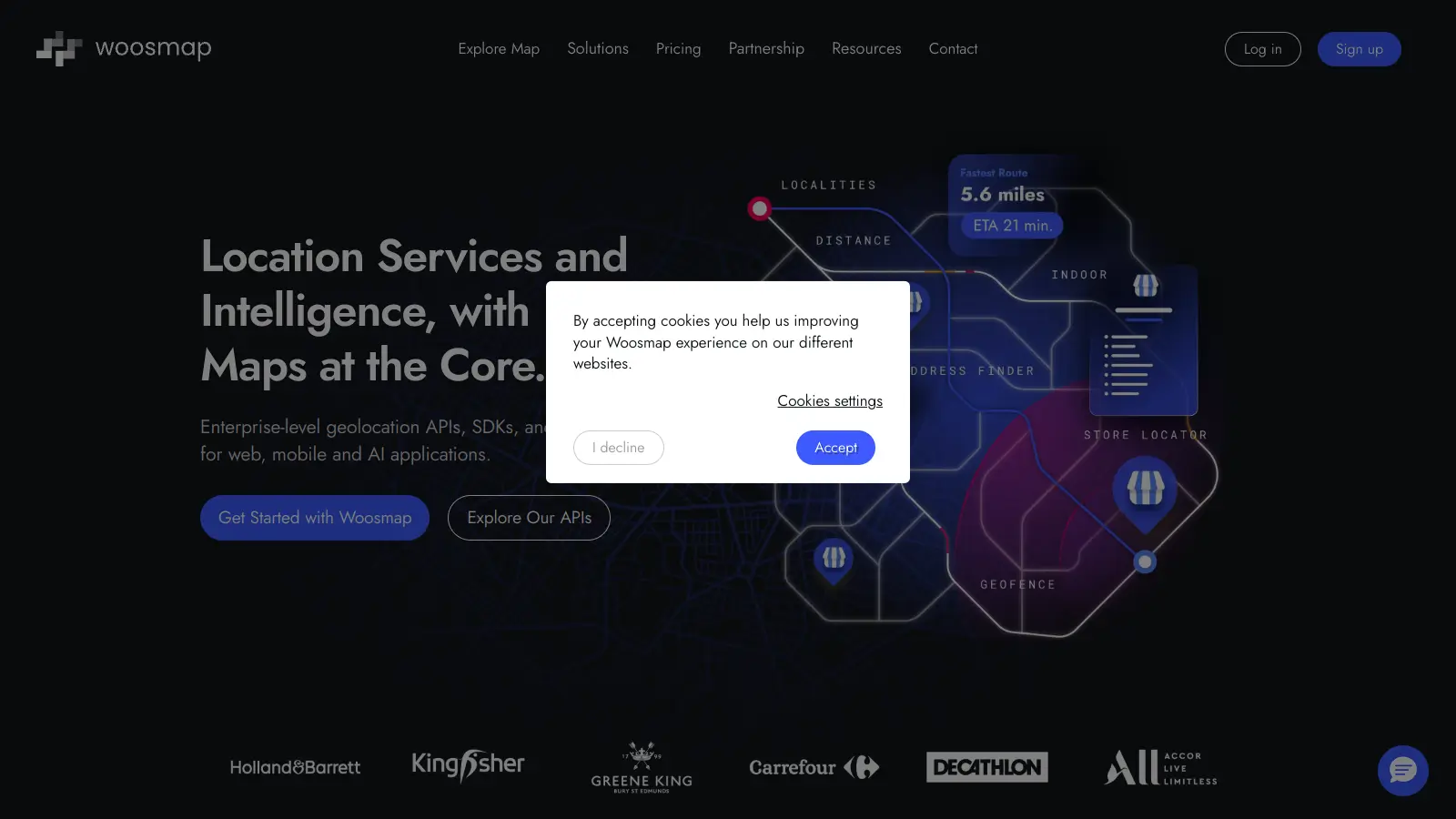
Woosmap is a location intelligence platform that helps developers add location-based services to their web and mobile applications. The platform combines mapping tools, geolocation features, and data management capabilities to create location experiences for users.
At its core, the service provides detailed mapping and store locator functions that businesses can customize to match their brand. Developers can access APIs and SDKs to integrate features like precise geolocation, indoor mapping, and route optimization. The platform also includes tools for managing location data and ensuring privacy compliance.
The service works for businesses of all sizes, from small companies to large enterprises. Users can start with a free plan that includes up to 40,000 monthly credits, while paid plans charge $6 per 1,000 credits after the free tier is exhausted. The platform scales based on usage, with custom enterprise solutions available for larger operations.
Companies like Sephora, Lacoste, Accor Hotels, Greene King, Jaguar, and Land Rover use Woosmap to help their customers find nearby locations and improve their service delivery. The platform's focus on developer-friendly tools makes it simple to add location features to existing applications while maintaining high performance and reliability.
monthly search interest
70/mo now
Woosmap grew steadily from near-zero searches through early 2025, peaked sharply in August 2025, then dropped by over 90% within months. That kind of spike-and-collapse pattern usually means a single external event drove a burst of interest that didn't convert into a sustained user base. The current low volume suggests Woosmap remains a niche tool: if you've already evaluated it and it fits your use case, that's fine, but the hype has definitively passed.
Whether Woosmap makes sense depends almost entirely on what location features you're building and how much you're currently paying for them. Pick your role below to see the honest breakdown.
overall sentiment
select your role to see what people like you are saying
App Developer
positiveIf you're tired of Google Maps Platform bills and your use case is store locators, autocomplete, or geofencing, Woosmap's SDKs will get you integrated without much pain. The documentation covers the basics well. The catch is when you hit edge cases: there's no large community to fall back on, so expect to lean on Woosmap's own support when things get tricky.
strengths
concerns
Retail Chain Manager
positiveWoosmap does one thing very well for multi-location retail: it lets you build a branded store finder without needing a developer on standby. The 10,000 free API requests per month cover small chains comfortably, and the customization options mean it doesn't look like a generic Google Maps embed. For large enterprise networks, you'll want to test scalability before committing.
strengths
concerns
E-commerce/Operations Manager
mixedThe route optimization and distance APIs are useful for delivery estimates and basic logistics, and the pricing is attractive compared to enterprise alternatives. But if your operations are complex, Woosmap hasn't published enough real-world logistics case studies to give you confidence at scale. Worth piloting on a single use case before replacing a specialized logistics platform.
strengths
concerns
Marketing Professional
mixedWoosmap shows up in proximity marketing shortlists for a reason: geofencing and location-based personalization are genuinely available and don't require deep technical setup. The limitation is that it's a building block, not a full campaign platform. You'll still need separate tools for the messaging layer, so it's only worth it if your team is comfortable stitching APIs together.
strengths
concerns
“Woosmap is a legitimate cost-reduction play for development teams currently paying Google Maps Platform bills they can't justify.”
Community coverage of Woosmap is thin. The available editorial sources list it as a recommended pick for e-commerce location data in proximity marketing roundups and geofencing software comparisons, but neither source contains user reviews or independent testing. What exists is essentially curated shortlisting, not community feedback. That leaves the honest assessment grounded in what the product actually is: a Google Maps Platform alternative with a free tier (up to 10,000 API requests per month), a credit-based Pro plan at $6 per 1,000 credits beyond that, and SDKs for iOS, Android, React Native, and Flutter. The feature set is narrower than Google Maps Platform but the pricing is meaningfully lower for businesses doing heavy API call volumes, which is the entire point of switching.
The free tier at 10,000 API requests per month is genuinely worth testing if you're building a store locator or address autocomplete feature. The Pro plan at $6 per 1,000 credits starts to pay off only if you're currently paying Google Maps Platform rates and your use case fits Woosmap's feature set. If you need niche capabilities like transit routing or global coverage depth, the savings won't compensate for the feature gaps.
App developers building location features into retail or logistics apps get the most from it, particularly when cost-per-call is a concern. Retail chain managers running multi-location store finders also fit well. E-commerce and operations teams can benefit from the route optimization and distance API, but should verify that the feature depth matches their logistics complexity before committing.
The feature set is narrower than Google Maps Platform, so if your project needs transit data, Street View, or the same global address completeness, you'll hit gaps quickly. Community resources and public documentation are limited compared to major platforms, which means debugging and onboarding lean heavily on Woosmap's own support rather than a broad developer community. Scalability for very high-volume e-commerce operations is also an open question with few public case studies to reference.
Google Maps Platform wins on feature breadth, data coverage, and developer community. Woosmap wins on cost if your use case is narrow. If you're building a store locator, running geofencing, or need address autocomplete for a UK or European market, Woosmap's pricing can be substantially cheaper at scale. If you need anything beyond those core cases, stay with Google Maps Platform.
You'll find the core APIs documented well enough to get started, and the SDKs for React Native and Flutter are a genuine time-saver. The problem is when you hit edge cases: unlike Google Maps, there's no large Stack Overflow community or extensive third-party tutorial base to fall back on. You'll be relying on Woosmap's own support forum, which is functional but slow compared to what you're used to with bigger platforms.
toolsforhumans editorial team
Reader ratings and community feedback shape every score. Since 2022, ToolsForHumans has helped 600,000+ people find software that holds up after launch. how we research →

Google Analytics is a free web analytics service by Google that helps businesses track and analyze website and app performance. It provides insights into user behavior, traffic sources, engagement, and conversions through real-time reports, audience segmentation, and advanced tracking tools. The latest version, GA4, offers machine learning capabilities, improved privacy features, and event-based tracking to measure online interactions across platforms.
best deal
Start with Google Analytics Free - Track visitor behavior, create custom reports, and get real-time insights across all your platforms at zero cost.

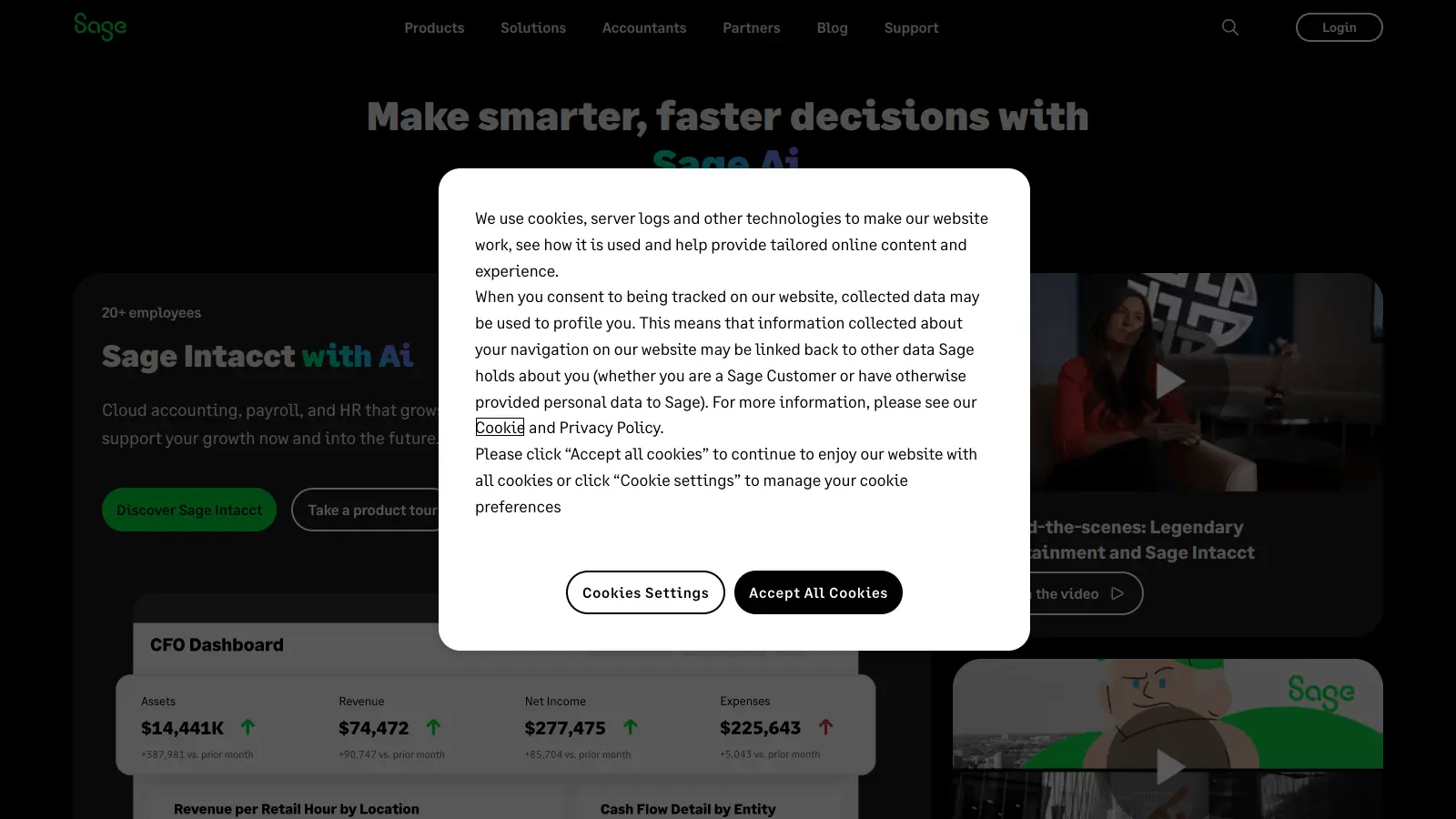
Sage is a software provider offering cloud-based accounting and enterprise resource planning (ERP) solutions for businesses. Their products range from simple accounting tools for small businesses to comprehensive ERP systems for larger enterprises, with features like invoicing, expense tracking, payroll management, data integration, and real-time analytics.
best deal
Start with Sage Accounting from just £12/month and streamline your small business finances today

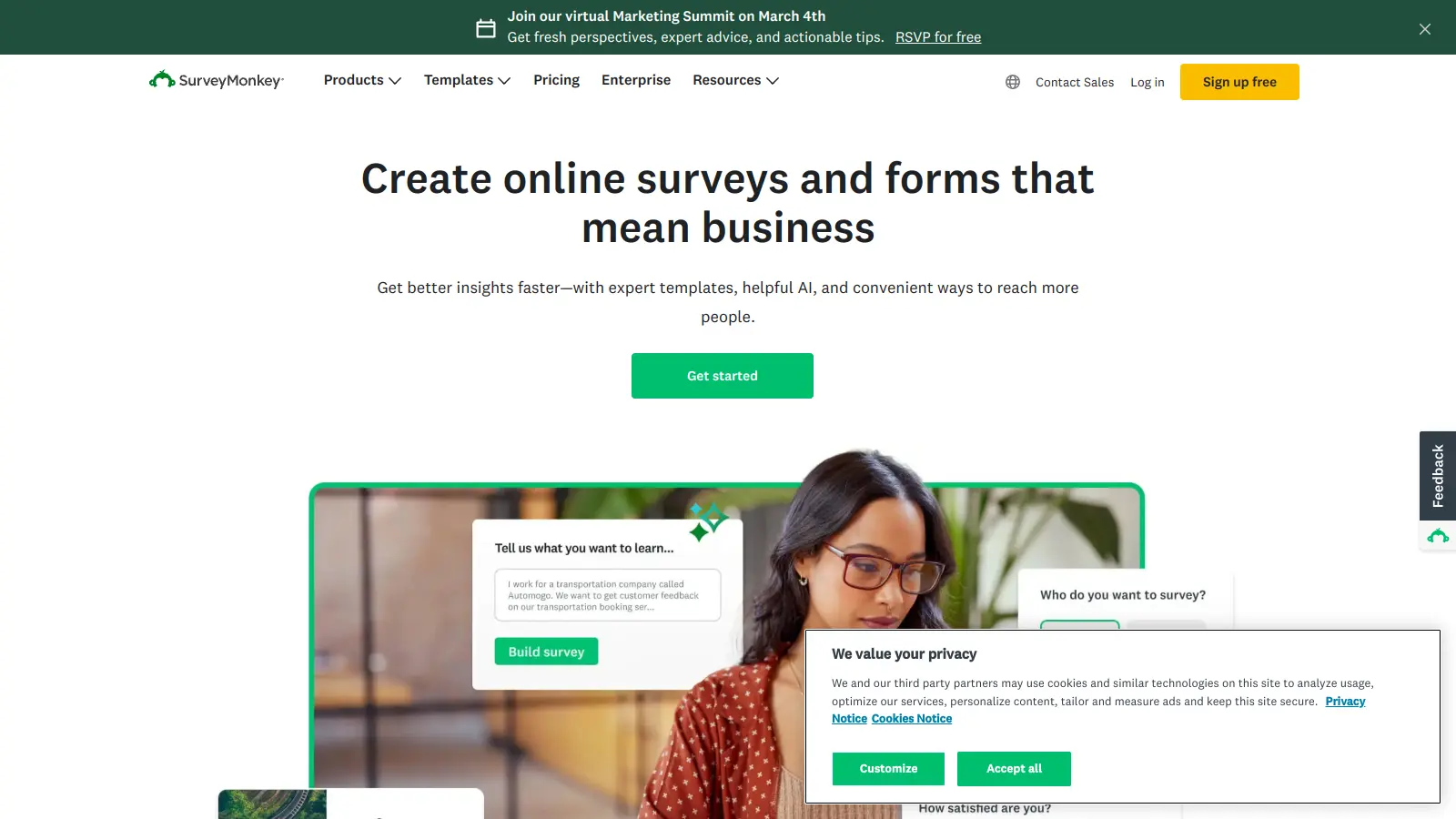
SurveyMonkey is an online survey platform that enables users to create, distribute, and analyze surveys with customizable forms and AI-powered tools. It offers multiple question types, survey templates, advanced logic, and analytics tools. Used by individuals and enterprises, SurveyMonkey provides integrations with other tools and flexible pricing plans for research and feedback collection.
best deal
Try SurveyMonkey's Basic Plan free – Create unlimited surveys with up to 10 questions each

Qualtrics is an AI-powered experience management platform for creating, distributing, and analyzing surveys. It uses machine learning, natural language processing, and generative AI to collect and analyze feedback across surveys, video, calls, and chats. Features include customizable surveys, AI-driven analytics, and enterprise integrations.
best deal
Start Free Now: Get 500 survey responses with basic features on a single-user account

Seamless.AI is an AI-powered sales intelligence platform that helps B2B sales and marketing teams find verified contact information in real-time. Founded in 2015, it provides emails, direct phone numbers, mobile numbers, and company data to connect with decision makers. The platform includes a web app, Chrome extension, CRM integrations, and AI-powered outreach tools.
best deal
Try Seamless.AI free with 50 lifetime credits to find verified B2B contacts with real-time search

Columns AI is a data storytelling platform that automates the creation of interactive visualizations and data stories from spreadsheets, databases, and APIs. It uses artificial intelligence to help marketers, analysts, and data teams transform raw data into narratives with annotations, animations, and voice overs. The platform offers an intuitive interface, data catalog management, and collaboration tools with pricing starting from a free tier up to $75 per year for premium features.
best deal
Lifetime deal available for $99 through AppSumo (89% off) – includes AI data storytelling and interactive visualization features