Business Intelligence Tool+2 more

Fullstory
best deal
Start Free with 30,000 Sessions/Month — FullStory Captures User Behavior with AI-Powered Insights
redeem now
Fullstory
best deal
Start Free with 30,000 Sessions/Month — FullStory Captures User Behavior with AI-Powered Insights
redeem nowWe start with direct ratings from our readers, then look at what real users are saying in practitioner forums and community spaces. We pair that with search demand data and profession-level persona analysis.
Editorial note: this was originally published in september of 2024
quick take
based on real user feedback, community sentiment, pricing value, and fit for target audience. see our full methodology
used Fullstory? we'd love to know your thoughts
reader ratings shape our score
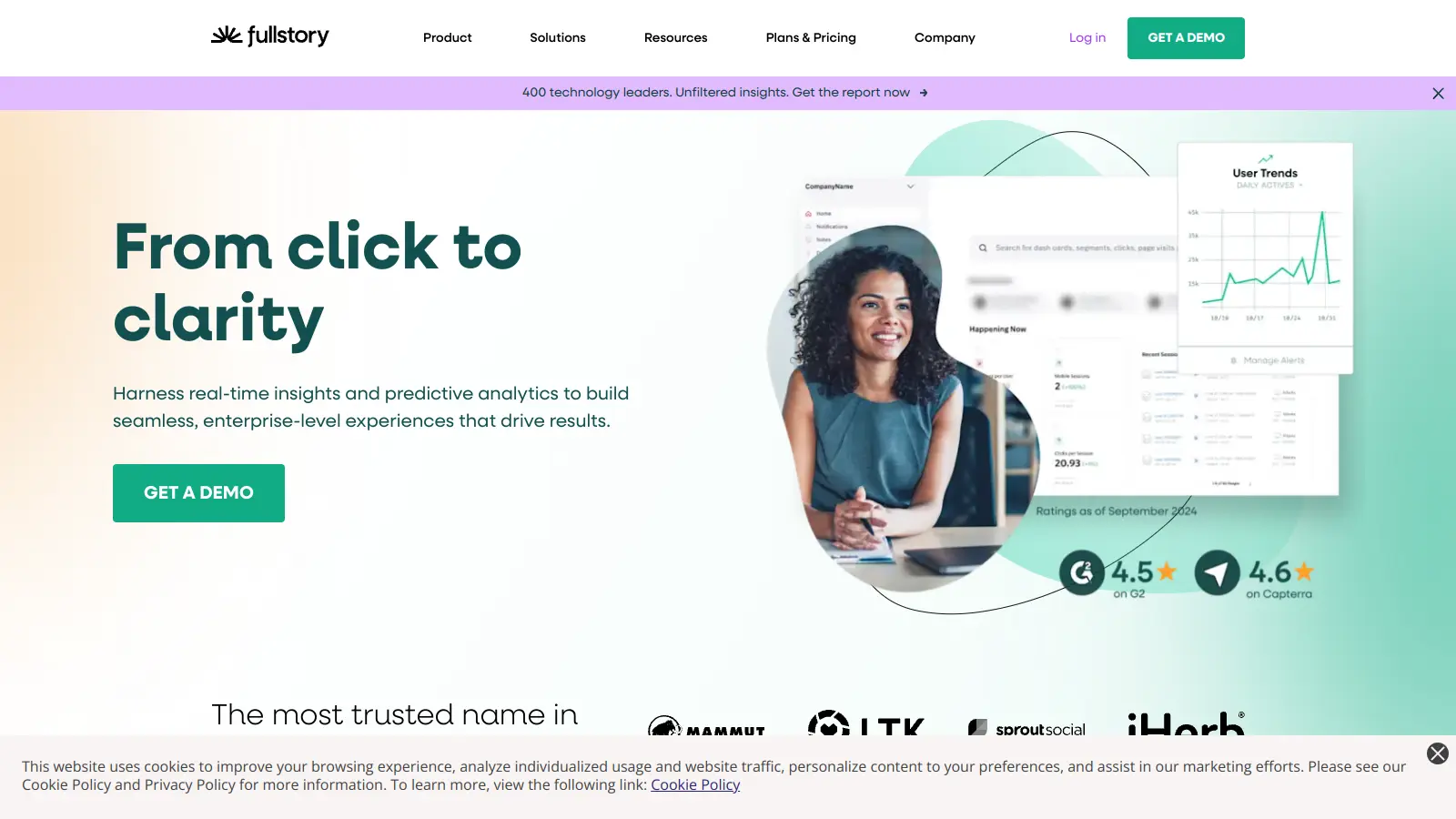
FullStory is a behavioral data analytics platform that helps businesses understand and improve how users interact with their websites and apps. By capturing detailed user sessions and behavioral data through its Fullcapture autocapture technology, it enables companies to identify problems, optimize experiences, and boost customer satisfaction without manual tagging.
The platform offers AI-powered session replay capabilities, letting teams watch real user interactions to spot issues like navigation problems or frustrated clicking. Its heatmaps and journey mapping tools show exactly where users spend time and how they move through digital properties. FullStory integrates Google's Gemini LLM and Vertex AI to power StoryAI, a suite of AI agents that analyze behavioral data to surface insights, identify conversion blockers, and generate recommendations.
Companies across retail, finance, gaming and other sectors use these insights to make decisions about their digital presence. The platform offers a free tier with 30,000 sessions per month and 10 user seats, with paid plans starting at custom pricing based on session volume and features needed.
Since its founding in 2014, the Atlanta-based company has grown to serve major brands like Adobe and Jaguar Land Rover. The platform processes billions of user interactions while maintaining strict privacy standards, automatically masking sensitive information like credit card numbers and passwords.
monthly search interest
3.6k/mo now
FullStory peaked in early 2022 and has lost roughly three-quarters of its search volume since then, settling into a slow but steady decline rather than stabilising. This pattern suggests the initial wave of interest from teams adopting behavioral analytics has passed, and FullStory is now competing harder to hold its position against cheaper and more visible alternatives. The tool isn't disappearing, but it's no longer the default name that comes up first in this category.
Whether FullStory is worth it depends heavily on what you're trying to do and how much traffic your product handles. Pick your role below to see the honest breakdown for your situation.
overall sentiment
select your role to see what people like you are saying
Product Manager
positiveIf you're trying to understand why users abandon a flow or where a new feature is creating confusion, FullStory's session replay and AI-powered insights give you evidence you can actually act on. The free tier at 30,000 sessions is enough to validate whether it fits your workflow. The catch: once your traffic grows, the custom pricing can make this one of your more expensive analytics line items, especially if you're also running Amplitude or Mixpanel.
strengths
concerns
Engineer/DevOps
mixedFullStory's session debugging is genuinely useful for reproducing errors without needing a user to describe what they did. Setup is straightforward and the performance overhead is minimal in most cases. The real friction is compliance: GDPR and CCPA documentation isn't as clear as it needs to be before you deploy on a product handling personal data, and high session volumes create storage overhead that complicates infrastructure planning.
strengths
concerns
UX Designer
positiveHeatmaps and session replays give you concrete user behavior to back up design decisions, which is exactly what you need when pushing back on opinion-based feedback in design reviews. The interface is accessible enough that you won't need engineering support for day-to-day use. The main tradeoff is cost: if your team's analytics budget is tight, FullStory's pricing can be hard to justify when cheaper tools like Hotjar cover the core session replay use case.
strengths
concerns
E-commerce/Growth Manager
mixedFullStory's conversion funnel analysis and session replay combination makes it practical for diagnosing checkout drop-off and cart abandonment without guessing. The AI-powered blockers identification is a genuine time-saver. But the custom pricing model means you'll need a sales conversation before you know what it actually costs at your traffic volume, which makes budgeting awkward compared to fixed-price alternatives.
strengths
concerns
“FullStory has slid into an awkward position: too expensive for most startups and too limited as a standalone analytics platform for larger teams who also need Amplitude or Mixpanel running alongside it.”
Community discussion around FullStory is thin but telling. On commercial review platforms, users consistently highlight the intuitive interface and ease of use, with non-technical team members able to get up and running without heavy IT support. Session replay and heatmaps earn genuine praise. The recurring criticism is pricing: FullStory's custom enterprise pricing model means costs escalate sharply as session volumes grow, and teams on high-traffic products often find the bill hard to justify against the feature set. Compliance concerns around GDPR and CCPA handling also surface regularly, particularly from engineering teams who need clarity before rolling it out across user-facing products. A thread on r/ProductManagement asking about tools that answer the 'why' behind analytics data shows that FullStory competes in a crowded field where Amplitude and Mixpanel are the default mentions, with FullStory coming up more as a session replay layer than a primary analytics platform.
The free tier, at 30,000 sessions per month, is genuinely useful for small teams who want to test session replay before committing. The Business and Advanced tiers use custom pricing, which in practice means costs scale fast with traffic. If you're running a high-traffic product, get a quote and compare it against Hotjar's fixed tiers before deciding. For teams that need both session replay and full product analytics in one platform, FullStory can justify the cost. If you only need one of those things, there are cheaper single-purpose tools.
Product Managers who need to validate feature decisions with real session data get the most direct value. UX Designers using it to build an evidence base for design changes also find it fits well into their workflow. It's less of a natural fit for engineers managing infrastructure, where the data volume and compliance overhead can outweigh the debugging benefits.
Pricing is the most consistent complaint: there's no mid-market fixed tier, so costs are opaque until you're in a sales conversation. The second major limitation is that it's not a complete analytics replacement. You'll likely still need Amplitude or Mixpanel for funnel analysis and cohort tracking, which means FullStory becomes an add-on cost rather than a standalone solution. GDPR and CCPA compliance documentation also needs more transparency than FullStory currently provides.
These tools do different things. Amplitude is a product analytics platform built around events, funnels, and cohorts. FullStory is built around session replay and behavioral data capture. If you need to understand what users are doing step by step, Amplitude wins. If you need to watch exactly what a user did during a broken session or confusing flow, FullStory is the better call. Most mid-to-large teams end up using both, which is where cost becomes the real question.
This is the top concern for engineers rolling out FullStory. It does have privacy controls, including data masking and exclusion rules, but the documentation on GDPR and CCPA handling isn't as transparent as it needs to be before you sign a DPA. Before deploying on anything handling personal data, get explicit written confirmation from FullStory on data residency, retention, and subprocessor details. Don't assume the default settings are compliant out of the box.
toolsforhumans editorial team
Reader ratings and community feedback shape every score. Since 2022, ToolsForHumans has helped 600,000+ people find software that holds up after launch. how we research →
is this your tool?
claim your listing to update details, respond to our review, or upgrade to a featured partnership.
claim this listing →
Google Analytics is a free web analytics service by Google that helps businesses track and analyze website and app performance. It provides insights into user behavior, traffic sources, engagement, and conversions through real-time reports, audience segmentation, and advanced tracking tools. The latest version, GA4, offers machine learning capabilities, improved privacy features, and event-based tracking to measure online interactions across platforms.
best deal
Start with Google Analytics Free - Track visitor behavior, create custom reports, and get real-time insights across all your platforms at zero cost.

Sage is a software provider offering cloud-based accounting and enterprise resource planning (ERP) solutions for businesses. Their products range from simple accounting tools for small businesses to comprehensive ERP systems for larger enterprises, with features like invoicing, expense tracking, payroll management, data integration, and real-time analytics.
best deal
Start with Sage Accounting from just £12/month and streamline your small business finances today

SurveyMonkey is an online survey platform that enables users to create, distribute, and analyze surveys with customizable forms and AI-powered tools. It offers multiple question types, survey templates, advanced logic, and analytics tools. Used by individuals and enterprises, SurveyMonkey provides integrations with other tools and flexible pricing plans for research and feedback collection.
best deal
Try SurveyMonkey's Basic Plan free – Create unlimited surveys with up to 10 questions each

Qualtrics is an AI-powered experience management platform for creating, distributing, and analyzing surveys. It uses machine learning, natural language processing, and generative AI to collect and analyze feedback across surveys, video, calls, and chats. Features include customizable surveys, AI-driven analytics, and enterprise integrations.
best deal
Start Free Now: Get 500 survey responses with basic features on a single-user account

Seamless.AI is an AI-powered sales intelligence platform that helps B2B sales and marketing teams find verified contact information in real-time. Founded in 2015, it provides emails, direct phone numbers, mobile numbers, and company data to connect with decision makers. The platform includes a web app, Chrome extension, CRM integrations, and AI-powered outreach tools.
best deal
Try Seamless.AI free with 50 lifetime credits to find verified B2B contacts with real-time search

Columns AI is a data storytelling platform that automates the creation of interactive visualizations and data stories from spreadsheets, databases, and APIs. It uses artificial intelligence to help marketers, analysts, and data teams transform raw data into narratives with annotations, animations, and voice overs. The platform offers an intuitive interface, data catalog management, and collaboration tools with pricing starting from a free tier up to $75 per year for premium features.
best deal
Lifetime deal available for $99 through AppSumo (89% off) – includes AI data storytelling and interactive visualization features