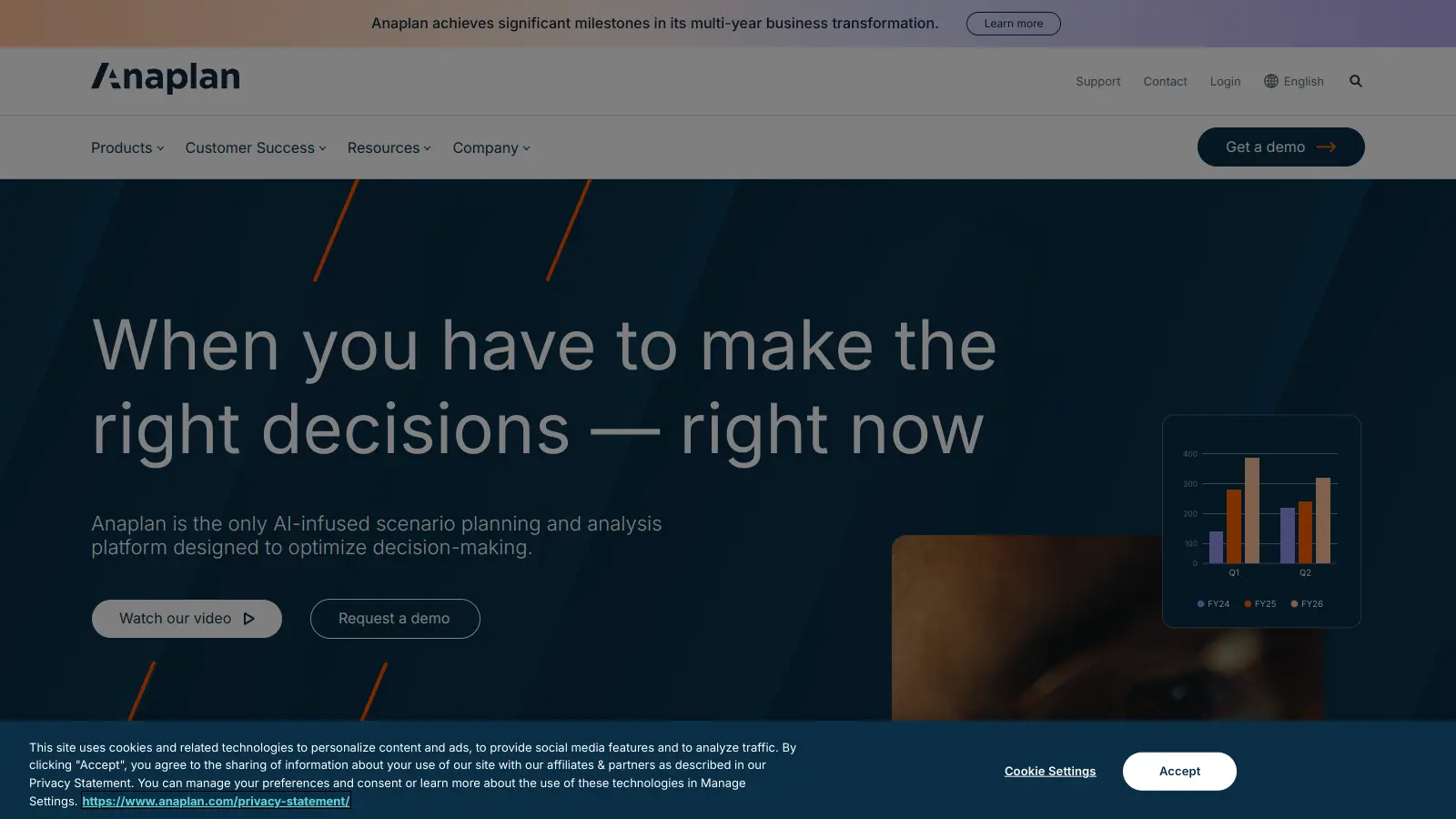
Anaplan is a cloud-based platform that helps organizations make better decisions by connecting their data, people, and plans. The platform brings together planning and analysis in real-time, making it easier for businesses to adapt quickly to changes and opportunities.
At its core, the platform offers tools for financial planning, sales optimization, supply chain management, and workforce planning. Users can build detailed models, run "what-if" scenarios, and collaborate across departments. The system uses AI to spot patterns and make predictions, including predictive tools like PlanIQ and Optimizer, generative AI via CoPlanner, and autonomous agents that monitor and optimize workflows. Its Hyperblock technology handles complex calculations across large datasets with in-memory processing.
Integration works with common business tools like Tableau and DocuSign, and security features include data encryption and single sign-on capabilities. The platform scales from small teams to global enterprises working with vast amounts of data.
Pricing isn't publicly available. Anaplan creates custom packages based on specific needs and usage requirements. The platform requires professional implementation, which adds to overall costs.
Anaplan works for decision-makers who need to connect planning processes across their organization and make data-driven choices quickly.
Common in retail, manufacturing, healthcare, and financial services, particularly at mid-sized to enterprise companies with complex planning requirements.
Users praise Anaplan's powerful planning and budgeting capabilities. The financial modeling and forecasting features are strong, integration with other enterprise systems works well, and reporting dashboards are solid. The platform scales well for large organizations and significantly reduces manual spreadsheet work. Customer support gets positive marks, and users appreciate the workflow automation.
The high cost and licensing fees make it prohibitive for many organizations. Users report a steep learning curve for new users. Performance slows down with large datasets. The implementation process is complex with long deployment timelines. Data refresh is time-consuming. The user interface isn't intuitive. Mobile functionality is limited. The platform requires significant IT resources. Maintenance and support costs add up quickly.
Anaplan includes three types of AI: predictive (PlanIQ and Optimizer for forecasting), generative (CoPlanner for conversational planning), and agentic AI (autonomous agents like Detector Agent, Workflow Agent, and specialized Finance and Supply Chain Analysts). These tools monitor data, detect anomalies, optimize scenarios, and execute workflows automatically. You can also build custom AI agents using Agent Studio to automate specific planning tasks.
Does Anaplan require special training to use?Yes, Anaplan has a learning curve, especially for new users. The platform is designed to be user-friendly, but you'll get the most value after some training. Anaplan offers learning resources including guided tutorials, certification programs, and documentation. Many companies assign "model builders" who receive deeper training while regular users can often get up to speed with basic functions in a few days.
How does Anaplan handle data security?Anaplan includes security features like data encryption at rest and in transit, single sign-on (SSO) with SAML 2.0 support, and Bring Your Own Key (BYOK) options. The platform uses role-based access controls so admins can set exactly who sees what data. Anaplan also maintains compliance with major regulations and regularly undergoes security audits.
Can Anaplan integrate with my existing systems?Anaplan connects with most popular business systems through its microservices architecture. It offers built-in connectors and APIs for major ETL tools like Informatica, MuleSoft, Dell Boomi, and SnapLogic. The platform also works with visualization tools like Tableau and document management systems like DocuSign. If you need custom connections, Anaplan provides REST APIs and scripting options.
How long does it take to implement Anaplan?Implementation time varies based on your needs. Simple use cases might take 4-6 weeks, while complex enterprise-wide deployments can take several months. Most companies start with one business area, like sales planning or finance forecasting, before expanding. Key factors affecting timeline include data complexity, integration requirements, and how customized your models need to be. Anaplan's implementation partners can provide more specific timelines for your situation.


Our newsletter comes with exclusive discounts, trials and practical insights from within the industry